AI Code Generation and Developer Productivity: Introduction (Part 1 of 15)
Part 1 of a 15-part series comparing Opencode, Claude Code, Codex, and Cursor. What AI code generation actually is in late 2026, where the productivity gains come from, and how to read the comparison that follows.
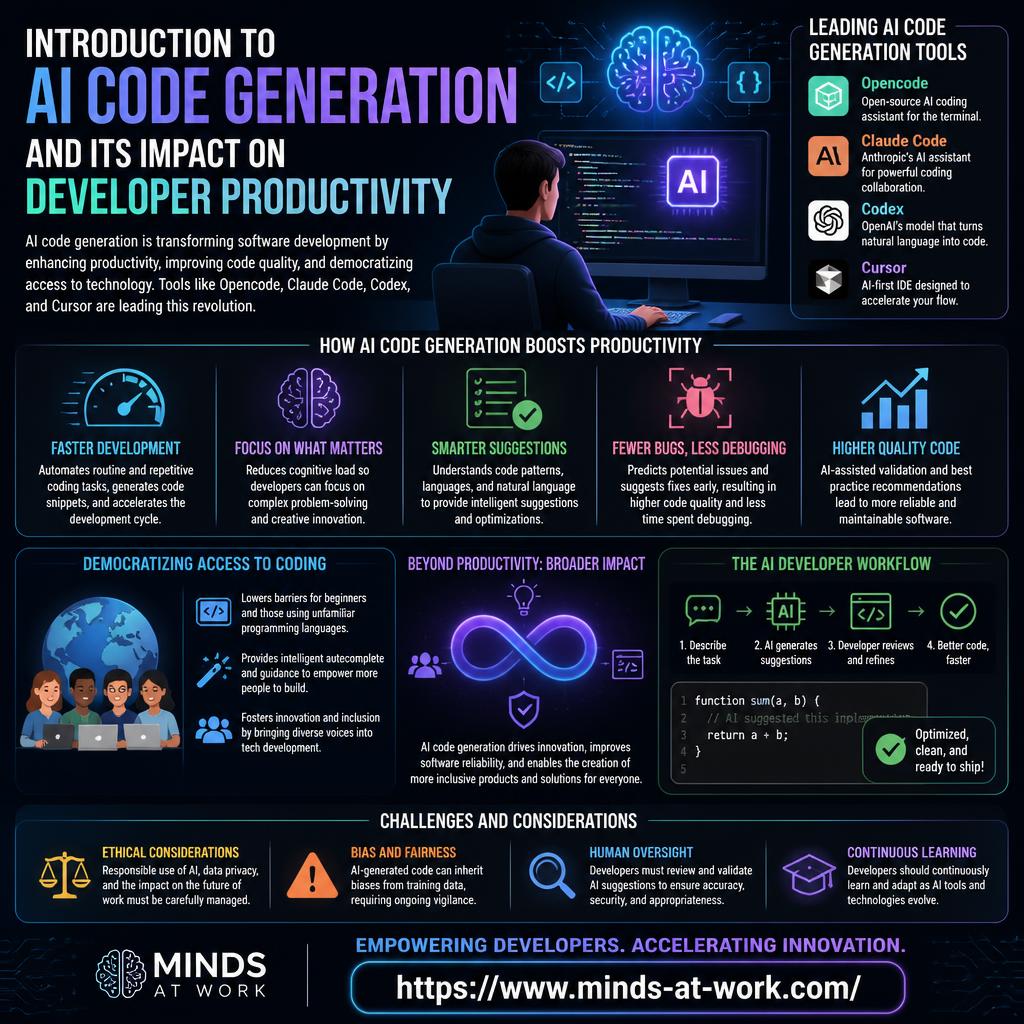
By Dr. Sanju Abraham, Fractional CTO, investor, multiple exits. Published October 17, 2026. Part 1 of a 15-part series: Comparing Opencode, Claude Code, Codex, and Cursor: Is There a Clear Winner?
Key takeaways
- AI code generation in late 2026 is a category of four serious contenders — Opencode, Claude Code, Codex, and Cursor — not a single-vendor conversation. Each ships a different answer to the same question: how does a developer best collaborate with a model that can write, read, and run code?
- The productivity gains are real but uneven. Routine scaffolding, test generation, refactors, and debugging are where the clock actually moves; novel architecture and judgment calls still belong to the developer.
- The right tool depends on where you work, not which model you prefer. Terminal-first (Opencode, Claude Code, Codex CLI), IDE-first (Cursor), and hybrid patterns map to different team shapes and codebases.
- The honest risks are code quality drift, inherited bias, security exposure, and the atrophy of unaided skill. Each one has a mitigation — none of them has a silver bullet.
- This series compares the four across eight axes and three scenarios — editing model, context handling, agent loop, cost, security, team workflow, enterprise fit, and developer experience; applied to a solo founder, a mid-market team, and an enterprise — before answering the headline question in Part 15.
The short answer: AI code generation is the use of large language models to draft, edit, review, and run source code on behalf of a human developer, usually inside an editor or a terminal. In late 2026 the category has consolidated around four tools worth comparing on their merits: Opencode (open-source, terminal-native), Claude Code (Anthropic, terminal + IDE), Codex (OpenAI, cloud + CLI), and Cursor (an AI-first IDE). This fifteen-part series exists because the “which one is best” answer depends on five variables — your editor, your codebase, your team shape, your cost ceiling, and your security posture — and no vendor benchmark separates the four on all five at once. I call that lens the five-variable pick, and every subsequent part in the series applies it to a different axis before Part 15 names a winner per scenario. Part 1 sets the frame.
What is AI code generation, exactly?
AI code generation is the use of a large language model to produce or modify source code from a natural-language instruction, a selection of existing code, or a running project state. In practice, that means autocompletion, chat-style edits, multi-file refactors, test writing, bug fixing, and increasingly, agentic work where the model proposes a plan, runs commands, and iterates until a task is done.
The category has three generations behind it. First came autocomplete — GitHub Copilot’s 2021 debut proved that a model trained on public code could suggest next lines usefully. Second came chat — ChatGPT and Claude put a conversational editor beside the code and let developers describe changes in English. Third, which is where late 2026 sits, is agentic coding: the model is given tools (read file, run shell, write file, grep, run tests) and allowed to iterate until a task completes, with the developer reviewing diffs instead of typing them.
The four tools this series compares all live in the third generation. They differ in where they live (terminal versus IDE), who ships the model (Anthropic, OpenAI, open-weight), what tools they expose, how they handle context, and what they cost. Those differences are the entire point of the comparison.
Where does the productivity actually come from?
Most of the measured productivity gain comes from four narrow tasks: generating boilerplate, writing tests, reading unfamiliar code, and debugging specific errors. The gains outside those tasks are smaller and more contested, which is why “AI makes developers 55% faster” and “AI made my team slower” are both true depending on what the team was doing.
The honest decomposition, as of late 2026:
- Scaffolding and boilerplate — new file structures, config, repetitive CRUD, migrations. Models are reliable here; the win is wall-clock minutes per task multiplied by many tasks.
- Test generation — unit tests, fixtures, edge-case enumeration. Models produce good first drafts; developers edit for intent. Net faster when existing tests exist for the model to pattern-match.
- Reading unfamiliar code — asking the model to explain, summarize, or trace through code. This is the lowest-friction, highest-leverage use for anyone onboarding to a new repo.
- Debugging specific errors — paste the stack trace, get a short list of likely causes. Hit rate is strong on well-trodden stacks (TypeScript, Python, Rails) and weaker on bespoke internals.
- Routine refactors — rename, extract, migrate between APIs. Agentic coding tools are strong here because they can read the whole codebase and apply the change consistently.
Where the gains thin out: novel architecture, cross-cutting design decisions, taste calls on API shape, and anything that requires understanding the business rather than the code. Those remain developer work — the model can draft, but the developer owns the choice.
For the broader frame of where AI fits in a small or mid-market software business, the companion piece AI strategy for SMB owners sits one level up from this series.
Who are the four tools we are comparing?
Four tools dominate the late-2026 landscape for agentic AI code generation: Opencode, Claude Code, Codex, and Cursor. Each is a serious contender; none is strictly dominant on all axes.
- Opencode — an open-source, terminal-native AI coding agent built by SST. Model-agnostic (works with Claude, GPT, Gemini, local models), MIT-licensed, strong at TUI ergonomics. The pitch: your terminal, your choice of model, no vendor lock-in. See the project repo at github.com/sst/opencode.
- Claude Code — Anthropic’s official terminal and IDE agent, built around Claude’s model family. Deep tool integration, strong at reading large codebases, enterprise-friendly billing and audit. The pitch: Anthropic’s best coding model, wrapped in a reference agent. Documented at claude.com/claude-code.
- Codex — OpenAI’s cloud and CLI coding agent, built around GPT models. Available as a cloud agent that runs long tasks in a sandbox and as a local CLI. The pitch: OpenAI’s model line and infrastructure, with managed background work. Documented at openai.com/codex.
- Cursor — an AI-first fork of VS Code built by Anysphere. The agent lives inside the editor; Composer, Agent, and inline chat all share the same context window. The pitch: the IDE itself is the AI surface, not a sidebar. Documented at cursor.com.
The naming matters because this series uses the exact product names in every table, benchmark, and recommendation. “The Anthropic tool” and “the OpenAI one” are ambiguous — the names below never are.
How does AI code generation democratize who gets to build?
Lowering the barrier to writing working code — in an unfamiliar language, an unfamiliar framework, or on an unfamiliar codebase — is the quieter productivity story. It matters because it changes who can ship, not only how fast existing developers ship.
Three concrete lifts, all of which the four tools in this series share to varying degrees:
- Language onboarding. A developer fluent in Python can produce correct Go within an hour because the model handles idiom while the developer handles intent. The dependency is reversible: Go developers get the same lift for Python.
- Framework onboarding. New hires who would have needed two weeks to be useful in an unfamiliar codebase are useful on day three when the agent can read, explain, and generate against the codebase’s own patterns.
- First-time builders. Founders without a developer background can get further on a prototype than any previous generation of no-code tools allowed, because the output is real code that a real developer can later own.
This third lift matters most for the audiences this blog serves. For founders working toward a first shippable product, Zero-to-Launch is the publication that walks through building when the AI is doing much of the typing. For SMBs that already run engineering teams and want the lift without the lock-in, the Fractional CTO engagement is the fastest way to pick the right tool without betting the quarter on a vendor-run demo.
What are the honest risks of leaning on AI code generation?
The risks are real, named, and manageable — but they are not solved, and anyone who tells you otherwise is selling a tool. Four of them deserve a sentence each in every tool-selection conversation.
- Code quality drift. Models produce code that passes tests but encodes subtle anti-patterns, especially in security-sensitive paths. Mitigation: human review of diffs, static analysis in CI, and the humility to say no to a suggestion.
- Inherited bias and license risk. Models trained on public code can reproduce copyrighted snippets or encode patterns from undermaintained libraries. Mitigation: license-aware tooling, provenance filters where vendors offer them, and policy around high-sensitivity domains.
- Security exposure. An agentic tool with shell access, file write, and network calls is a privileged user. Mitigation: least-privilege sandboxing, allowlists for commands, review-before-run for anything irreversible, and audit logs by default.
- Skill atrophy. Developers who never write a line without the model get worse at the parts of the job the model is weakest at — architecture, judgment, debugging novel systems. Mitigation: deliberate practice unaided, especially early-career, and resisting the urge to accept the first plausible diff.
None of these risks is reason to avoid AI code generation. All four are reasons to deploy it with intent — the same way any other privileged tool enters a codebase.
What does this fifteen-part series cover?
Fifteen parts, three groups: foundations, head-to-head comparison, verdict. Each later part links back here, so Part 1 is the stable landing page for the series.
- Parts 1–3 — Foundations. What AI code generation is (this piece), what each of the four tools actually ships, and the fair-comparison framework we will use.
- Parts 4–11 — The axes. Editing model and context handling; agent loop and tool use; cost; security posture; team workflow and collaboration; enterprise and compliance fit; extensibility and ecosystem; developer experience and ergonomics.
- Parts 12–14 — Scenarios. Which tool wins for a solo founder on a greenfield prototype, for a mid-market team on a brownfield monolith, and for an enterprise with security and audit constraints.
- Part 15 — The verdict. Is there a clear winner? Spoiler: not globally, but there is a clear winner per scenario, and that is the more useful answer.
If you want the comparison in advance of the fifteen parts, that is exactly the shape of a one-hour Fractional CTO call — bring your codebase and team shape, leave with a short pick. If you want to follow the series as it publishes, the AI Strategy archive lists every post in order, and the Minds at Work newsletter sends each new part on publication.
A clean, product-forward series roadmap infographic on an off-white background showing a horizontal timeline with 15 numbered nodes grouped in three bands. Band 1: Parts 1–3 FOUNDATIONS (pale slate). Band 2: Parts 4–11 THE AXES — eight tiles reading editing model, context, agent loop, cost, security, team workflow, enterprise fit, DX (pale emerald). Band 3: Parts 12–15 SCENARIOS + VERDICT — four tiles reading solo founder, mid-market, enterprise, verdict (pale sand). A thin emerald rule connects the bands. Short tagline above: 'Fifteen parts, one headline question'. Clean, flat, geometric. Palette: off-white background, pale slate borders, one emerald accent, pale sand accent, navy ink. Linear or Stripe editorial feel. No AI robots.
- Aspect ratio: 16:9
- Source size: 1280 × 720 px (sharp on retina at 760 px display width)
- Format: PNG
- Target file size: under 500 KB
Save to /public/images/blog/<slug>/, then set
src and alt on this <MediaFigure /> to swap it in. Keep the ratio prop so the browser reserves the right space.
Frequently asked questions
What is AI code generation in simple terms?
AI code generation is when a large language model writes, edits, or runs source code on behalf of a developer, based on a natural-language instruction, a code selection, or the state of a running project. In late 2026 the serious tools in the category are agentic — the model is given a set of tools (read file, run shell, write file, run tests) and allowed to iterate until a task is done, with the developer reviewing diffs instead of typing them.
Which AI code generation tool is best in 2026?
There is no single best tool across every use case. Opencode wins when model freedom and open licensing matter. Claude Code wins on terminal-first teams that want Anthropic’s model wrapped in a reference agent. Codex wins when a team already lives in the OpenAI ecosystem and wants cloud-backed background runs. Cursor wins when the IDE is the center of the workflow. This series spends fifteen parts breaking down the choice; Part 15 is the per-scenario verdict.
How much faster does AI code generation actually make developers?
The honest answer is “it depends on the task.” Measurements published since GitHub’s 2022 Copilot study — which reported a 55% completion-time improvement on a narrow HTTP-server task — have varied widely by task, team, and codebase (Kalliamvakou, GitHub Blog, 2022). The pattern that holds across most late-2026 reports: strongly positive on scaffolding, test writing, routine refactors, and reading unfamiliar code; near-zero or occasionally negative on novel architecture, cross-cutting design, and debugging systems the model has not seen. Averages hide this. Measure on the tasks your team actually does.
Is AI-generated code safe to ship?
AI-generated code is as safe to ship as any other code that passed your review, testing, and security pipeline. The risk is not that the model writes a bug a human would never write; the risk is that reviewers trust diffs they would scrutinize if a junior engineer had written them. Treat model output as a draft from a very fast junior — review every diff, run the usual static analysis, and never give an agent irreversible shell access without a prompt and an audit log.
Will AI code generation replace developers?
No, not in the shape the question usually imagines. The parts of the job that pay the most — architecture, product judgment, debugging novel systems, owning the consequences of a shipped feature — are the parts the model does least well. What AI code generation does replace is the hours spent on scaffolding, boilerplate, and the first-pass draft of routine work. For most teams, the net effect is more shipped product per developer, not fewer developers.
What is agentic coding, and why does it matter?
Agentic coding is the generation of code where the model has tools — read file, run shell, write file, grep, run tests — and can iterate autonomously until a task is complete. It matters because it changes the unit of work from “a suggested line” to “a merged pull request.” All four tools in this series — Opencode, Claude Code, Codex, and Cursor — are agentic. The differences in how they handle the agent loop (planning, tool use, error recovery, review) are a large part of what distinguishes them, and are covered in detail in Parts 5–6.
How should a mid-market SMB pick an AI code generation tool?
Pick in three steps. First, decide where your team actually works — terminal, IDE, or both. Second, decide whether model freedom and open licensing matter enough to accept a slightly smaller ecosystem (Opencode) or whether you want a single vendor’s reference agent (Claude Code, Codex, Cursor). Third, run a one-week pilot on real tickets, measured against the same tickets done unaided. If the comparison is time-sensitive and the pilot has to be right the first time, that is the exact shape of a Fractional CTO engagement.
If you are weighing AI code generation tools for a team in the next ninety days and the choice has to be right the first time, that trade-off is what a Fractional CTO engagement is for. The category commoditized faster than most procurement cycles can follow; the mistakes that matter are the ones made in the first ninety days. One hour of the right conversation can save a quarter of engineering time. For more pieces in this series as it publishes, follow the AI Strategy archive; for the broader frame on where AI fits in a small or mid-market software business, start with AI strategy for SMB owners.