Training Data: How It Shapes AI Code Accuracy and Quality (Part 5 of 15)
Part 5 of 15. Where Opencode, Claude Code, Codex, and Cursor get their training data, how quality beats quantity, and the four signals you can actually verify before trusting a model with production code.
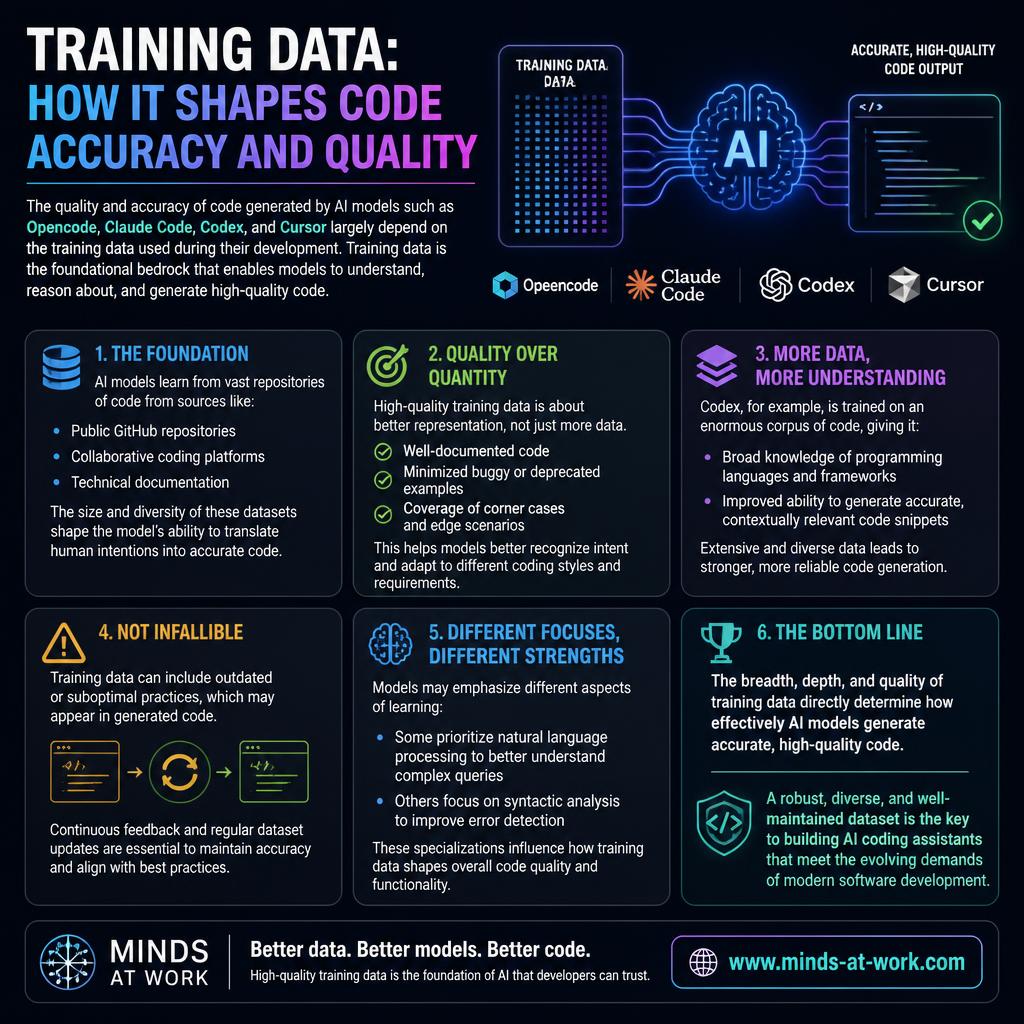
By Dr. Sanju Abraham, Fractional CTO, investor, multiple exits. Published October 21, 2026. Part 5 of a 15-part series: Comparing Opencode, Claude Code, Codex, and Cursor: Is There a Clear Winner?
New to the series? Part 1 — AI Code Generation and Developer Productivity — frames the “five-variable pick.” Part 2 — Overview of the four tools. Part 3 — The Role of Language Models — separates model from wrapper. Part 4 — Deep Learning Foundations — the training pipeline. This part zooms into the single ingredient that most shapes what you feel day to day: the data.
Key takeaways
- Training data is the single most under-discussed driver of AI coding tool quality. Architecture is similar across tools; training data is where the real differences live, and almost no procurement team asks about it.
- Quality beats quantity in late 2026. “Trained on more GitHub” stopped being a differentiator two years ago. Curation, licensing, and post-training data mix are what separate the frontier.
- Four axes decide training-data quality for code models: language and framework coverage, documentation density, provenance and license hygiene, and the mix of instruction and reasoning data in post-training.
- The dataset explains model blind spots. When a model is weak on a stack, the first question is “what did it see?” — not “is the model dumb?”
- Procurement should ask four verifiable questions. Vendor filtering policies, “do you train on my code” settings, license-indemnification scope, and how often the base dataset refreshes. All four have public or contractual answers.
The short answer: The AI code generation models behind Opencode, Claude Code, Codex, and Cursor are trained on a mix of public code repositories, permissively licensed open-source projects, technical documentation, Q&A corpora, and vendor-curated instruction data. The ceiling on what any of these tools can do on your workload is set by what the model saw in training — the languages, frameworks, patterns, and edge cases that were represented in the dataset. In late 2026, every frontier lab has roughly the same scale of raw data available; the difference between tools is now dominated by curation, licensing, and post-training data mix, not by raw token count. This piece walks the four axes that actually matter and the four questions procurement should ask.
Where do AI coding models get their training data?
Pretraining corpora for AI coding models are a layered mix of code, documentation, prose, and synthesized data — not a single dump of GitHub. The composition is more varied than most procurement conversations assume, and each layer serves a different purpose.
The four main layers in a modern coding model’s dataset:
- Public and permissively licensed code. The bulk of raw code volume still comes from permissively licensed open-source repositories — Apache 2.0, MIT, BSD, and compatible licenses — hosted on GitHub, GitLab, and public mirrors like Software Heritage. Vendor filtering excludes copyleft or restrictively licensed code, and removes repositories flagged for secrets, malware, or PII.
- Technical documentation and tutorials. Official framework docs, language specifications, Stack Overflow (under its Creative Commons license), and curated tutorial corpora. This layer is where the model learns to pair “intent in English” with “code in some language.”
- Instruction and reasoning triplets. Curated or synthesized (prompt, code, explanation) triplets. This is the post-training layer that turns a next-token-predictor into a usable instruction-following coding assistant. Most of the quality gap between competing tools in 2026 lives here.
- Execution-grounded data. Code samples paired with their test suites, their runtime output, and sometimes their bug fixes. Used in reinforcement learning to teach the model that “the code runs” is more important than “the code looks plausible.” Pioneered at scale by DeepMind’s AlphaCode line and now standard across frontier labs.
What’s not in the dataset is often as important as what is. Private repositories, paid API documentation, proprietary SDKs, and recent library releases all show up as “the model does not know” — not because the architecture is weak, but because the data was not there.
For the companion piece on how the training pipeline turns this raw data into a usable model, see Deep Learning Foundations Behind AI Code Generators (Part 4).
Why does quality beat quantity for AI coding model training?
Because the field crossed the “enough data” threshold around 2023, and since then, every additional terabyte of unfiltered GitHub has produced diminishing returns. The models that lead the leaderboards in late 2026 win on data hygiene, not data size.
Three evidence-based reasons the field moved this way:
- Dedup and filter work. Removing near-duplicate files, boilerplate, and auto-generated code produces measurable improvements. The widely-cited The Stack and The Stack v2 releases from the BigCode project were as influential for their deduplication methodology as for their size.
- Buggy data teaches buggy patterns. A model trained on a corpus where 15% of files have known defects will reproduce those defects. Static analysis and vulnerability filtering of training data is a quiet but material differentiator between vendors.
- Instruction data compounds. Twenty million high-quality (instruction, code) pairs often beats two hundred million mediocre ones. This is why vendors invest in human-curated or well-synthesized instruction datasets rather than just scaling raw code.
The practical consequence for teams picking a tool: you cannot evaluate training-data quality from the outside, but you can evaluate its downstream effects on your workload. Run a two-day pilot on your own repository with your own language mix. The tool with the best fit to your stack is almost always the one whose training data best represented your stack.
How do coverage and documentation density shape generated code?
Coverage decides whether the model can produce usable code for your stack at all; documentation density decides how well it can explain and refactor what it produces.
- Coverage is a long tail. Python, JavaScript, TypeScript, Java, C/C++, Go, Rust, and C# are all first-class citizens in modern coding model training sets. SQL dialects, shell, HTML, CSS, and the major framework DSLs (React, Vue, Django, Rails, Spring) are well-represented. The long tail — Zig, Nim, Elixir, Racket, Haskell, Lean, your in-house DSL — gets progressively weaker, which shows up as the model confidently inventing syntax that does not exist.
- Documentation density is a quiet multiplier. Code with docstrings, type annotations, and paired tests teaches the model the intent behind the code, not just the surface. Models trained on well-documented corpora produce more useful explanations, better refactor plans, and fewer confused edits — regardless of whether your own code is documented.
The practical move: if your stack is in the long tail, run a one-day pilot before buying. The right answer is often “pay for Opencode or Cursor and point it at an open-weight model specialized for your language” rather than “default to Codex or Claude Code on faith.” For the broader framing of pilots-before-procurement, see AI strategy for SMB owners.
Why does training data sometimes produce incorrect or outdated code?
Because training data is a frozen snapshot of the world, and the world keeps moving. Three distinct failure modes come from this.
- Deprecated APIs and old patterns. A model trained in Q2 learns the libraries, frameworks, and standards that existed in Q2. If a popular library ships a breaking change in Q3, the model will keep writing code against the old API until the next training cycle. The fix is explicit — “we are on version 5.x of library Y” — in the prompt.
- Buggy patterns reproduced at scale. If the training corpus contains common anti-patterns (SQL built with string concatenation, broken crypto defaults, insecure deserialization), the model will reproduce them. Mitigation is static analysis in CI and never shipping agent output without security review.
- Hallucinated APIs. The model predicts “the next plausible token,” which sometimes means inventing a function, flag, or header that looks right but does not exist. Mitigation is tool use (actually run the code, actually import the module) and verifying load-bearing calls against primary documentation.
A fourth, subtler mode is temporal drift: the gap between training cutoff and today. In fast-moving ecosystems (modern JS tooling, LLM libraries themselves), that gap can be the difference between a working snippet and a broken one. Vendor-published cutoff dates are the single most useful piece of information for predicting this; procurement should ask for them explicitly.
For a related framing on how to interpret vendor-reported model quality claims that depend on these dynamics, see Be careful with “beats Jev”.
How does training data differ across the four tools?
Each of the four tools in this series rides a model with a different training-data story — not because the labs are secretive about everything, but because they prioritize different data types.
- Claude Code → Claude. Anthropic has published high-level descriptions of Claude’s training approach and emphasizes long-context data, instruction fine-tuning, and Constitutional AI for post-training. The company’s acceptable use and data policy sets what training data the hosted service may collect from customers; the default is “not trained on business API traffic.”
- Codex → GPT. OpenAI’s GPT family training is covered at a high level in model cards and the data-use policy. API traffic (including Codex) is by default not used for training. OpenAI has partnerships with content publishers and has shifted toward licensed data in post-training.
- Opencode → any model. The agent itself has no training data of its own — it is a wrapper. Its training-data story depends entirely on the model you point it at. This is both a strength (you choose) and a procurement burden (you own the diligence).
- Cursor → mixed. Anysphere ships small, fast proprietary models (cursor-small, cursor-tab) alongside routing to Anthropic and OpenAI frontier models. The small models are trained on Anysphere’s own curated code corpora; the frontier calls inherit the training-data story of the underlying vendor.
The honest consequence: “which model is better trained?” is almost never the right question. “Which model’s training data best represents my workload?” is. For a Python-heavy data team, the answer is usually any of the frontier models. For a Rust kernel-driver team, Opencode pointed at a Rust-specialized model may outperform all three vendor-locked options.
What four questions should procurement ask about training data?
Four questions, every one of which has a public or contractual answer. If a vendor cannot answer them, that itself is signal.
- Will my code be used to train your models? Default answer should be “no” for business API traffic. If “yes,” what is the opt-out, and does the opt-out apply retroactively to data already seen?
- What is the model’s training-data cutoff, and how often does it refresh? A cutoff from eighteen months ago is a problem for anyone shipping against fast-moving dependencies. Vendors differ widely on refresh cadence.
- What is your license-indemnification scope? If your team ships generated code and the code reproduces a copyrighted snippet, which party owns the exposure? GitHub, Microsoft, OpenAI, Anthropic, and the open-source projects have different answers — read the enterprise plan carefully.
- How do you filter training data for secrets, PII, malware, and known-bad patterns? Every vendor filters; the quality and transparency of the filter varies. Ask for the actual categories of filters applied, not a marketing summary.
These four questions take under an hour to answer across all four tools in this series, and the answers are the single most load-bearing input to a serious procurement decision. The deeper framing is in Where decision models fit in an agent stack, which treats the model as one component among several — a useful lens when evaluating training-data risk across the whole pipeline.
A clean, product-forward checklist-style infographic on an off-white background with four large check-row tiles stacked vertically. Each tile is a pill shape in a soft shade (pale slate, pale emerald, pale sand, pale blue). Row 1 'DO YOU TRAIN ON MY CODE?' with sub-text 'business API default: no'. Row 2 'WHAT IS THE TRAINING CUTOFF?' with sub-text 'refresh cadence matters'. Row 3 'WHAT IS YOUR INDEMNIFICATION SCOPE?' with sub-text 'read the enterprise plan'. Row 4 'HOW DO YOU FILTER THE DATA?' with sub-text 'secrets, PII, malware, copyleft'. Short tagline above: 'four questions, one hour, every vendor'. Palette: off-white background, pale slate borders, pale emerald accent, pale sand accent, navy ink. Linear or Stripe editorial feel. No AI robots.
- Aspect ratio: 16:9
- Source size: 1280 × 720 px (sharp on retina at 760 px display width)
- Format: PNG
- Target file size: under 500 KB
Save to /public/images/blog/<slug>/, then set
src and alt on this <MediaFigure /> to swap it in. Keep the ratio prop so the browser reserves the right space.
Frequently asked questions
What data are AI code generators trained on?
They are trained on a layered mix: public and permissively licensed code from GitHub and similar repositories, technical documentation and tutorials (including Stack Overflow under its Creative Commons license), curated (instruction, code, explanation) triplets for post-training, and increasingly, execution-grounded data where code is paired with the result of actually running it. The exact mix differs between vendors, and most frontier labs publish high-level descriptions in their model cards without naming every source.
Why do AI code generators sometimes produce outdated code?
Because the training data is a frozen snapshot of the world as of the training cutoff. If a library ships a breaking change after that cutoff, the model will keep writing code against the old API until the next training cycle. The fix is to tell the model explicitly which library version you are on, or to use tool-use (actually import the module, actually run the code) to catch the mismatch before it merges.
Will the training data for Claude Code or Codex include my private code?
By default, no. Both Anthropic and OpenAI treat business API traffic — including Claude Code and Codex — as not-for-training by default. Enterprise plans make this a contractual commitment. If you use the consumer-tier chat products, defaults differ and should be checked. Opencode never sends code to a vendor for training in any configuration, because it runs locally against the model API you point it at.
How often is the training data updated?
Varies by vendor and model. Frontier labs push major model refreshes every three to six months and smaller updates monthly. Specific training-data cutoffs are usually documented in each model’s card; vendor dashboards also expose “model version” strings that you can pin to avoid silent drift. For fast-moving ecosystems (modern JS frameworks, LLM libraries), a six-month-old training cutoff can be the difference between usable and broken suggestions.
Does more training data always mean a better AI coding model?
No, not since roughly 2023. Scaling raw code volume now produces diminishing returns; the frontier differentiator is data quality — deduplication, license hygiene, documentation density, and the mix of instruction and reasoning data in post-training. Twenty million high-quality (instruction, code) pairs often outperforms ten times as many mediocre ones. The models leading the leaderboards in late 2026 are winning on curation, not quantity.
What is the biggest hidden risk in training data?
License exposure, by a wide margin. If a model reproduces a copyrighted snippet that your team ships, who owns the risk? Different vendors answer this differently; some offer explicit indemnification scoped to enterprise plans, some do not. Read the enterprise agreement before committing to a vendor at scale, and prefer vendors that filter copyleft and attribution-required code out of their training sets rather than relying on post-hoc blocklists.
How can I tell if a model’s training data covers my stack well?
Run a two-day pilot on your own repository, with your own language mix and your own team’s prompts. Aggregate benchmarks (HumanEval, MBPP, SWE-bench) are useful for frontier comparisons but tell you almost nothing about your specific stack. The signal that matters is “does the model produce usable code for my codebase on my team’s first ten real tickets?” — that question answers the training-coverage question better than any marketing page.
If you are picking an AI coding tool for a team in the next ninety days and training-data provenance, license risk, and refresh cadence are decision inputs — as they should be — that is the kind of nuance a one-hour Fractional CTO call is for. For more pieces in this series as it publishes, follow the AI Strategy archive; the broader frame on where AI fits in a small or mid-market software business sits in AI strategy for SMB owners.