Deep Learning Foundations Behind AI Code Generators (Part 4 of 15)
Part 4 of 15. The transformer architectures, pretraining corpora, fine-tuning passes, and reinforcement-learning loops that make Opencode, Claude Code, Codex, and Cursor possible — in plain English.
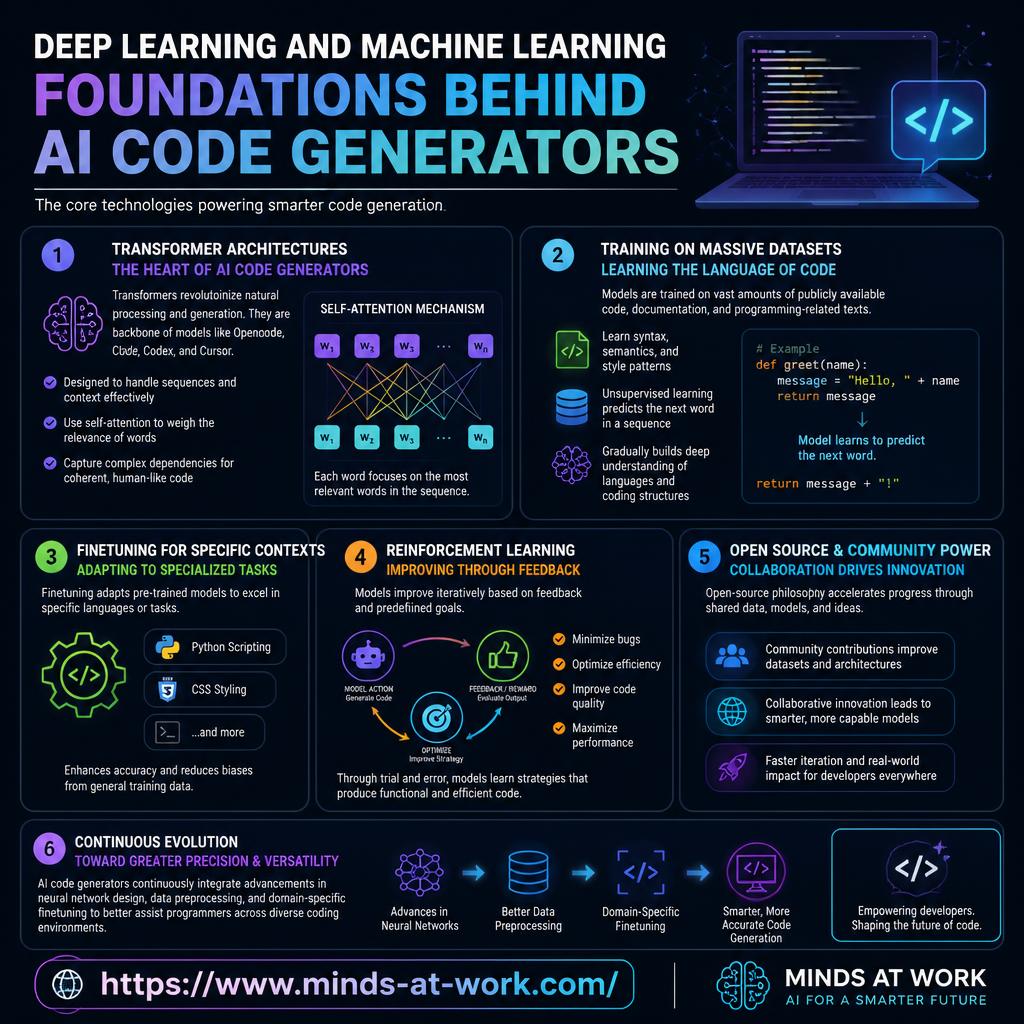
By Dr. Sanju Abraham, Fractional CTO, investor, multiple exits. Published October 20, 2026. Part 4 of a 15-part series: Comparing Opencode, Claude Code, Codex, and Cursor: Is There a Clear Winner?
New to the series? Part 1 — AI Code Generation and Developer Productivity — frames the “five-variable pick.” Part 2 — Claude Code vs Codex vs Opencode vs Cursor: An Overview — profiles each tool. Part 3 — The Role of Language Models in AI Coding Tools — separates model from wrapper. This piece goes one layer deeper: what is actually inside the model.
Key takeaways
- Every tool in this series rides a transformer. The 2017 “Attention Is All You Need” paper is the common ancestor; every production model behind Opencode, Claude Code, Codex, and Cursor is a transformer variant trained at scale.
- Pretraining teaches syntax and style; fine-tuning teaches jobs; RL teaches preferences. Three stages, three different objectives — mixing them up is why vendor marketing often confuses what actually improved between versions.
- Self-attention is the mechanism that makes code generation work. It lets the model weigh how every token in the context relates to every other, which is why a model can “see” a function definition fifty files away and use it correctly.
- Data quality beats data quantity in late 2026. The gap between frontier coding models is no longer “who trained on more GitHub”; it is “who curated and licensed cleaner data, and who did better post-training.”
- The gap you feel between tools is often the gap between post-training recipes, not architectures. All four tools in this series call transformers; what you experience as “smarter” or “safer” is mostly fine-tuning and RL, not a different kind of model.
The short answer: AI code generators are transformer-based large language models trained in three stages — pretraining on massive text and code corpora, supervised fine-tuning on curated examples, and reinforcement learning (usually RLHF or RLAIF) on human or model-graded preferences. The transformer’s self-attention mechanism, introduced in Vaswani et al., 2017, lets the model weigh relationships between every pair of tokens in its context window, which is why a modern coding model can reason about a function it saw thousands of tokens ago. Every production model behind the four tools in this series — Opencode, Claude Code, Codex, Cursor — is a variant of this architecture with a different post-training recipe on top.
What is a transformer, and why is it the backbone of AI code generators?
A transformer is a neural network architecture that processes a sequence of tokens by letting every token attend to every other token in parallel, rather than one at a time. That one design choice is the reason the modern AI-coding category exists.
Before transformers, the dominant approach for sequence modeling was the recurrent neural network (RNN) and its variants (LSTM, GRU). RNNs processed tokens one at a time, carrying a hidden state forward — which made them slow to train and limited in how far back they could “remember.” The 2017 paper Attention Is All You Need replaced recurrence with attention and made two things possible at once: parallel training on GPUs, and effectively infinite reach across a sequence (bounded only by the context window).
Three practical consequences for code:
- Code is long-range. A function used in one file may be defined in another, imported through three layers of indirection. The transformer’s attention mechanism handles this natively.
- Code is highly structured. Indentation, brackets, and token types encode meaning. Attention over token embeddings captures that structure without hand-coded rules.
- Code benefits from scale. Transformer architectures were the first that reliably improved with more parameters and more data, which is why GPT-5-codex and Claude Opus can do things their 2020 ancestors could not.
For an architectural companion to this piece — the model is one piece of a stack — see Where decision models fit in an agent stack.
How does self-attention work in plain English?
Self-attention is a way for a model to decide, for each token it is reading, which other tokens in the context matter most to it. Think of it as a weighted lookup: for every word, the model asks “which other words should I pay the most attention to right now?” and uses the answers to build its next prediction.
A one-paragraph mechanical sketch, no math. Each token is projected into three vectors: a query, a key, and a value. For a given token’s query, the model computes a similarity score against every other token’s key, turns those scores into weights, and uses the weights to pull a blended version of every token’s value. The next layer repeats this with the blend as input. After a dozen or so layers, each token’s representation is a rich summary of its relationship to every other token in context.
Three things fall out of this design that matter for code generation:
- Long-range dependencies. The model can “see” a type definition 20,000 tokens earlier and use it correctly in the function it is writing now.
- Context-aware disambiguation. The word
mapmeans something different in Python than in JavaScript than in Go; attention lets the model use the surrounding tokens to pick the right meaning. - Parallel training. Because all tokens attend in parallel rather than one at a time, modern GPUs can train transformers at a scale that RNNs never reached.
The companion piece on how model benchmarks are shaped by this architecture — and how to read them critically — is Be careful with “beats Jev”.
What data are these models trained on, and how is that changing?
Pretraining corpora for coding models mix large volumes of publicly available code, technical documentation, scientific papers, and web text — but the frontier has shifted from quantity to quality. The models that lead the leaderboards in late 2026 are winning on curation and licensing, not on raw volume.
Three practical shifts since 2023:
- Licensed, filtered code. Vendors have moved from scraping-first to license-aware curation. GitHub-hosted repositories under permissive licenses, vendor-partner codebases, and purpose-collected datasets are now the backbone — with filtering for secrets, PII, malware, and known-bad patterns.
- Instruction and reasoning data. Modern coding models train not only on raw code but on (instruction, code, explanation) triplets, often synthesized or human-curated. This is what makes the model useful as a collaborator, not just as an autocomplete.
- Repository-aware context. Fine-tuning stages increasingly include multi-file packs — the model sees not just “a function” but “a function inside its tests, its docs, and its usages.” This is why late-2026 agentic tools handle cross-file refactors better than their 2023 ancestors.
Two honest caveats on data. First, training on your private code is not a given — all four tools in this series let you keep private code out of future training by default or by setting. Second, license risk did not disappear — vendors differ in how aggressively they filter copyrighted code and how willing they are to indemnify customers. Procurement should ask both questions explicitly.
What is fine-tuning, and why does it matter so much?
Fine-tuning is the stage where a pretrained base model is further trained on a smaller, carefully curated dataset to make it better at a specific job. In late 2026, this is where most of the day-to-day quality difference between tools comes from.
Three fine-tuning passes that matter for coding:
- Instruction fine-tuning. The base model is taught to follow instructions (“write a function that validates…”) rather than just continue text. This is why a modern coding model understands English prompts; the base model would just continue the prompt as if it were a story.
- Tool-use fine-tuning. The model is trained to produce structured outputs that a wrapper can parse and act on — “I want to read file X” instead of “you should probably read file X.” This is what makes agentic coding possible.
- Domain fine-tuning. Vendors sometimes release variants specialized for a language (Python, Rust), a framework (React, Django), or a workflow (code review, test generation). Each variant trades some general capability for sharper performance on its target domain.
The practical consequence: when a vendor ships “a new version” of their coding tool, the model architecture almost never changes. What changed is the fine-tuning data, the fine-tuning recipe, or the mix of specialized variants the wrapper routes to. Reading release notes well is mostly reading which of these moved.
What role does reinforcement learning play?
Reinforcement learning teaches a model to prefer outputs humans (or other models) rate higher. In coding, this is where “the code runs” and “the diff is reviewable” get baked into the model, not just “the code looks plausible.”
Two reinforcement-learning techniques dominate in late 2026:
- RLHF — Reinforcement Learning from Human Feedback. Human raters compare pairs of model outputs; the model is trained to prefer the ranked-higher one. This is the technique that moved GPT-3 to GPT-3.5 and ChatGPT. It is expensive and slow but produces outputs humans like.
- RLAIF — Reinforcement Learning from AI Feedback. A stronger model (or the same model with better prompts) ranks outputs instead of humans. Cheaper, faster, and increasingly common; the trade is that any bias in the ranking model propagates into the fine-tuned one.
Coding-specific RL variants also use execution feedback — the model’s suggested code is actually run against unit tests, and the model is rewarded when the tests pass. This is one of the most important ideas of the last two years and is why late-2026 coding models are measurably better at producing code that runs on the first try than their 2024 ancestors.
For a related framing on how to read model-quality claims that come out of RL training runs, see Be careful with “beats Jev”.
What is the role of open-source and community data?
Open-source and community contributions remain central to the field — in architecture, in benchmarks, and in the models themselves. The field would not look the way it does today without them, and no vendor in this series is fully independent of the open ecosystem.
Three concrete contributions worth naming:
- Open architectures. The transformer itself was published openly. So were LLaMA (Meta), Mistral, Qwen (Alibaba), DeepSeek-Coder, and many others — each released weights or papers that competitors read, learned from, and improved on.
- Open benchmarks. HumanEval, MBPP, SWE-bench, and LiveCodeBench are community-maintained benchmarks that let vendors and researchers compare models honestly (or at least, publicly). Without them, every vendor would ship “best in class” with no way for anyone to check.
- Open tools. Opencode is the clearest example in this series — the agent itself is MIT-licensed. Hugging Face, the open-weight hubs, and the broader open-source toolchain are infrastructure the whole category depends on, including the closed-source vendors.
The honest trade-off is between pace and ownership. Closed-source labs can move fast with proprietary data and compute. Open-source efforts move slower but produce models that any team can audit, embed, or self-host. The healthy ecosystem has both, and late-2026 is a good example of that balance.
Where is this foundation evolving next?
The next twelve months will be dominated by better post-training, longer effective context, and tool-aware training — not by a new architecture. The transformer era is far from over.
Four specific directions worth watching, each already underway:
- Mixture-of-experts (MoE). Many frontier coding models are now MoE under the hood: a routing network sends each token to a subset of specialized “experts,” making a 500B-parameter model behave like a 50B one at inference time. Cheaper, faster, and often sharper.
- Longer effective context. Published context windows have grown past one million tokens on some models; the research now is on making the model actually use that context well, not just technically fit it in. Retrieval and memory layers are part of the answer.
- Tool-aware pretraining. Instead of adding tool use as a late fine-tuning pass, labs are starting to pretrain models with tool calls natively in the training mix. This is one of the biggest expected quality jumps in 2027.
- Smaller, task-specialized models. The era of “one giant model for everything” is ending. Expect every vendor in this series to ship a family of models — a fast small one for in-flow completion, a strong medium one for most tasks, a heavy specialist for long jobs — with the wrapper routing per task.
For a related forward-looking piece on where decision-shaped models are heading in the same window, see OpenAI’s Decisions API and the shape of the market.
A clean, product-forward dashboard-style infographic on an off-white background with a 'what-changed-when' horizontal timeline. Four milestones from left to right, each a pill-shaped tile in a soft shade: 2017 'TRANSFORMER' pale slate, 2022 'RLHF AT SCALE' pale emerald, 2024 'EXECUTION-FEEDBACK RL' pale blue, 2026 'TOOL-AWARE PRETRAIN' pale sand. Each tile has a one-line label beneath explaining what the milestone unlocked for coding tools. A short tagline above reads 'ten years of post-training, one chart'. Thin emerald rule across the bottom. Palette: off-white background, pale slate borders, pale emerald accent, pale sand accent, pale blue accent, navy ink. Linear or Stripe editorial feel. No AI robots.
- Aspect ratio: 16:9
- Source size: 1280 × 720 px (sharp on retina at 760 px display width)
- Format: PNG
- Target file size: under 500 KB
Save to /public/images/blog/<slug>/, then set
src and alt on this <MediaFigure /> to swap it in. Keep the ratio prop so the browser reserves the right space.
Frequently asked questions
What is a transformer in the context of AI code generators?
A transformer is a neural network architecture, introduced in the 2017 paper Attention Is All You Need, that processes sequences of tokens using self-attention rather than recurrence. In AI code generators, transformers are the backbone of every production model behind Opencode, Claude Code, Codex, and Cursor. Self-attention lets the model weigh how every token in its context relates to every other, which is why a modern coding model can reason about a function defined thousands of tokens earlier in the same prompt.
How are AI code generators trained?
They are trained in three stages. Pretraining teaches the base model to predict the next token in a sequence, using massive corpora of code, documentation, and web text. Supervised fine-tuning teaches the model to follow instructions and produce structured outputs, using curated instruction/response pairs. Reinforcement learning (RLHF, RLAIF, or execution feedback) teaches the model to prefer outputs that humans, other models, or test runners rate higher. All four tools in this series ride models trained in this three-stage pipeline.
What is the difference between pretraining and fine-tuning?
Pretraining is the one-time, very expensive stage where a model learns the general shape of code and language from a massive corpus. Fine-tuning is the smaller, repeated stage where a pretrained model is adapted to a specific job — following instructions, using tools, specializing in a language or framework. In 2026, pretraining budgets are enormous but similar across frontier labs; most of the day-to-day quality difference you feel between coding tools comes from fine-tuning and reinforcement learning on top.
Why do AI code generators sometimes produce incorrect or insecure code?
Three reasons tied to the training stack. Pattern reproduction: models reproduce the insecure patterns they saw during pretraining (SQL injection, path traversal, broken crypto defaults). Hallucinated APIs: models predict plausible-sounding tokens, which sometimes means inventing functions or flags that do not exist. Objective mismatch: the training objective rewards “code that looks right,” which is not identical to “code that runs” or “code that is secure.” Mitigations include tool use (actually running the code), static analysis in CI, and human review of agent-generated changes.
What role does reinforcement learning play in AI code generators?
Reinforcement learning is how models are taught to prefer outputs that are rated higher — by humans (RLHF), by other models (RLAIF), or by executing the code against tests (execution-feedback RL). It is where “the code runs” and “the diff is reviewable” get baked into the model’s preferences, rather than just “the code looks plausible.” Most of the measurable quality improvements between 2024 and 2026 coding models come from better RL recipes, not from new architectures.
Are AI code generators trained on my private code?
By default, no — all four tools in this series let you keep private code out of future training through either a default setting or an enterprise plan. Opencode never sees your code at a vendor at all, because it runs locally against the model API you point it at. Claude Code, Codex, and Cursor each publish their data-use policies; procurement teams should read them and configure the “no training on my data” switch explicitly rather than trusting the default.
Will a new neural network architecture replace the transformer?
Possibly over the next five years, but not in the next twelve months. Candidate architectures (state-space models like Mamba, hybrid attention/SSM designs, retrieval-first approaches) are active research areas but have not displaced transformers in production at frontier scale. The near-term quality improvements in AI code generators will come from better post-training, longer effective context, and tool-aware pretraining on top of the transformer, not from replacing it.
If you are picking an AI coding tool for a team in the next ninety days and the model-level details matter — training data provenance, fine-tuning recipes, data-use policies — that is the kind of nuance a one-hour Fractional CTO call is for. For more pieces in this series as it publishes, follow the AI Strategy archive; the broader frame on where AI fits in a small or mid-market software business sits in AI strategy for SMB owners.