Claude Code vs Codex vs Opencode vs Cursor: An Overview (Part 2 of 15)
Part 2 of 15. A plain-English overview of the four leading AI coding tools in late 2026 — Claude Code (Anthropic), Codex (OpenAI), Opencode (open-source), and Cursor (AI-first IDE) — with a side-by-side comparison table.
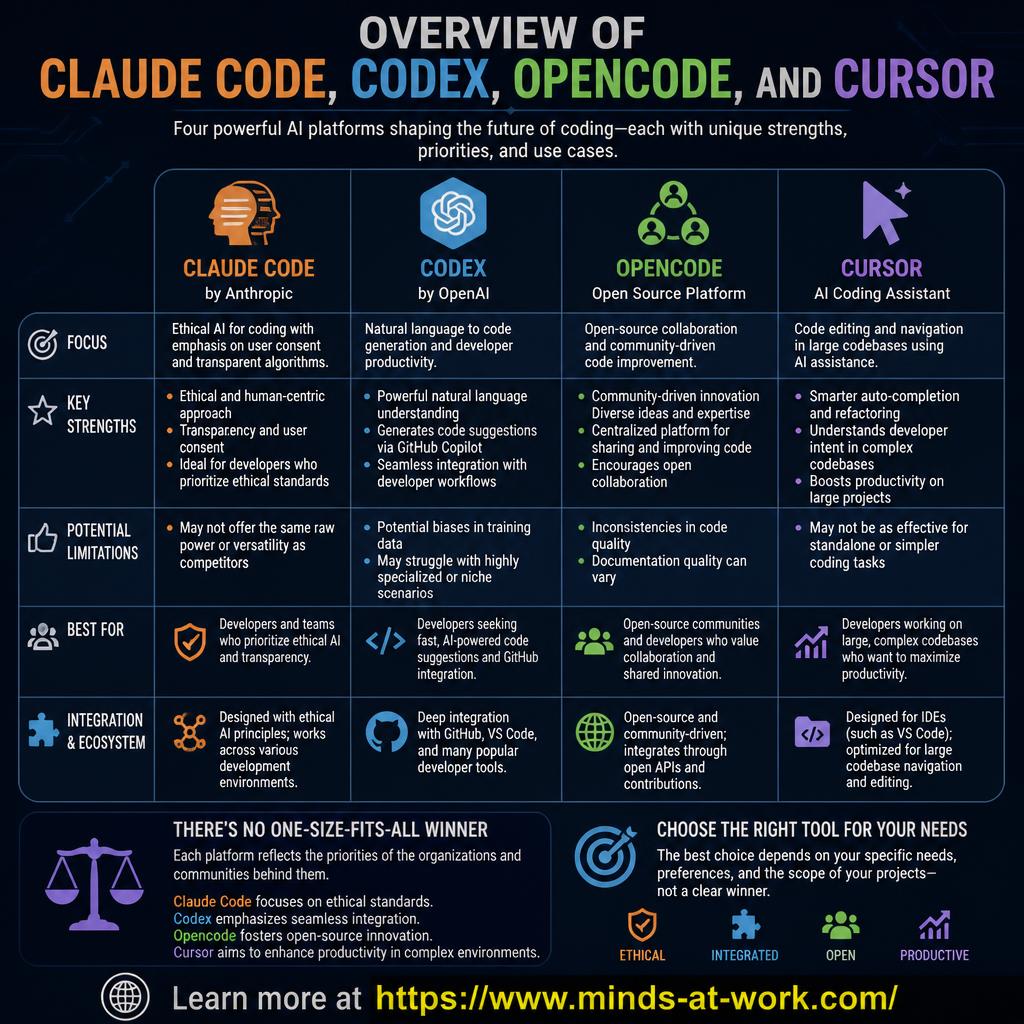
By Dr. Sanju Abraham, Fractional CTO, investor, multiple exits. Published October 18, 2026. Part 2 of a 15-part series: Comparing Opencode, Claude Code, Codex, and Cursor: Is There a Clear Winner?
New to the series? Start with Part 1 — AI Code Generation and Developer Productivity: Introduction for the framing, the “five-variable pick” lens, and the series roadmap. This piece is the one-page overview that every later part builds on.
Key takeaways
- Claude Code is Anthropic’s reference agent for Claude — a terminal + IDE tool that leans on Claude’s long-context reading and ships enterprise controls (audit, usage reporting, SSO) out of the box.
- Codex is OpenAI’s coding agent line in 2026 — a CLI and a managed cloud agent that runs long tasks in a sandbox, built around the GPT model family. Not the 2021 Codex model that powered the original GitHub Copilot — this is the agent product that replaced it.
- Opencode is open-source and model-agnostic — a terminal-native agent built by SST, MIT-licensed, bring-your-own-key for any frontier or local model. Not a code-sharing platform; it is a coding agent you install and run.
- Cursor is an AI-first IDE — Anysphere’s fork of VS Code, where Composer, Agent, and inline chat all share the same editor context. Strong on large codebases with heavy navigation.
- No one wins every row. Each tool reflects the priorities of the organization behind it; the choice depends on where your team works, what model you prefer, and how much lock-in you can accept.
The short answer: In late 2026, the four leading AI coding tools split cleanly by surface and licensing. Claude Code (Anthropic) and Codex (OpenAI) are vendor-shipped agents tied to a single model family — strong defaults, enterprise polish, hosted-only. Opencode (SST) is open-source and model-agnostic — the escape hatch when you want to swap models or keep the agent in your perimeter. Cursor (Anysphere) is the only one of the four that is an IDE first and an agent second — if your team lives in VS Code, it is already the closest thing to a native experience. The rest of this piece gives each tool a short, honest profile and ends with a side-by-side table you can keep next to your laptop.
What is Claude Code, and who is it for?
Claude Code is Anthropic’s official terminal and IDE agent, built around the Claude model family. It is the reference implementation for how Anthropic thinks developers should work with Claude: tool-first, diff-reviewed, with hooks for enterprise controls.
- Who ships it. Anthropic, the research lab behind the Claude models.
- Where it lives. A CLI you run in a terminal, plus first-class integrations with VS Code and JetBrains IDEs.
- The underlying model. Claude Opus and Sonnet model families; configurable per task, with long-context reading as a flagship capability.
- What it is strong at. Reading large, unfamiliar codebases; multi-file refactors with explicit diffs; enterprise audit trails, SSO, and seat-based billing; writing tests for existing code.
- Where it is less strong. No native IDE of its own — the terminal is the first-class surface. Single-vendor by design: you cannot swap the model to GPT or a local Llama without leaving the tool.
- Best for. Teams that already use Claude for other work, teams that need enterprise controls on day one, and developers who prefer a terminal over an editor sidebar.
What is Codex, and who is it for?
Codex in 2026 is OpenAI’s coding agent — not the 2021 model of the same name. The product line includes a local CLI and a managed cloud agent that runs long tasks in a sandbox, both built around the current GPT model family.
- Who ships it. OpenAI, the lab behind GPT.
- Where it lives. A CLI, a web interface, and an IDE extension; the cloud agent runs background tasks in OpenAI’s hosted sandbox.
- The underlying model. GPT-5-codex and other GPT variants, selectable per task.
- What it is strong at. Long, mostly-autonomous tasks that can run while you do something else; strong hit rate on well-represented stacks; tight integration with ChatGPT and the broader OpenAI tool surface.
- Where it is less strong. Hosted-only by default; the open-source CLI narrows the gap but the cloud agent is the differentiator. Single-vendor like Claude Code — you buy into the OpenAI stack.
- Best for. Teams already deep in the OpenAI ecosystem, developers who want to delegate longer-running tasks to a background agent, and shops that value a managed cloud sandbox over a local-only agent.
Important disambiguation. The original Codex, released by OpenAI in 2021, was a language model that powered the first version of GitHub Copilot. OpenAI retired that model in 2023 and later relaunched the Codex name as an agent product line, documented today at openai.com/codex. When this series says “Codex,” it means the current agent — not the model behind the original Copilot.
What is Opencode, and who is it for?
Opencode is an open-source, terminal-native AI coding agent built by SST. It is MIT-licensed and model-agnostic — the same agent runs against Claude, GPT, Gemini, or a local model, with your own API key.
- Who ships it. SST, the team behind the SST serverless framework; the project repo is at github.com/sst/opencode.
- Where it lives. A terminal CLI with a TUI; no vendor cloud, no SaaS layer.
- The underlying model. Your choice — Anthropic, OpenAI, Google, Groq, local Ollama. The agent is the product; the model is a config value.
- What it is strong at. Model freedom and portability; no lock-in; works offline against local models; MIT license means you can audit, fork, or embed it in your own tooling.
- Where it is less strong. No vendor-managed cloud agent; enterprise features (SSO, centralized billing, audit) are what you build on top; smaller ecosystem than the Big Two.
- Best for. Developers who want to A/B test models without changing tools; teams that need an agent in their own perimeter or air-gapped environment; anyone who considers vendor lock-in a first-class risk.
Common misconception. Opencode is not a GitHub-like platform for sharing code. It is a coding agent you install and run against your own project, model-agnostic by design. The “open” in the name refers to the license and the model choice, not to a social code-hosting service.
What is Cursor, and who is it for?
Cursor is an AI-first fork of VS Code, built by Anysphere. Unlike the other three, the IDE itself is the AI surface — Composer, Agent, inline chat, and autocomplete all share the same editor state and context window.
- Who ships it. Anysphere, a San Francisco startup.
- Where it lives. A desktop IDE for macOS, Windows, and Linux. VS Code extensions and keybindings mostly work.
- The underlying model. A mix: Cursor’s own “cursor-small” for fast operations plus frontier models from Anthropic and OpenAI for heavy lifting. Pro users can pick per-task.
- What it is strong at. Large codebases with heavy navigation; smart autocomplete that reads surrounding context; keeping chat, agent, and inline edits in one editor instead of three windows; onboarding developers already fluent in VS Code.
- Where it is less strong. IDE-only — no terminal-first experience, so terminal-centric developers may find it heavy. Pricing has shifted several times in the last year; forecast cost carefully.
- Best for. Teams who live inside VS Code; developers who prefer the IDE as the center of gravity; projects where navigation across many files matters more than long autonomous runs.
How do the four tools compare side by side?
The honest side-by-side. Each row is a factual axis; each cell is a short, verifiable statement. Pricing changes often — check vendor pages before committing.
| Axis | Claude Code | Codex | Opencode | Cursor |
|---|---|---|---|---|
| Vendor | Anthropic | OpenAI | SST (open-source) | Anysphere |
| License | Proprietary, hosted | Proprietary, hosted; CLI open | MIT, open-source | Proprietary, hosted |
| Primary surface | Terminal + IDE plugins | CLI + cloud + IDE plugin | Terminal (TUI) | Desktop IDE (VS Code fork) |
| Model choice | Claude family only | GPT family only | Any model you configure | Mix: Cursor models + frontier |
| Agent loop | Tool-use with explicit diffs | Local tool-use + cloud sandbox | Tool-use, pluggable | In-IDE Composer + Agent |
| Enterprise | SSO, audit, usage reports | SSO, ChatGPT Enterprise tie-in | DIY on top of OSS | Teams plan with SSO |
| Lock-in | High (single model, single vendor) | High (single model, single vendor) | Low (bring any key) | Medium (IDE lock, model choice) |
| Best fit | Enterprise + terminal | OpenAI shops + background runs | Model-agnostic + OSS teams | VS Code teams + large codebases |
Five truths about this table. First, no column dominates every row — if one did, the series would be one post instead of fifteen. Second, “lock-in” is not synonymous with “bad” — Claude Code and Codex ship real enterprise polish precisely because they control the full stack. Third, “model choice” is the one axis Opencode wins outright; everything else is a trade. Fourth, Cursor is the only tool in the row where the IDE itself is the product, not a surface around a model. Fifth, every one of these facts is checkable against the vendor’s own documentation, which is linked in the sections above.
Why is there no one-size-fits-all winner?
Because each tool reflects the priorities of the organization that ships it, and no organization optimizes for every priority at once. Claude Code is built by a lab that treats safety and enterprise fit as first-class. Codex is built by a lab that treats model capability and ecosystem breadth as first-class. Opencode is built by a team that treats openness and portability as first-class. Cursor is built by a company that treats the editing experience itself as the product.
Those priorities are visible in the first ten minutes of using each tool. Claude Code gives you an audit log before you ask. Codex offers to run a thirty-minute task in the cloud and tag you when it finishes. Opencode lets you point at a local model and keeps the configuration in a plain file in your repo. Cursor renders a Composer window that reads the whole project without the user doing anything.
The right choice depends on five variables, which this series calls the five-variable pick: where your team works, which model family you prefer, how much lock-in you can accept, your cost ceiling, and your security posture. Part 1 names the five; Parts 4–11 go deep on each. If you want the shape of the answer before the full series lands, that is the exact conversation a one-hour Fractional CTO engagement is for.
A clean, product-forward decision-tree infographic on an off-white background. Top node asks 'What matters most for your team?' Four branches fan down to four pill-shaped tiles, each a soft shade: pale emerald labeled 'MODEL FREEDOM → Opencode', pale blue labeled 'IDE EXPERIENCE → Cursor', pale slate labeled 'ENTERPRISE CONTROLS → Claude Code', pale sand labeled 'BACKGROUND TASKS → Codex'. A thin emerald rule connects the top node to each tile. Short tagline above: 'Four priorities, four picks'. Clean, flat, geometric. Palette: off-white background, pale slate borders, pale emerald accent, pale sand accent, pale blue accent, navy ink. Linear or Stripe editorial feel. No AI robots.
- Aspect ratio: 16:9
- Source size: 1280 × 720 px (sharp on retina at 760 px display width)
- Format: PNG
- Target file size: under 500 KB
Save to /public/images/blog/<slug>/, then set
src and alt on this <MediaFigure /> to swap it in. Keep the ratio prop so the browser reserves the right space.
Frequently asked questions
What is the difference between Claude Code and Codex?
Claude Code is Anthropic’s agent built around the Claude model family; Codex is OpenAI’s agent built around GPT. Both are terminal-first with IDE plugins, both lock you to a single model vendor, and both ship enterprise controls. The practical differences are the model (Claude’s long-context reading versus GPT’s broader tool ecosystem), the cloud agent (Codex ships a managed cloud sandbox; Claude Code does not), and billing (Claude Code’s seat model versus Codex’s ChatGPT Enterprise tie-in). Pick based on which model your team already trusts.
Is Opencode a replacement for Claude Code or Cursor?
Opencode is a replacement for Claude Code and the Codex CLI, not for Cursor. The three terminal-native tools occupy the same niche — an agent you run in the shell against a project. Cursor is an IDE, so comparing it to Opencode is comparing an editor to a CLI. Teams who want model freedom and a terminal workflow pick Opencode; teams who want the IDE itself to be AI-native pick Cursor; the two can co-exist for different developers on the same team.
Which AI coding tool is best for enterprise teams?
Claude Code and Codex are the two with the deepest enterprise defaults as of late 2026. Claude Code ships SSO, audit logs, usage reporting, and seat-based billing with centralized administration. Codex integrates with ChatGPT Enterprise, which brings the same identity and audit surface for shops already on that plan. Cursor’s Teams plan adds SSO and shared billing. Opencode is open-source — enterprise features are what your team adds on top. Pick based on where your identity provider and audit pipeline already live.
Does Opencode have a cloud version?
No. Opencode is a local, terminal-native agent as of October 2026. The project is MIT-licensed and runs on your machine against whichever model’s API key you provide. Teams who want a hosted cloud agent should look at Codex’s cloud offering or Claude Code’s managed service; teams who want model freedom with a hosted layer should look at the broader market or build a thin orchestration layer themselves.
Can I use Cursor and Claude Code together?
Yes, and many teams do. Cursor is an IDE and Claude Code is a terminal agent — they do not overlap functionally. A common pattern is to keep Cursor open for in-editor edits, autocomplete, and small refactors, and drop into Claude Code (or Codex, or Opencode) in a terminal for long-running agentic tasks that need to touch many files or run tests across the project. The tools cost separately, so the question is whether the combined bill is justified by the workflow.
Which of the four tools has the lowest lock-in risk?
Opencode by a wide margin. It is MIT-licensed, model-agnostic, and runs on your machine against any API key or local model you point it at. If Anthropic, OpenAI, or any single vendor raises prices or deprecates a model, the switch is a config change. Claude Code and Codex are the opposite end of the spectrum — single model, single vendor. Cursor sits in the middle because the IDE is proprietary but the model layer is swappable within the limits of what Anysphere supports.
How often do these tools change?
Fast enough that any claim in this piece should be re-verified against vendor documentation before a procurement decision. All four shipped at least one major update in the past quarter; pricing, model options, and enterprise features move on a monthly cadence. The reason to keep the comparison framework (the five-variable pick, introduced in Part 1) rather than a frozen scorecard is exactly this — tools churn, but the five variables that decide the choice do not.
If you are weighing these four tools for a team in the next ninety days and the decision has real cost — in dollars, in developer time, or in platform lock-in — that is the exact shape of a one-hour Fractional CTO call. The category commoditized faster than most procurement cycles can follow; the mistakes that matter are the ones made in the first ninety days. For more pieces in this series as it publishes, follow the AI Strategy archive; for the broader frame on where AI fits in a small or mid-market software business, start with AI strategy for SMB owners.