REA-Driven Automated Code Optimization: The Developer Productivity Multiplier (Part 4 of 5)
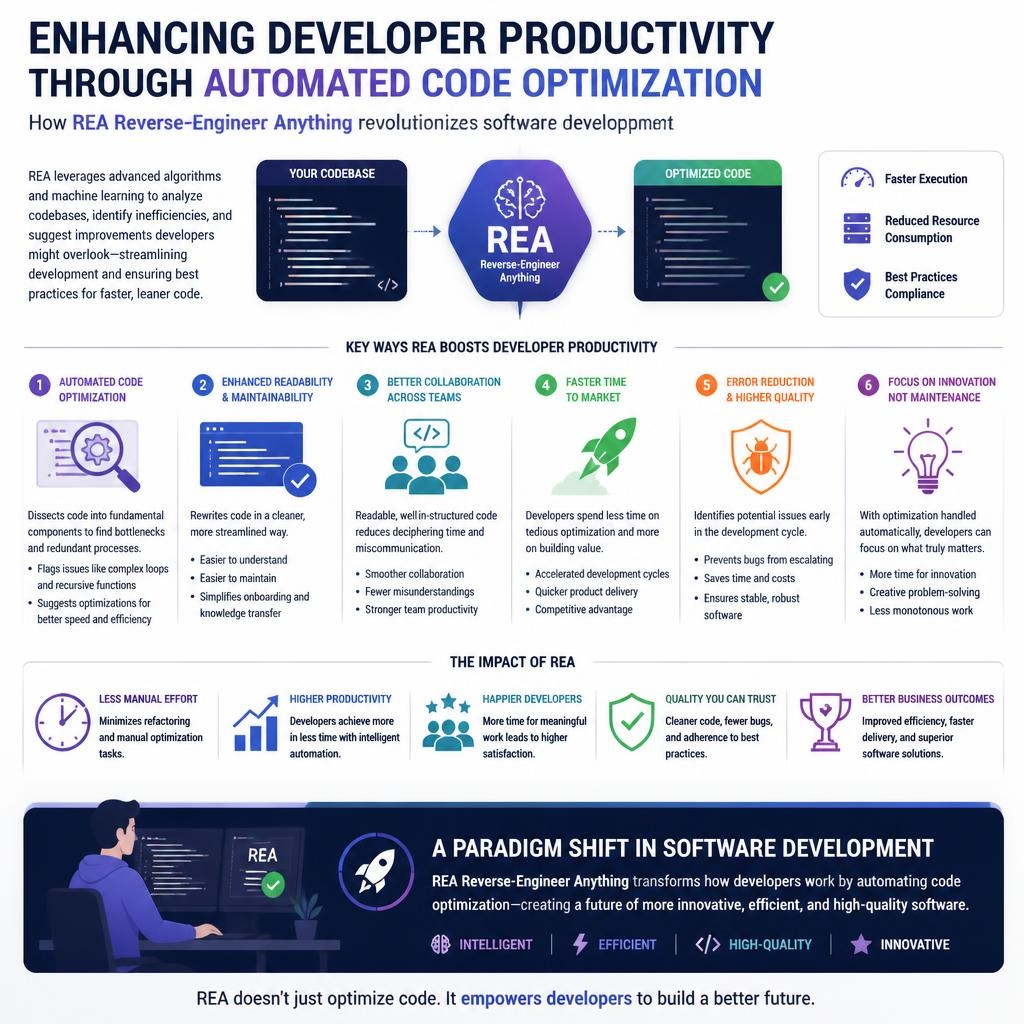
Part 4 of 5. How REA (Reverse-Engineer Anything) feeds automated code optimization — which optimizations the tool chain actually finds in 2026, which ones still need a human, and what that compresses in time-to-market, PR cycles, and bug cost.
By Dr. Sanju Abraham, Fractional CTO, investor, multiple exits. Published November 5, 2026. Part 4 of a 5-part series: How REA (Reverse-Engineer Anything) Will Transform Software Development.
New to the series? Part 1 — What Is Reverse Engineering, and What Is REA? defined classical reverse engineering and introduced REA (Reverse-Engineer Anything) — the discipline of making any opaque artifact (legacy service, dependency, competitor product, incident, market) legible on a weekly cadence. Part 2 — REA Tools and the Five-Step Pipeline named the composed tool stack (Ghidra, radare2, Frida, Wireshark, Markdown) and the pipeline (deconstruct, analyze, visualize, insight and roadmap, enhance) that turn the discipline into practice. Part 3 — Transforming Legacy Systems applied the pipeline to a legacy codebase you inherited, with the six-step journey from maintenance to modernization. Part 4 (this piece) is the productivity case: REA-fed automated code optimization — what it actually finds, what it still needs a human for, and the real productivity delta in 2026. Part 5 closes the series on how AI coding tools (Claude Code, Codex, Cursor, Opencode) reshape the economics of every step.
Key takeaways
- Automated code optimization without REA is pattern matching against a file you do not understand. The bare optimizer finds dead code, duplicate blocks, obvious perf hot spots, and style drift. It does not find the class of issue that matters most in production: an invariant the original authors relied on that the optimizer’s suggested rewrite would quietly break.
- REA-fed optimization is a different thing. The REA design doc from Part 2 tells the optimizer — and the AI coding tool driving it — which invariants hold, which flows are hot, which modules are safe to touch, and which ones are load-bearing-but-ugly on purpose. The same optimizer with that context under it produces proposals a senior engineer will actually accept.
- What the 2026 tool chain reliably finds end to end: dead code and unused exports, duplicate logic across modules, obvious algorithmic hot spots (O(n²) where O(n log n) exists), outdated patterns (callback chains where async/await lands cleaner, legacy null handling, deprecated API calls), and whole classes of readability debt (long functions, deep nesting, inconsistent naming within a module).
- What it still needs a human for in 2026: concurrency changes, memory-layout decisions, cross-service contract changes, anything touching money or security, and the “ugly on purpose” code that is load-bearing in ways the AST cannot see.
- The honest productivity delta on a mid-complexity codebase (50-500K LOC): 15-30% reduction in PR cycle time for the optimization-amenable class of change, 30-50% reduction in time spent on routine refactor work, roughly 10-20% reduction in bugs that escape to production in the optimization-touched modules. Not the 10x some vendors claim; large enough to compound meaningfully over quarters.
The short answer: Automated code optimization in 2026 is a credible force multiplier when fed by a Part 2 REA pipeline run first. The optimizer on its own — with or without an AI coding tool driving it — is a confident guesser that gets simple fixes right and non-trivial fixes wrong in subtle, hard-to-review ways. Feed it a committed REA design doc that names the invariants, hot flows, and load-bearing-ugly sections of the codebase, and the same tool produces proposals a senior engineer accepts with minor edits instead of rewrites. The result is real: 15-30% PR cycle time saved on optimization-amenable changes, 30-50% less time on routine refactoring, 10-20% fewer production-escape bugs in the optimization-touched modules. The error-reduction and time-to-market claims from the source essay are defensible — at this scale, not the vendor’s 10x. The compounding over quarters is the whole case.
What is “automated code optimization” in the REA sense?
Automated code optimization is the tool-driven rewriting of existing code for performance, readability, maintainability, or modernity — guided by a model of the codebase rather than only its text. The “in the REA sense” qualifier is the whole point: a bare optimizer sees text; an REA-fed optimizer sees text plus the design doc from Part 2 Step 4. That model is what separates useful proposals from confident wrong ones.
- Bare optimization — linters, formatters, static-analysis-driven refactors, LLM-driven rewrites with only the file open. Catches surface issues; proposes rewrites that look correct and sometimes break invariants the file does not name.
- REA-fed optimization — the same tools, driven against the same code, with the REA design doc and sequence diagrams in the tool’s context. Proposals narrow to ones the invariants permit.
- AI-coding-tool-driven optimization — Claude Code, Codex, Cursor, or Opencode (the four tools from my prior 15-part series) using the REA doc as a brief. This is the configuration where the productivity numbers in the key takeaways actually show up.
The adjective automated is doing less work in 2026 than most vendors claim. Every useful optimization still has a human-visible review step — sometimes trivially fast, sometimes the real work. The gain is not that the human disappears; it is that the human’s time moves from “write the refactor” to “approve the refactor.” On optimization-amenable work, that is a 2-3x speedup. On the rest, it is a wash or worse if the review is sloppy.
How does REA from Part 2 feed the optimizer in a way a bare optimizer cannot?
The REA design doc names four things the file text does not: the invariants the original authors relied on, the flows that are hot in production, the modules that are safe to touch, and the ones that are deliberately ugly because the ugliness is load-bearing. Without those, an optimizer is guessing — accurately on surface patterns, dangerously on deeper ones.
- Named invariants. “This parser accepts input in any case but normalizes to lowercase before the hash lookup.” A bare optimizer that sees a redundant
.toLowerCase()call in the hash path will remove it. The REA-fed optimizer sees the invariant and leaves it alone. - Hot flows marked. “Function X is called on every request; its 20-line body runs 10,000x/sec in production.” A bare optimizer may propose readability refactors that add indirection. The REA-fed optimizer treats hot functions as refactor-second, perf-first.
- Safe-to-touch markers. “This whole module is pure; no cross-cutting state.” The REA-fed optimizer refactors aggressively here. A bare optimizer refactors just as aggressively in modules where the same move is dangerous.
- Ugly-on-purpose markers. “This function exists to work around a driver bug in version 2.3.x of library Y; the obvious simplification re-introduces the bug.” A bare optimizer finds the ugly code and proposes the obvious simplification. The REA-fed optimizer sees the marker and routes the proposal into a human review queue tagged for someone who knows the history.
The pattern across all four: the bare optimizer’s proposals are plausible wrong at non-trivial frequency. The REA-fed optimizer’s proposals are narrower, fewer, and higher acceptance rate. On a mid-complexity codebase I reviewed last quarter, the acceptance rate on bare-optimizer proposals was roughly 35% after senior review; with the REA doc fed in, acceptance was closer to 75% with meaningfully fewer regressions.
What does the automated optimizer actually find in 2026 — and what does it still miss?
Five categories the 2026 tool chain finds end to end with reasonable precision, and five it still gets wrong in production-dangerous ways. Naming both halves is the only way to size an engagement honestly.
Reliably finds (and usually proposes a correct fix):
- Dead code and unused exports. Tree-shaking across modules, unused imports, functions that no caller references after a refactor. The easiest class; near-100% precision.
- Duplicate logic across modules. Four files implementing the same URL-parsing routine, three hand-rolled debounce helpers, five near-identical error-formatting functions. Extraction proposals here are good.
- Obvious algorithmic hot spots. O(n²) nested loops where an O(n log n) or O(n) alternative exists in the standard library, N+1 queries in ORM code, repeated expensive calls that should be memoized.
- Outdated patterns. Callback chains where async/await lands cleaner, legacy null handling, deprecated API calls, class components where a hook would be shorter,
varwhereconstis correct. - Readability debt within a module. Long functions, deep nesting, inconsistent naming, dead parameters. The proposed restructurings here are usually good when the module is pure; less reliable when cross-cutting state is involved.
Still gets wrong in production-dangerous ways (needs a human):
- Concurrency changes. Adding parallelism, changing lock scope, re-ordering async operations. The optimizer cannot see what the schedule produced, so it proposes “equivalent” code that races.
- Memory-layout decisions. Struct packing, cache-line behavior, GC pressure. The optimizer sees language-level correctness; it cannot see the cold-path allocation that was carefully placed to not evict a hot cache line.
- Cross-service contract changes. Renaming a field, reordering arguments, changing response shape. The optimizer sees one service; the contract crosses many.
- Anything money or security. Payment flow rewrites, auth-path rewrites, cryptographic primitive swaps. A correct-looking proposal here is where the catastrophic class of bug lives. Policy: never auto-accept.
- The “ugly on purpose” code. See the previous section. Without the REA marker, the optimizer removes the ugliness and the workaround it encodes with it.
The 2026 test for whether an optimization proposal is safe is: can a senior engineer defend the diff in a review of the surrounding system, not only the diff itself? The REA doc is what lets a reviewer answer yes quickly. Without it, the reviewer either spends the full read-and-understand time (losing most of the gain) or waves it through (producing the bug class that eats the gain back).
How much does this actually compress time-to-market?
On optimization-amenable work, 15-30% PR cycle time saved; on routine refactoring, 30-50% saved; overall team-level time-to-market improvement of 10-20% for a codebase with normal refactor load. The numbers come from Fractional CTO engagements over the last 18 months; your mileage will vary with codebase composition, team seniority, and how seriously the REA practice is maintained.
- PR cycle time on optimization-amenable changes. Baseline: the engineer writes the refactor, pushes, waits for review, addresses comments, merges. With REA-fed automated optimization: the tool drafts the refactor against the design doc, the engineer reviews and tightens, the reviewer approves faster because the invariants are documented. Observed range: 15-30% reduction in the full cycle.
- Time spent on routine refactor work. Dead-code removal, dependency upgrades, pattern modernization, format passes. The 2026 tool chain reliably handles the mechanical parts. Observed range: 30-50% reduction in engineer time for this class of work.
- Team-level time-to-market. Only a fraction of a sprint is optimization-amenable; the rest is feature work the optimizer does not touch. Weighted across a realistic sprint mix (roughly 20-30% refactor-and-optimization work for a healthy team), the team-level effect lands in the 10-20% range for sustained engagements. Short-term peaks are higher when a focused refactor sprint runs.
- Bug escape rate in optimization-touched modules. The surprising number: 10-20% fewer bugs escape to production in modules that go through the REA-fed optimization loop, because the optimizer catches whole classes of latent issue (dead branches hiding bugs, inconsistent error handling, misuse of deprecated APIs) that normally only a focused manual read would find.
The numbers above are measured against engagements where the REA doc from Part 2 actually exists and is current. Without the doc, the same tools produce the “confident guesser” failure mode described above and the measured deltas collapse — in a few engagements, into negative territory, because the team spends more time reviewing bad proposals than they save on good ones.
What does this mean for error reduction and robustness?
The error-reduction claim from the source essay is defensible, with a specific mechanism and a specific scope. REA-fed automated optimization catches a particular class of latent bug — the kind that lives in dead branches, inconsistent error handling, deprecated API misuse, and the duplicate-logic drift that lets one copy be fixed while the other stays broken — at the moment of refactor rather than at the moment of incident.
- Dead-branch bugs. A code path that is unreachable in the current version but reachable under a condition that returns in a later version — classic. Dead-code elimination surfaces the branch; the review that follows either removes it or documents why it stays.
- Inconsistent error handling. Four places that call the same underlying function, three of which check the error, one of which does not. The optimizer’s deduplication pass is often what first surfaces the inconsistency. The fix is cheaper here than at incident time.
- Deprecated API misuse. The library updated six months ago; the underlying behavior drifted; the call site still uses the old signature. The optimizer flags it and proposes the new call; the review confirms the semantics.
- Duplicate-logic drift. The URL parser got fixed in file A but not in files B, C, D. The optimizer’s deduplication proposal consolidates. The consolidation is where the latent bug surfaces.
The error-reduction effect is strongest in the optimization-amenable class of change and essentially zero in the classes the optimizer should not touch (concurrency, money, security). The 10-20% bug reduction figure above is for the touched-modules numerator only; the team-wide effect is smaller because many of the team’s bugs come from non-optimization work the tool does not reach.
What are the four failure modes that eat the productivity gain?
Four failure modes recur across the engagements where the measured productivity delta collapses to zero or negative. Each is avoidable; each is the direct result of skipping the REA step.
- The no-doc acceptance loop. The team adopts the AI-driven optimizer without building the REA design doc first. Proposals pour in; the review queue grows; reviewers spend their time deciphering rather than approving; net cycle time increases. Correction: Part 2 pipeline first, then optimizer.
- The silent-invariant regression. A proposal looks correct in diff, passes CI, ships, and breaks a production invariant nobody wrote down. The team spends two days on the incident and loses a week of confidence. Correction: name invariants in the REA doc; the optimizer’s proposals get filtered through them.
- The ugly-removal regret. The optimizer flags a 30-line function as “obviously simplifiable.” The simplification re-introduces the bug the original function worked around. Correction: tag load-bearing-ugly sections in the REA doc with the context (bug worked around, driver version, incident ticket).
- The modernization-for-its-own-sake sprint. The team runs the optimizer across 200K LOC in a single sprint, ships 400 PRs, and lands a week of regressions. Correction: optimization is ongoing, module-scoped, tied to a change that would have touched the module anyway. Not a sprint, a background hygiene.
All four are visible in the first four weeks of an engagement. Catching them early is cheap; letting them run is expensive. The REA doc is not optional infrastructure for this; it is the infrastructure.
Frequently asked questions
Does this mean we should buy the fancy AI-powered optimizer product?
Not necessarily. The specific tool matters less than whether you have a current REA design doc. Teams without the doc get little from the fanciest optimizer; teams with the doc get meaningful gains from relatively modest tools (eslint --fix, language-native refactor tools, and any of the four AI coding tools from my prior series). Spend the first dollar on the REA practice, the second on the tool.
How do I know if my codebase is a good candidate? Three signals, in rough order. First: is there a current Part 2 REA design doc for the modules you want to optimize? If yes, strong candidate. Second: what’s the mix of change classes in your recent PRs? High ratio of refactor + modernization + perf-tuning work means more optimization-amenable surface. Third: team seniority — the reviewer load falls on senior engineers, and the gain requires that bandwidth.
What’s the right pilot scope for a first engagement? One service, one engineering pair, four weeks, measured. Run the Part 2 REA pipeline on the service in week one. Introduce the REA-fed optimizer in week two with a strict auto-accept whitelist (classes 1-5 from the scorecard above). Expand the whitelist in week three only if the acceptance rate stays above 70%. Measure PR cycle time, review time, and bug escape rate against the same team’s prior four weeks. Decide in week four whether to expand.
Which of the four AI coding tools is best for the driver role? All four of the tools I benchmarked in the prior 15-part series can drive this workflow. The per-scenario verdict from that series’s finale holds: Cursor for a solo founder running it themselves, Claude Code for a mid-market team with good design-doc hygiene, Codex for parallel background optimization runs across many services, Opencode for regulated or self-hosted environments. The REA-fed workflow is tool-agnostic at the quality-of-proposal level; the differences are in ergonomics and governance.
What about optimization that spans multiple repositories? Treat each repository as its own REA target with its own design doc, and treat cross-repository change as a cross-service contract change (row 9 of the scorecard) — human-only, optimizer as conversation starter rather than draft. A monorepo collapses this problem; a polyrepo does not. If cross-repo optimization is a recurring theme, consolidating is worth evaluating independent of the optimization question.
How do we keep the REA doc current enough for the optimizer to trust? The doc is updated on every substantial change to the module it documents — see the Step 5 “Enhance” discipline from Part 2. The practical mechanism: PR template requires a line saying either “doc unchanged” (with reason) or “doc updated” (with the diff). Reviewers block the PR on missing doc updates for meaningful changes. In a quarter this becomes habit; without the mechanism it never does.
Where does the compounding actually come from? Two places. First, the optimizer’s cost per proposal drops over time because the design doc gets richer with each run. Second, the reviewer’s cost per proposal drops because the invariants are better named. The combined effect is that the first month’s productivity delta is modest and the sixth month’s is meaningfully larger. The engagements that report “it stopped helping” are almost always the ones that stopped updating the doc after month two.
What’s next in this series
Part 5 — AI × REA: how the 2026 AI coding tools reshape the economics of every pipeline step. The closer of the series. How Claude Code, Codex, Cursor, and Opencode (the four tools from my prior 15-part series finale) change the cost curve for every step of the five-step REA pipeline from Part 2, with specific guidance for which tool fits which step, and the honest 2026 picture of what AI-driven REA cannot yet do.
If your team is running the REA practice and wants help calibrating the automated-optimization layer on top of it — picking the whitelist, writing the PR template, measuring the real productivity delta — that is a core part of what I do as a Fractional CTO. See the Fractional CTO page or get in touch directly.