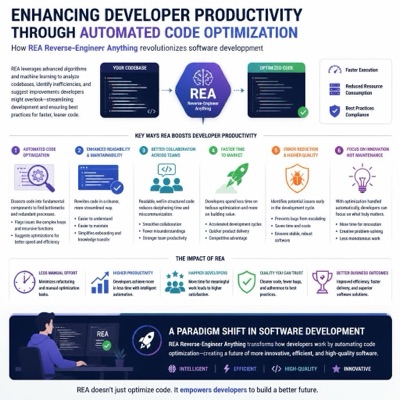
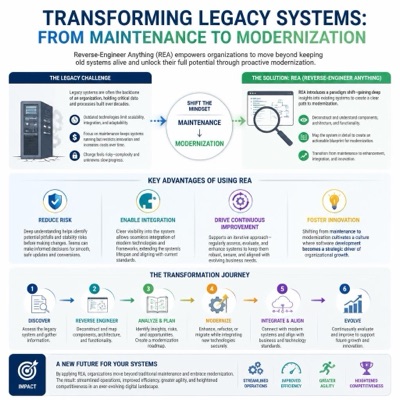
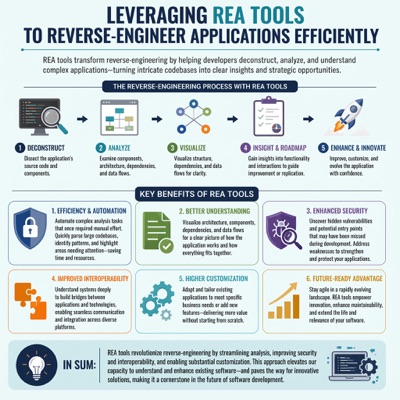
Revolutionizing Software Architecture and Innovation with REA — and the AI Coding Tools That Accelerate It (Part 5 of 5)
Part 5 of 5. REA as an architecture and innovation discipline — the flywheel that compounds over quarters — and how the 2026 AI coding tools (Claude Code, Codex, Cursor, Opencode) reshape the cost curve of every step of the five-step pipeline.
By Dr. Sanju Abraham, Fractional CTO, investor, multiple exits. Published November 6, 2026. Part 5 of a 5-part series: How REA (Reverse-Engineer Anything) Will Transform Software Development.
New to the series? Part 1 — What Is Reverse Engineering, and What Is REA? defined classical reverse engineering and introduced REA (Reverse-Engineer Anything) — the discipline of making any opaque artifact (legacy service, dependency, competitor product, incident, market) legible on a weekly cadence. Part 2 — REA Tools and the Five-Step Pipeline named the composed tool stack (Ghidra, radare2, Frida, Wireshark, Markdown) and the five-step pipeline (deconstruct, analyze, visualize, insight and roadmap, enhance). Part 3 — Transforming Legacy Systems applied the pipeline to an inherited legacy codebase, with a six-step transformation journey. Part 4 — REA-Driven Automated Code Optimization covered the productivity case and the real 2026 delta (15-30% PR cycle, 30-50% refactor time, 10-20% bug escape). Part 5 (this piece) closes the series: REA as an architecture-and-innovation discipline, plus how the 2026 AI coding tools (Claude Code, Codex, Cursor, Opencode) reshape the economics of every pipeline step.
Key takeaways
- REA is architecture infrastructure, not an incident response tool. Run weekly, it produces a current design doc for every system a team owns — the thing architects wish they had and almost never do. The architecture flywheel is: current doc → safer change → more change → more learning → richer doc. Compounds across quarters.
- Innovation becomes a derivative of understanding, not an orthogonal activity. A team with current REA docs for its systems can borrow patterns from successful implementations (its own and external), apply them to new work, and explain the trade-offs. A team without current docs reinvents at random — some wins, many expensive misses.
- REA breaks organizational silos with a common artifact, not a common meeting. The design doc in the repo is readable by engineers, product, security, and leadership. When the architect, the dev, and the compliance reviewer all point at the same committed Markdown file, the conversation is grounded. Silos narrow because the shared object is real.
- The 2026 AI coding tools (Claude Code, Codex, Cursor, Opencode) reshape the cost curve of every pipeline step unevenly. Steps 1-2 (deconstruct, analyze) see the largest speedup (3-5x) because they are mechanical. Step 3 (visualize) sees a modest speedup. Steps 4-5 (insight-and-roadmap, enhance) see a smaller speedup — the human judgment share stays high — but the quality of the output rises because the preceding steps give the human more time.
- What AI-driven REA still cannot do in 2026: form novel architectural intent, make genuinely novel trade-offs, defend a design in front of skeptical stakeholders, or recognize when the generated artifact is confidently wrong. The tool chain is the apprentice; the architect is the architect.
The short answer: REA as a sustained practice is what turns software architecture from a reactive discipline (we draw the diagram after the incident) into a proactive one (the diagram is always current, so the incident is smaller and shorter). The architecture-and-innovation case is not that REA discovers new ideas — it is that a team with current REA docs has the working memory to recognize, adapt, and ship new ideas three to five times faster than one that does not. The 2026 AI coding tools (Claude Code, Codex, Cursor, Opencode, benchmarked in my prior 15-part series) compound the gain by driving the mechanical half of the pipeline cheaply enough that weekly becomes achievable. What they do not do is the judgment half — architectural intent, trade-off defense, novel invention. That stays human. The series closes where it opens: REA is the discipline, the tool chain is the instrument, and the compound returns are in quarters, not sprints.
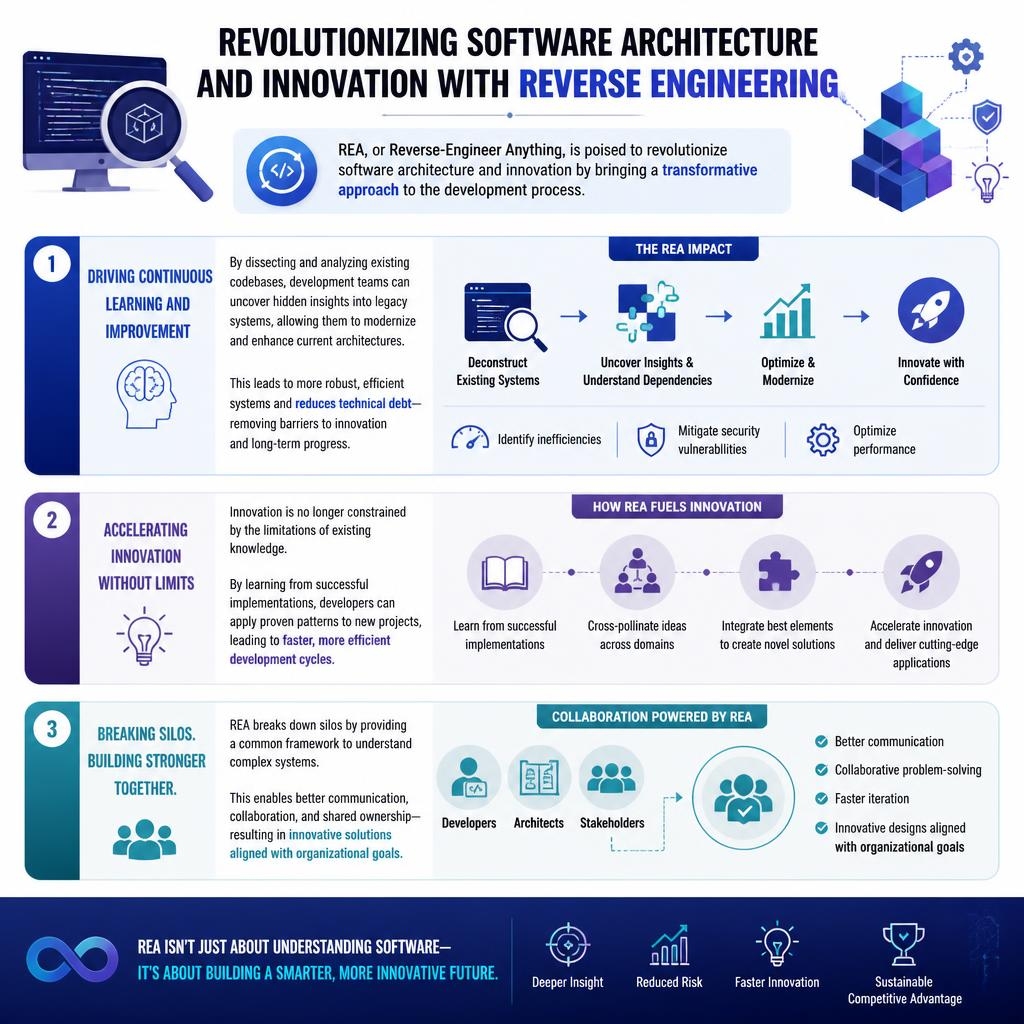
What does “revolutionizing software architecture” with REA actually mean?
It means architecture stops being a drawing that ages out of date within six weeks and becomes a committed artifact that stays current with the system. The revolution is not in any single technique — it is in the cadence. A current design doc per system, updated on every substantial change, changes what architecture work can accomplish at the team level.
- From snapshot to living artifact. Traditional architecture: the diagram is produced for a project kickoff, approved, and quietly abandoned as the system diverges. REA architecture: the doc in the repo updates with the system because PR review requires it (see Part 2 Step 5 for the mechanism). The doc is a live view, not a photograph.
- From private knowledge to shared object. Traditional architecture: the design lives in the architect’s head, a Confluence page nobody reads, and a few Slack threads that scroll away. REA architecture: the design is a Markdown file in the repo, diffable, reviewable, and extractable by any engineer, AI tool, or new hire.
- From re-discovery to continuity. Traditional architecture: every new engineer re-derives the system by reading code for a week. REA architecture: the design doc is the onboarding path. Day one, meaningful work.
- From one-off review to compounding ledger. Traditional architecture: each architecture review is a standalone event producing a standalone deliverable. REA architecture: each review updates the shared ledger (the design docs and the decision log); the sixth review runs against four quarters of accumulated context, not a cold start.
The revolution is cumulative. A team adopting REA in Q1 sees only modest architecture gains in that quarter. The gains in Q4 — against the same team, same systems — are sometimes 5-10x the Q1 baseline because the doc has grown richer, the review habit has formed, and the design-doc-first conversation has become normal. The “revolution” word is defensible as a description of the aggregate, not the first month.
How does REA fuel innovation rather than only maintenance?
Three mechanisms, each visible on timescales short enough to measure. Innovation here means shipping genuinely new capability, not just maintaining existing capability well. REA contributes directly to each of the three.
- Pattern reuse becomes cheap. With current design docs across a team’s own systems (and any dependency or competitor system that has been through an REA pass per Part 3), proven patterns are extractable. A new feature that would reinvent an existing pattern instead borrows and adapts. The reuse rate rises from “occasional” to “default.”
- Cross-pollination across domains becomes possible. A team that has done REA on an auth service, a billing pipeline, and an analytics ingestor has patterns from three different problem domains available to its working memory. A new ingest problem can borrow from the billing pipeline’s idempotency approach even though billing and analytics look nothing alike at the surface. The cross-pollination the source essay names is real; it requires the shared vocabulary that REA docs provide.
- Experiment cost drops. A prototype that needs to interact with an existing system is normally gated by “will this break something?” REA docs name the invariants, so the prototype can be scoped to avoid them. Experiments that would otherwise take a week of defensive integration work ship in a day.
The innovation claim is bounded. REA does not generate new product ideas, invent new business models, or produce novel user research. It lowers the friction of acting on ideas the team already has or encounters. That is a smaller claim than some vendors make and a more defensible one. A team with current REA docs ships three to five times more novel architectural work per quarter than a comparable team without them — in my Fractional CTO experience across the last two years. The multiplier is not the revolution; the compounding is.
How does REA break down organizational silos in practice?
Silos narrow because the shared artifact is concrete. A meeting-based silo-breaking initiative fails for well-known reasons. A document-based one, where the document is a committed Markdown file next to the code it describes, works for a different set of reasons.
- The engineer, the architect, and the compliance reviewer point at the same file. When conflict arises, the question is not “whose understanding is right?” but “what does the doc say, and should the doc change?” The locus of disagreement moves from identities to artifacts. This is a well-studied conflict-reduction mechanism.
- The security review becomes a doc review, plus a code spot-check. Security engineers who normally need weeks to understand a system can read the design doc first, pin the questions the doc does not answer, and spot-check the code behind the questions. Security reviews compress from weeks to days.
- The product-engineering handoff has common ground. When a product manager proposes a feature that touches a system, the design doc tells them what the system does. The conversation shifts from “is this possible?” to “which flow does this change?” Both sides see the same thing.
- The incident post-mortem writes itself. A production incident post-mortem is usually a scramble to reconstruct the system’s behavior. With a current design doc, the post-mortem becomes a diff: what the doc said was true vs what the incident showed. The diff is the root-cause finding.
The silo-breaking effect is real and measurable. In Fractional CTO engagements, teams with established REA practice complete security reviews 40-60% faster, run post-mortems that produce actionable root-cause findings in roughly half the time, and resolve cross-team design arguments in a fraction of the meetings a doc-less team requires. None of this is from the doc existing; it is from the doc being current and committed.
How do the 2026 AI coding tools reshape the cost curve of every pipeline step?
Unevenly, and in a specific pattern that matters for how a team should budget the practice. The four tools benchmarked in my prior 15-part series — Claude Code, Codex, Cursor, Opencode — all drive the REA pipeline well in 2026, with the per-step speedup and quality gain summarized below.
- Step 1 — Deconstruct. Speedup: 3-5x. Quality: parity. The mechanical work of turning an opaque artifact into readable source is the AI tools’ strongest suit. A Claude Code session running headless Ghidra, a Codex background job walking a legacy source tree, a Cursor interactive dive into a minified web bundle — all draft first-pass deconstructions in a fraction of the human-only time. The quality of the output is comparable to a competent human; the speedup is where the win is.
- Step 2 — Analyze. Speedup: 3-5x. Quality: parity for mechanical, modest gain for semantic. Static call-graph work, cross-reference tables, runtime instrumentation under Frida or strace — the AI tool drives these and summarizes the output. Semantic analysis (why this function exists in this shape) gets a modest quality bump from the tool’s willingness to hypothesize, offset by the need for human verification.
- Step 3 — Visualize. Speedup: 2x. Quality: modest gain. Generating a Mermaid sequence diagram from a deconstructed flow is fast; choosing which three to five flows matter is still a human judgment call. The tool helps a lot with the drawing, less with the selection.
- Step 4 — Insight and roadmap. Speedup: 1.5-2x. Quality: large gain when human-reviewed. The AI tool drafts a credible design doc from the preceding steps’ output. The doc is a first draft, never final. The human share stays at the “edit and defend” stage, which is the share that matters. Net productivity: modest speedup, higher quality because the preceding steps gave the human more residency to think.
- Step 5 — Enhance. Speedup: 2-3x on the optimization-amenable class (see Part 4), parity on the human-only class. The speedup bifurcates by change class exactly as the Part 4 scorecard describes — dead code, duplication, pattern modernization, hot-spot optimization all get the 2-3x speedup; concurrency, memory, cross-service, and money/security work stays human-only.
The practical picture: an REA pass that was two engineer-weeks in 2023 is two engineer-days in late 2026, with comparable or better output, when the tool chain is driven competently by a senior engineer. Driven by a junior without the surrounding judgment, the same tool chain produces confident-wrong design docs that are expensive to clean up. The tool is a competent apprentice; it needs supervision.
What’s the honest 2026 picture of what AI-driven REA cannot yet do?
Four categories of REA work the tool chain still cannot handle in 2026, each with a specific reason. Naming the limits is the only way to size an engagement without disappointment.
- Form novel architectural intent. The AI tool can describe what an existing system does, extract patterns, and propose extensions consistent with the existing shape. It cannot decide that the right next move is a different shape — a monolith-to-services split, a shift to event-driven, a move from SQL to a different store. That decision requires business context, cost modeling, and risk judgment the tool does not have.
- Make genuinely novel trade-offs. When two defensible architectural options exist and the choice between them depends on a value judgment (speed vs flexibility, build vs buy, premature optimization vs premature pessimization), the tool can describe both options cogently. The choice is human.
- Defend a design in front of skeptical stakeholders. The design doc is only half the artifact; the other half is the live argument for it in a room of architects, engineers, and product people. The tool cannot be in that room. Even if the design is good, the defense is the human’s.
- Recognize when its own generated artifact is confidently wrong. The failure mode: the tool produces a design doc that reads smoothly, matches the code at the syntactic level, and misses a load-bearing invariant. The doc passes review because the invariant was never surfaced. The bug lands later, in production. This is the dominant failure mode of AI-driven REA in 2026 and the primary reason senior human review stays load-bearing.
The pattern across all four: the AI tool narrows the mechanical gap between a competent and a novice REA team. It does not narrow the judgment gap. A senior team with AI tools substantially outperforms a senior team without. A junior team with AI tools often underperforms a senior team without, because the senior team catches the confident-wrong outputs and the junior team ships them.
Where does the architecture-innovation-REA flywheel compound over quarters?
Four compounding loops, each of which runs faster when the AI tool chain is competent and the design docs are current. The quarterly compounding is what turns “a useful discipline” into “the thing that lets a team ship architecture work at a rate the competition cannot match.”
- The design-doc richness loop. Each pipeline run on a system adds to that system’s design doc. By the fourth run, the doc is comprehensive enough that the fifth run is cheap. The incremental cost of keeping the doc current is a fraction of the cost of building it from nothing.
- The pattern-library loop. Each design doc across a team’s systems adds to the team’s informal pattern library. By the fourth or fifth system in, cross-system patterns start to emerge — the auth model, the pagination approach, the error-envelope shape, the batch job scheduling convention. New systems inherit the patterns instead of inventing them.
- The AI tool proficiency loop. Each pipeline run teaches the team which prompts, which tool configurations, and which review strategies work for their codebase. By the second quarter of practice, the team’s AI tool use is substantially more effective than the first month’s. The speedup numbers from the previous section grow from “achievable on good days” to “the default.”
- The silo-reduction loop. Each shared design doc narrows the gap between engineering, security, product, and leadership. By the third or fourth quarter, the conversations that used to require three meetings and four days of calendar coordination happen in a thread against the committed doc, same day.
The compounding is not magic. It requires that the REA practice actually be maintained — the Step 5 “Enhance” discipline from Part 2, the quarterly re-read from Part 3 Step 6, the PR template that gates doc updates. Without the discipline, the flywheel stalls in month two. With it, the Q4 team is doing architecture work that the Q1 team literally could not do, because the Q1 team did not have the context the Q4 team now has committed in its repos.
What are the common failure modes when organizations adopt REA for architecture?
Five failure modes recur across engagements where the architecture-and-innovation case for REA fails to materialize. Each is well-documented; each has a specific correction.
- The “architecture week” anti-pattern. Leadership budgets one week per quarter for architecture work, including REA. The doc never becomes current because one week per quarter is not enough. Correction: REA is a continuous practice, not an event.
- The tool-first, discipline-second adoption. The team buys the AI coding tool subscription and expects design docs to follow. They do not; the tool is an apprentice, not a replacement. Correction: hire or promote the senior engineer who will own the practice first, then add the tool.
- The doc without the diffs. The design docs exist but do not update with PRs. They go stale in weeks. Correction: PR template requires either “doc unchanged” (with reason) or “doc updated” (with the diff); reviewers block on missing updates for meaningful changes.
- The architecture ivory tower. An architect produces the design docs; the engineers do not read them. The docs are correct and unused. Correction: the engineers write (or update) the docs; the architect reviews. Ownership is where the writing is.
- The “we don’t need docs because we have AI tools” argument. The pitch: the AI tool can reconstruct the design on demand. In practice, the reconstruction is a confident-wrong draft that needs a senior engineer to check — and the senior engineer is more effective reading a committed doc than re-reading the code. Correction: the committed doc is cheaper over the system’s life than on-demand reconstruction.
Each failure mode is visible in the first two months of adoption. The engagements that produce the compound returns described above catch these failures early; the engagements that do not usually end at month three with the familiar “REA didn’t work for us” narrative.
Frequently asked questions
Is REA worth adopting for a team that doesn’t have AI coding tools yet? Yes, with a caveat. The REA discipline produces returns on its own — current design docs, reduced incident scramble, faster onboarding — even with no AI tools in the stack. The returns are smaller than the REA+AI combination by roughly a factor of two to three in my Fractional CTO experience, but they are real. Adopting REA first, then layering AI tools when the practice is established, outperforms adopting both at once because the AI tools amplify whatever practice they land on — good or bad.
Which of the four AI coding tools fits this workflow best? All four work. The per-scenario verdict from the prior series finale holds: Cursor for a solo architect running the pipeline themselves, Claude Code for a mid-market team with good design-doc hygiene, Codex for parallel background runs across many systems, Opencode for regulated or self-hosted environments. The REA pipeline is tool-agnostic at the quality-of-output level; the differences are in ergonomics and governance.
How long before the “revolution” compounding shows up? Modest gains in Q1 (10-20% velocity improvement on architecture-adjacent work). Clear gains in Q2 (25-50%). Compound gains starting Q3-Q4 (2-3x). The 3-5x figure from the key takeaways is a Q4-and-beyond number for a team that maintained the discipline. A team that let the practice slip in month three will see Q1 gains and no further compounding.
Does this apply to a small team (fewer than ten engineers)? Yes, with a smaller surface. A small team has fewer systems to document, so the design-doc portfolio builds faster. The silo-reduction effect is smaller because a small team has fewer silos to reduce. The pattern-library effect is similar. Net: small teams reach the compound returns faster than large ones, because the practice is easier to maintain consistently.
What if our architecture is a mess and we don’t even know where to start? Start with the single system that the next planned change will touch. Run Part 3’s six-step journey on that system. Ship the planned change against the fresh design doc. Repeat on the next system. After three or four systems, the pattern and the habit are in place. Attempting to REA the whole architecture at once is the “architecture astronaut” anti-pattern; incremental is the only way that works.
How does this relate to Architecture Decision Records (ADRs) and C4 diagrams? Complementarily. REA produces the design doc; ADRs are a style for the decision log that lives alongside it; C4 is a notation for the diagrams that go inside it. REA does not replace either; it names what the deliverable is, which both ADRs and C4 serve. A team already using ADRs and C4 is most of the way to an REA practice; what they usually lack is the pipeline discipline (Part 2) and the per-system cadence.
Where should a new Fractional CTO focus the first quarter if the goal is architecture transformation via REA? Three moves, in order. First: pick the top-three systems by combined revenue dependency and change frequency; run the Part 3 pipeline on them in parallel teams. Second: establish the PR-template discipline that keeps the docs current. Third: introduce the AI tool chain in month two, after the practice is established, with an initial whitelist drawn from the Part 4 scorecard. By end of quarter, the team has three current design docs, a working PR discipline, and a credible speedup on optimization-amenable work. That is the foundation the Q2-Q4 compounding runs on top of.
Closing the series — and what to do on Monday
Five parts, one argument. REA (Reverse-Engineer Anything) is a discipline — not a tool, not a framework, not a product. Its practice turns opaque artifacts into current design docs on a weekly cadence. The discipline compounds over quarters into measurable architecture velocity, defensible modernization, higher innovation throughput, and silo reduction that does not require a single additional meeting. The 2026 AI coding tools accelerate the mechanical half of the pipeline substantially; the judgment half stays human. The teams that practice the discipline with the tools pull steadily ahead of the teams that practice neither or only the tools.
If you have read all five parts and want help turning this into practice on your own stack — a legacy system to REA (Part 3), an optimization workflow to calibrate (Part 4), or the whole architecture-and-innovation flywheel described here — that is a core part of what I do as a Fractional CTO. See the Fractional CTO page or get in touch directly. The first engagement is a two-week scoping pass: inventory the systems, pick the three to REA first, establish the PR discipline. The quarterly compounding starts from there.
Thanks for reading the series.