Is There a Clear Winner Among Opencode, Claude Code, Codex, and Cursor? (Part 15 of 15)
Part 15 of 15. The verdict after fourteen parts of comparison: no overall winner, but a clear per-scenario winner — Cursor for solo builders, Claude Code for mid-market teams, Opencode for self-host, Codex for background runs.
By Dr. Sanju Abraham, Fractional CTO, investor, multiple exits. Published October 31, 2026. Part 15 of a 15-part series: Comparing Opencode, Claude Code, Codex, and Cursor: Is There a Clear Winner?
New to the series? Part 1 — AI Code Generation and Developer Productivity. Part 2 — Overview of the four tools. Part 3 — The Role of Language Models. Part 4 — Deep Learning Foundations. Part 5 — Training Data and Code Quality. Part 6 — Code Completion Compared. Part 7 — Synthesis Techniques. Part 8 — NLP and Context Understanding. Part 9 — Speed and Efficiency. Part 10 — API Integration and Workflow Compatibility. Part 11 — Programming Languages Supported. Part 12 — Collaboration Features. Part 13 — Code Accuracy — the six measurable axes. Part 14 — Unique Strengths and Differentiators — one load-bearing differentiator per tool. This finale maps those four differentiators onto four real scenarios and names the winner per scenario.
Key takeaways
- There is no overall winner. On the thirteen axes compared across Parts 3–13 — language models, deep-learning foundations, training data, completion, synthesis, NLP, speed, API, languages, collaboration, accuracy — the four tools are close enough that no tool wins on all axes, or even most. “Which is best?” is not a well-formed question in 2026.
- There is a clear winner per scenario. When you specify the work — solo founder shipping fast, mid-market SaaS team doing many PRs a day, enterprise with regulated code, a team that wants to parallelize long autonomous runs, an open-source maintainer who needs self-host — the right tool is unambiguous, because each tool owns exactly one load-bearing differentiator (established in Part 14).
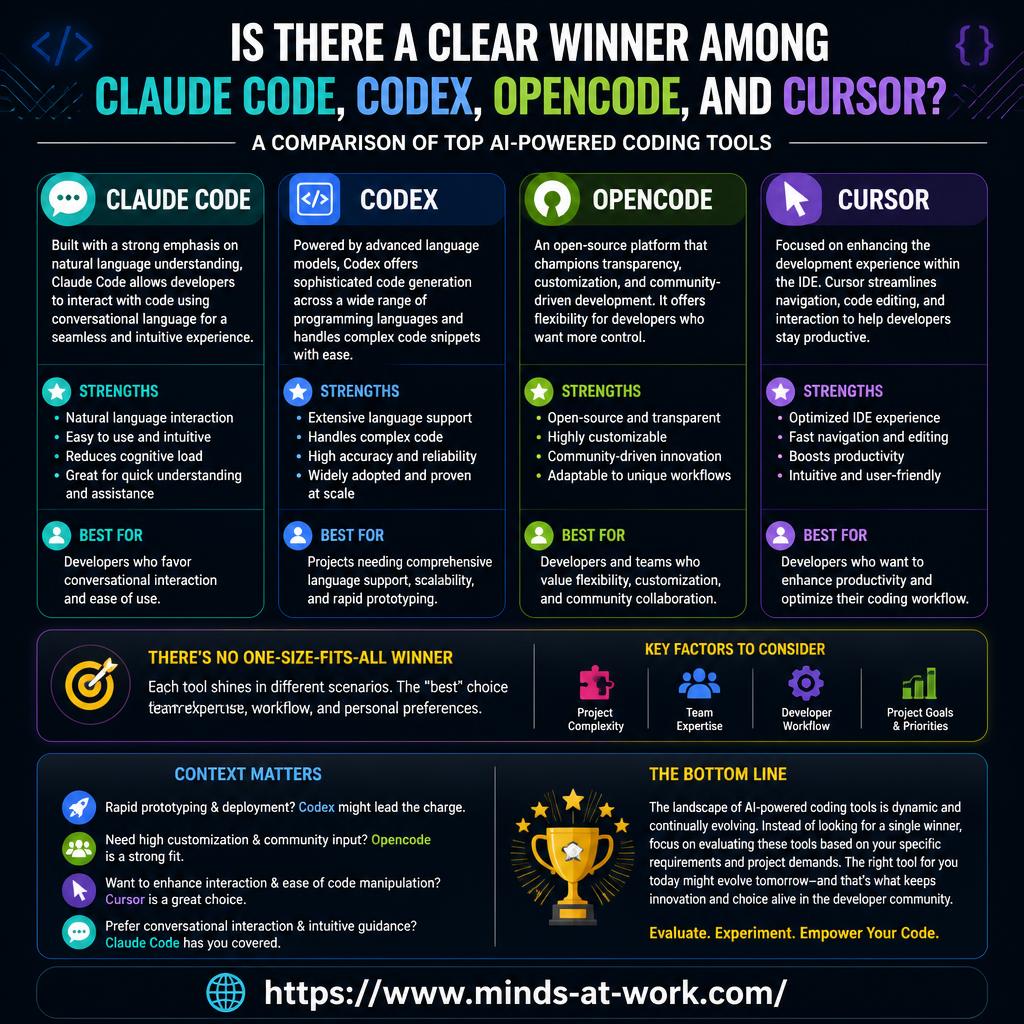
- The four scenario winners. Solo founder shipping fast → Cursor (Cursor Tab + AI-native IDE). Mid-market team on day-job work → Claude Code (plan-first + long context + SSO). Enterprise with regulated code or an open-source maintainer who needs self-host → Opencode (model freedom + MIT license). Team that wants to parallelize long autonomous runs → Codex (managed cloud sandbox).
- Mixing is normal, cheap, and often correct. Most teams running this seriously in 2026 use two of the four — an in-editor tool for interactive work and an agent/cloud tool for longer autonomous work. The series’s four differentiators compose; they do not conflict.
- The decision is reversible. Diffs are the universal interface. Prompts, rules, and
.mdplaybooks move between tools in minutes. The honest switching cost in 2026 is editor retraining (highest for Cursor), not model lock-in — pick the per-scenario winner now, revisit in six months.
The short answer: No, there is no overall winner — and asking the question that way is the mistake. There is a clear winner per scenario, because each of the four tools owns one load-bearing differentiator (Part 14) and real work maps cleanly onto one of them. Solo founder shipping fast → Cursor (Cursor Tab + an AI-native IDE is the highest moment-to-moment productivity in the series for one person). Mid-market team doing day-job work with reviews and SSO → Claude Code (plan-first synthesis, hundreds of thousands of tokens of context, enterprise defaults on day one). Enterprise with regulated code, or an open-source maintainer who needs self-host → Opencode (MIT license, agent runs locally, bring any model including open-weight). Team that wants to parallelize long autonomous runs → Codex (the only tool with a managed cloud sandbox as a first-class product surface). Pick the one that matches your work. Switch when the work changes.
Why isn’t there a single overall winner in 2026?
Because the category has commoditized on most axes, and no one tool wins on all of the remaining ones. This is a reporting result, not an opinion: across the thirteen axes measured in Parts 3–13, the four tools are statistically close on the ones that have commoditized — basic chat quality, mainstream-language coverage, inline completion for routine code, baseline agent loops — and each tool wins on exactly one or two of the axes that haven’t (Part 14).
Three concrete pieces of evidence from earlier in the series:
- Language-model quality has converged on the top end. Part 3 and Part 4 show that the frontier models driving these tools — Claude Opus/Sonnet, GPT-5 family, and whatever Opencode is pointed at — all land in the same correctness band on standard code benchmarks, within noise. The gap between “best model” and “second-best model” is smaller than the gap between “well-prompted session” and “poorly-prompted session” on the same model.
- Language support no longer differentiates on the top languages. Part 11 found that TypeScript, Python, Go, Rust, Java, C#, Ruby, and PHP all get first-class treatment from every tool in the series. The tail (Nim, Fortran, OCaml) is thin everywhere.
- Real-world code accuracy is close. Part 13 measured six axes of accuracy — compilation, tests passed, hallucinated APIs, semantic correctness, security defects, benchmark-vs-reality — and found no clean winner across the matrix. The differences are small enough that a prompt or a playbook change dominates the tool choice.
What is left — the four axes that haven’t commoditized — is exactly the four differentiators from Part 14: model freedom, long-context plans, cloud sandbox, Cursor Tab. Those four map cleanly to the four scenarios below. There is no single winner because there isn’t a single shape of work.
Who wins for a solo founder shipping fast?
Cursor. For one person building a new product with an editor open all day, Cursor Tab plus the AI-native IDE is the highest moment-to-moment productivity in this series.
Why:
- Cursor Tab predicts the next edit, not the next token. For a solo builder who edits across files, renames symbols, extracts components, and refactors as they go, Tab’s cross-file prediction turns ten keystrokes into one. (Part 14 has the mechanism; Part 6 has the completion comparison.)
- One surface, zero context switches. Inline Tab, inline ⌘K chat, Composer, Agent — all share the editor’s context. No alt-tabbing to a terminal, no copying code into a chat window. For solo flow, this is the single biggest win.
- The switching cost is irrelevant at team-of-one scale. The downside of Cursor is editor retraining and config lock-in. For a solo founder on their own repo, that cost is zero: there is nothing to retrain and no one else’s config to migrate.
Where Cursor loses this slot. The moment the solo founder hires their second engineer and that engineer doesn’t want to leave VS Code or JetBrains, re-evaluate. The scenario below (mid-market team) is where Claude Code starts to win.
Who wins for a mid-market SaaS team doing day-job work?
Claude Code. Ten to fifty engineers, a review-heavy workflow, mandatory SSO, and a lot of medium-complexity PRs — plan-first synthesis with long context and enterprise defaults is the shortest path to shipping without churn.
Why:
- Long-context planning fits review-first teams. Hundreds of thousands of tokens of code in a single prompt means Claude Code can read the relevant slice of your repo rather than guess. The explicit plan-before-diff pattern surfaces the design question before the 400-line diff lands in a reviewer’s queue. (Part 7 and Part 8 cover the mechanics.)
- Enterprise defaults ship on day one. SAML/OIDC SSO, SCIM provisioning, audit logs, per-user usage, seat-based billing — all on team and enterprise plans at claude.com/claude-code. For a mid-market CISO or Head of Eng, procurement is one call, not a quarter.
- CLI + plan file is review-friendly. The agent produces explicit diffs and plan files that drop cleanly into GitHub PRs. (Part 12 covers the collaboration side.)
Where Claude Code loses this slot. If the team has a hard “no single-vendor model lock-in” rule, flip to Opencode. If the team needs cloud background runs as a first-class pattern, pair Claude Code with Codex (see “Mixing” below).
Who wins for enterprise with regulated code, or an open-source maintainer who needs self-host?
Opencode. When the compliance team says “the model cannot touch an outside server” — healthcare, defense, finance, a sovereign-cloud requirement, or an OSS project with a hard self-host rule — Opencode is the only tool in this series that passes.
Why:
- Agent runs locally, period. Opencode is a local binary. Pointed at a local model via Ollama or an OpenAI-compatible local endpoint, every byte of code and every byte of response stays inside your perimeter. (Part 14 and Part 10 cover the mechanics.)
- Model freedom is a hard requirement, not a nice-to-have. When a regulator or a procurement team asks “what happens when your vendor deprecates its model?”, “we point at a new one in
opencode.json” is a complete answer. The vendor-locked tools can’t give that answer. - MIT license. Fork it, audit it, embed it. For a Fortune-500 security team, source-available with a permissive license is often the only path. The project is maintained by SST (github.com/sst/opencode) but your deployment of it never depends on their continued existence.
Where Opencode loses this slot. If you need SSO, SCIM, and audit as a vendor-managed service, Opencode makes you build it yourself. Teams without a platform engineer who can run that work should look at Claude Code or Codex instead and have the procurement conversation about data residency.
Who wins for a team that wants to parallelize long autonomous runs?
Codex. When the workflow is “hand off a 10-to-60-minute task, come back to a PR” — long refactors, test backfills, dependency upgrades, migration sweeps — Codex is the only tool in this series with a managed cloud sandbox as a first-class product surface.
Why:
- Cloud agent is the product, not an afterthought. Submit a task via web, API, or CLI. OpenAI spins up the isolated sandbox, runs the agent with execution feedback, and surfaces a PR. Documented at openai.com/codex. (Part 10 has the integration surface.)
- Bigger retry budget than any local CLI. The cloud agent will try, fail, read the error, and try again until the task completes or the budget runs out — because it isn’t competing with your foreground latte. For long autonomous work this is the single biggest win.
- Procurement-free for teams already on ChatGPT Enterprise. SSO, SCIM, audit, and billing inherit. If you already have ChatGPT Enterprise, Codex is one admin toggle, not a new vendor relationship.
Where Codex loses this slot. Interactive-latency work (inline tab completion) is competent but not Cursor-grade. For teams whose main pattern is “developer typing with the agent beside them,” pair Codex with Cursor or Claude Code (see “Mixing” below).
Can one team mix two of these tools without churn?
Yes — and most serious teams in 2026 do. The series’s four differentiators are orthogonal, not competing. The costs that make mixing painful in other categories (data duplication, auth sprawl, model drift) don’t apply here: diffs are the universal interface, and prompts, rules, and .md playbooks move between tools in minutes.
Three common pairings that work in practice:
- Cursor + Codex. A product team writes interactively in Cursor during the day, hands off long tasks (dependency bumps, test backfills) to Codex overnight. Diffs land as PRs; the team reviews in the morning.
- Claude Code + Codex. A mid-market SaaS team runs Claude Code in the terminal for review-first interactive work, and Codex in the cloud for background runs. Both share the OpenAI/Anthropic enterprise procurement model.
- Opencode + a vendor tool. A regulated team runs Opencode locally for anything that touches sensitive code and Cursor or Claude Code for everything else. The config file documents which paths route to which tool.
The one anti-pattern. Two in-editor tools for the same engineer (Cursor and VS Code with Claude Code’s extension both configured on the same repo). The models fight for the same shortcut keys and the UX degrades. Pick one in-editor tool per engineer; pair it with a non-editor tool for the complementary scenario.
What switches the per-scenario winner in 2027?
Three things to watch, in order of likelihood. None of them is “a new frontier model lands,” because Parts 3–4 show that model quality has already commoditized at the top end — the Part 15 verdict wouldn’t flip on a Claude or GPT point release.
- Opencode (or another MIT-licensed agent) ships managed SSO. The moment a self-hostable agent clears the enterprise-procurement bar out of the box, Opencode steals the mid-market slot from Claude Code. Watch for a hosted “Opencode Cloud” or a well-funded fork that bundles SAML and audit. Likelihood: moderate within 12 months.
- A vendor-locked tool ships a credible local-model mode. If Claude Code or Codex ships a documented local-inference path (open-weight model under a free license, running in your perimeter, with the vendor’s agent harness on top), Opencode loses the regulated-enterprise slot. Likelihood: low — the business incentive runs the other way — but non-zero.
- Cursor Tab becomes a feature of a non-Cursor editor. If VS Code or JetBrains ships cross-file edit prediction at Cursor Tab’s quality level, Cursor loses the solo-founder slot. Likelihood: low in 12 months, higher in 24.
What won’t change the verdict. A better benchmark score for any one model. A new chat UI. A larger context window on an already-long-context model. These are nice-to-haves that don’t touch any of the four load-bearing differentiators.
How should a reader actually use this verdict?
Three steps. This is the whole decision framework; it is deliberately short because the series did the hard work in Parts 3–14.
- Step 1 — Name the scenario. Pick one of the four above. If the real answer is “two,” pick the one that dominates your week by hours and start there.
- Step 2 — Pick the per-scenario winner. Not the one with the most buzz, not the one your friend uses — the one in the matrix above. For most readers that is Cursor, Claude Code, Opencode, or Codex in that order of likely fit.
- Step 3 — Revisit in six months. The honest switching cost is editor retraining (highest for Cursor) and playbook migration (low across the board). The decision is reversible. Re-run this exercise when the scenario changes — a hire, a compliance ask, a new workflow — not on a vendor release schedule.
Frequently asked questions
Is there any single tool that wins in 2026 if I can only pick one? No. The honest answer is “pick the one that matches the shape of your week,” and for most readers that is either Cursor (solo, interactive) or Claude Code (team, review-heavy). “Which is best” was a well-formed question in 2023 when the tools were further apart; in 2026 the differentiators are shape-of-work, not quality.
Will the winner change if OpenAI or Anthropic ships a new frontier model? Probably not. Parts 3 and 4 found model quality has commoditized at the top end — the gap between models is smaller than the gap between prompts. A new Opus or GPT release is a nice-to-have, not a verdict-flipper. What would flip the verdict is a packaging change: Opencode shipping managed SSO, or Claude Code shipping a credible local-model mode.
Can I use Opencode and still get enterprise SSO? Not out of the box in 2026. Opencode is a local binary; SSO, SCIM, and audit are things you (or your platform team) build around it. For most mid-market teams this is prohibitive; for regulated teams with a platform engineer who can run that work, it’s the only acceptable path. The “watch list” above tracks when this changes.
Is Codex the same as GitHub Copilot? No, and this is the single most common confusion. Today’s Codex is OpenAI’s agent product — a managed cloud sandbox and CLI, not an inline editor completion. GitHub Copilot in 2026 is a separate product line that runs on OpenAI and Anthropic models but doesn’t share Codex’s cloud-agent surface. The 2021 Codex model that originally powered Copilot was retired long ago. (Part 14 has the full correction.)
I run a hybrid team — some engineers in VS Code, some in JetBrains. Does Cursor still win the solo slot? Only if those engineers are willing to switch editors. Cursor is a VS Code fork; it doesn’t run as a plugin inside JetBrains. If editor neutrality is a hard requirement, use Claude Code (CLI) or Codex (CLI + web); both are editor-agnostic.
Does the verdict change if my team is non-English-speaking or works in non-English code comments? No. All four tools in the series handle non-English natural-language prompts and comments at parity. Code is code; identifiers in a non-English language get the same treatment as English identifiers. (Part 8 covers the NLP side.)
What if a Fractional CTO reviewed my team and recommended something different from this matrix? Trust them. A matrix captures the median case; a Fractional CTO who has seen your repo, your team shape, and your compliance surface will know what the matrix leaves out — a specific regulator, a specific legacy codebase, a specific hiring plan. The verdict here is the right default; the right answer for your team may be a well-reasoned exception.
The series finale, in one line
The clear winner in 2026 is the right scenario-tool pair, not a single tool. Pick the pair, ship the work, revisit in six months. If you want a second pair of eyes on which pair fits your team — the compliance surface, the hiring plan, the actual shape of your week — I run Fractional CTO engagements built to answer exactly that question. See the Fractional CTO page or get in touch directly. Thank you for reading all fifteen parts of this series.