Programming Languages Supported by AI Coding Tools (Part 11 of 15)
Part 11 of 15. Which languages Opencode, Claude Code, Codex, and Cursor actually handle well — the tier list, the long tail, and why the real question isn't the language, it's the tooling around it.
By Dr. Sanju Abraham, Fractional CTO, investor, multiple exits. Published October 27, 2026. Part 11 of a 15-part series: Comparing Opencode, Claude Code, Codex, and Cursor: Is There a Clear Winner?
New to the series? Part 1 — AI Code Generation and Developer Productivity. Part 2 — Overview of the four tools. Part 3 — The Role of Language Models. Part 4 — Deep Learning Foundations. Part 5 — Training Data and Code Quality. Part 6 — Code Completion Compared. Part 7 — Synthesis Techniques. Part 8 — NLP and Context Understanding. Part 9 — Speed and Efficiency. Part 10 — API Integration and Workflow Compatibility — how each tool plugs into your stack. This part answers the question that follows: how well does each tool handle the actual language your team ships in?
Key takeaways
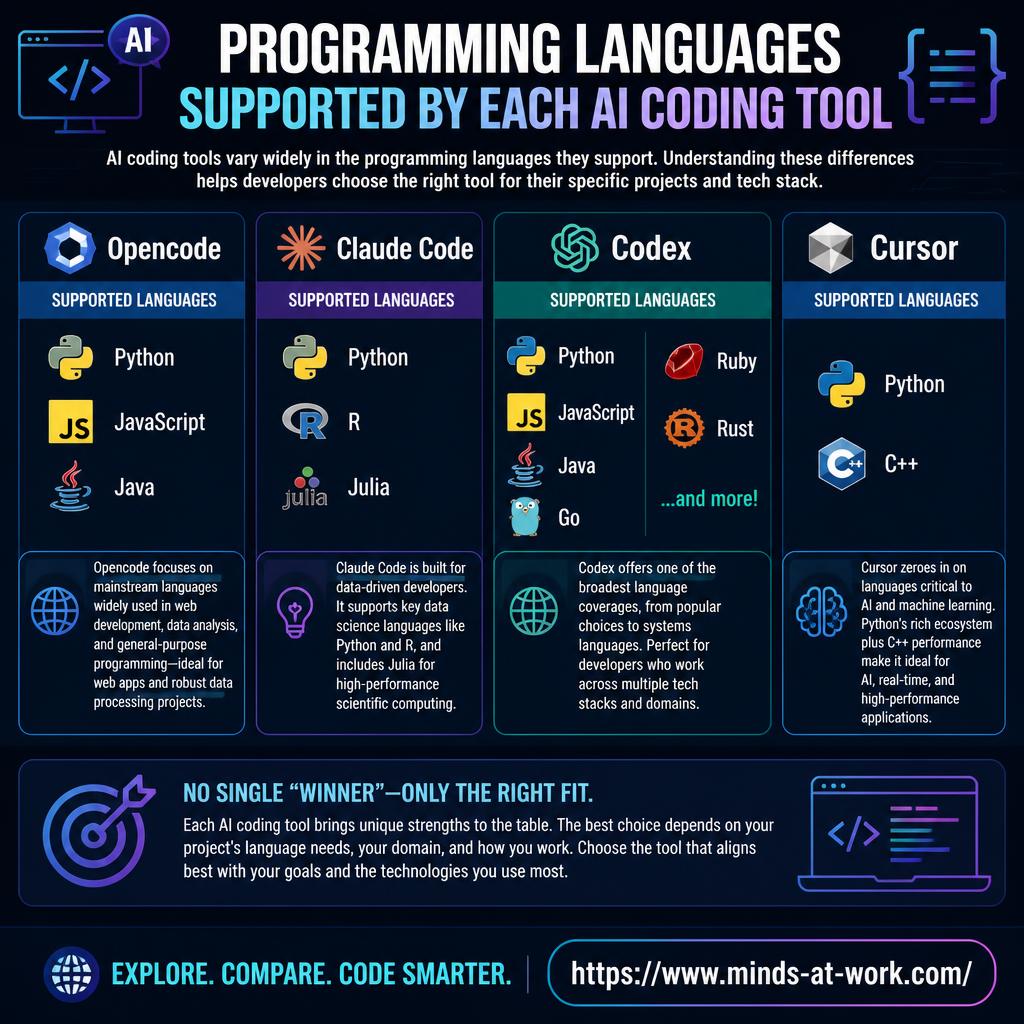
- Language coverage is a model property, not a tool property. Opencode, Claude Code, Codex, and Cursor all ride frontier models that handle every top-10 language well. The common framing that “Claude Code is for Python and R, Cursor is for Python and C++” is wrong — all four handle all of them.
- The honest tier list has three bands. Tier 1 (strong across all four): Python, JavaScript, TypeScript, Java, C/C++, Go, Rust, C#, SQL. Tier 2 (good, with occasional misses): Ruby, PHP, Swift, Kotlin, Scala, Dart, R, Shell. Tier 3 (weaker everywhere): Zig, Nim, Elixir, Erlang, OCaml, Haskell, Lean, Prolog, in-house DSLs.
- The real differentiators sit around the language, not inside it. Agent tool use for the language’s build system (
cargo,go test,pytest,mix test), ecosystem knowledge for popular frameworks, and IDE support for syntax and LSP.- Opencode wins the long tail by letting you swap models. When Tier 3 bites, the fix is often a model specialized for your language (DeepSeek-V3-Coder, Qwen Coder, StarCoder2, or a hand-tuned fine-tune) — only Opencode lets you point at that model while keeping the agent.
- Pick by the language your team ships, not the tool’s marketing language list. The real test is a two-day pilot on your own repo in your own language mix.
The short answer: In late 2026, “which languages does this AI coding tool support?” is nearly the wrong question. All four tools in this series — Opencode, Claude Code, Codex, Cursor — call frontier models with similar language coverage, so the answer is “all the ones you probably care about, with similar quality.” The real question is: how well does the tool handle the ecosystem around the language — the build system, the test runner, the popular frameworks, the IDE’s LSP for that language, and the agent’s willingness to run language-specific tools? This piece gives the honest three-tier language ranking, maps each tool’s ecosystem strengths, and ends with the two-day pilot that beats any language-support marketing page.
Why is “language support” the wrong question in late 2026?
Because the language is handled by the model, and the four tools in this series mostly share the same models. The old framing — “Tool A supports Python, Tool B supports JavaScript” — made sense for the autocomplete generation of 2021. It stopped being accurate in 2024 and is actively misleading in 2026.
Three reasons the framing broke:
- Frontier models cover every mainstream language. GPT-5-codex, Claude Opus, Gemini 2.5 Pro, and the open-weight DeepSeek-V3-Coder all handle Python, JavaScript, TypeScript, Java, C, C++, Go, Rust, C#, SQL, Ruby, PHP, Swift, Kotlin, Scala, Dart, and most of the next tier at usable quality out of the box. “Support” is a near-constant across tools.
- The tool wraps the model, not the compiler. Opencode, Claude Code, Codex, and Cursor are agent wrappers. The language expertise lives in the model layer underneath. If you swap Opencode’s model from Claude to GPT, the language quality tracks the model, not the wrapper.
- The real variation is around the language. How well does the agent run
cargo testversuspytestversusmix test? How well does it know your framework’s conventions? How well does the IDE highlight the syntax and surface diagnostics? Those are the real differentiators, and they are not what the word “support” usually means.
For the model-vs-wrapper distinction that explains why language quality is nearly uniform across the four tools, see Part 3 on the role of language models.
What is the honest three-tier language ranking for late 2026?
Three tiers, drawn by model quality on each language — not by which tool advertises it.
-
Tier 1 — Strong across all four tools, no caveats. Python, JavaScript, TypeScript, Java, C, C++, Go, Rust, C#, SQL (ANSI, PostgreSQL, MySQL, SQLite dialects). These are the languages with the largest training corpora and the most instruction-tuning data. Expect production-quality code generation, strong agent tool use, and solid framework knowledge.
-
Tier 2 — Good, with occasional misses. Ruby, PHP, Swift, Kotlin, Scala, Dart, R, Shell (bash/zsh/fish), HTML/CSS, YAML/JSON/TOML. Model quality is high; the misses are usually around newer frameworks or less-documented libraries. The agent will produce usable code; expect occasional review-time edits.
-
Tier 3 — Weaker everywhere; model-specific help matters. Zig, Nim, Elixir, Erlang, OCaml, F#, Haskell, Lean, Prolog, Fortran, Julia, Racket, Clojure, in-house DSLs, mainframe languages (COBOL, RPG), and any domain-specific language without a strong public corpus. The agent may hallucinate syntax, miss idiomatic patterns, or produce code that compiles but is not canonical. Mitigation: a model specialized for your language (where one exists) or a dedicated prompt library with examples the agent can mirror.
The honest consequence: the “winner” per language depends on your tier. For Tier 1 and most of Tier 2, pick based on the other axes in this series (speed, cost, integration). For Tier 3, model freedom becomes a hard requirement, which favors Opencode. For the model-swap lens on this, see Part 7 on synthesis techniques.
Where does each tool actually stand on language coverage?
All four tools match the model’s language tier; the differentiators sit around it.
- Claude Code — Claude’s language coverage. Tier 1 is strong, Tier 2 reliable, Tier 3 depends on how well Claude saw the language. No model routing per language.
- Codex — GPT’s language coverage. Tier 1 is strong, Tier 2 reliable, Tier 3 mirrors the GPT family’s language distribution. Cloud agent handles long multi-language tasks well in a single sandbox.
- Opencode — your choice. The agent runs against whichever model you point it at. For a Rust-heavy team, point it at DeepSeek-V3-Coder or Qwen Coder specialized for Rust; for a Python team, point it at Claude Sonnet. Model freedom is the whole pitch.
- Cursor — mixed. Cursor’s own small models (cursor-small, cursor-tab) are tuned mostly for the Tier 1 set and inline completion. Composer and Agent route to frontier Anthropic and OpenAI models for heavier work, inheriting their language coverage.
The implication for polyglot teams: a team that works mostly in Tier 1 and 2 languages is well-served by any of the four. A team with meaningful Tier 3 workload should pilot Opencode with a language-specialized model before committing to a vendor-locked tool.
How does framework and ecosystem knowledge compare?
The language is only half the story. Framework idioms, build systems, and ecosystem conventions are the other half — and they vary more across tools than the raw language does.
Four ecosystem dimensions where tools differ in late 2026:
- Framework idioms. React patterns, Django ORM, Rails conventions, Spring annotations, FastAPI dependency injection — the frontier models all know the top frameworks per language. Niche or very new frameworks are weaker; this is where retrieving the framework’s own docs via MCP (see Part 10) pays off.
- Build and test tool use. Can the agent run
pytest,go test ./...,cargo test,mix test,rspec, ornpm testand read the output correctly? Codex and Claude Code have the strongest default tool-use setups; Opencode matches when configured; Cursor runs these inside its editor-aware agent. - Package managers. Does the agent know when to use
pip install,uv,poetry,npm/pnpm/bun,cargo add,go get,mix deps.get? Frontier models know; the agent needs permission to actually run them, which is a tool-use question, not a language question. - Linter and formatter conventions. Will the generated code pass your
ruff,eslint,clippy,gofmt,rustfmt, orbiomeconfig out of the box? Tools with strong repo awareness (Cursor’s semantic index, Claude Code’s long-context reads — see Part 8) usually do better here because they can see the config.
The common blocker is almost never “the model does not know the language” — it is “the agent does not know your conventions for the language.” Mitigation lives at the context layer, not the model layer.
What about domain-specific and in-house languages?
Domain-specific languages (DSLs) are Tier 3 almost by definition — public training data is thin, so the model guesses. For in-house DSLs (your query language, your config format, your workflow language), the model has seen zero data unless you explicitly provide it.
Three patterns that work in late 2026:
- Point the agent at the DSL’s grammar and docs. MCP servers that serve the DSL’s grammar file, example snippets, and documentation turn a Tier 3 language into a near-Tier 2 one. Opencode and Claude Code are the strongest fits because of their MCP support.
- Give the agent a prompt library. A small, curated library of (intent, DSL snippet, explanation) examples that the agent can read before generating code. Works even on tools without native MCP.
- Fine-tune a small open model. For high-volume DSL work (think: your in-house query language running at scale), fine-tuning an open-weight model on your DSL corpus is affordable in 2026 and gives much better results than any frontier model’s zero-shot attempt. Opencode is the natural wrapper to serve that fine-tune through.
For the model-choice framing that this maps to, see Open-weight decision models.
When does language choice actually decide the tool?
When your team’s primary language is Tier 3, or when you have a load-bearing DSL, language considerations should drive the pick. Otherwise, the five-variable pick from Part 1 still rules.
- Primary language is Tier 1 or 2 → language is not the deciding factor. Pick based on surface (IDE vs terminal), cost, integration, or team shape. All four tools will handle Python, TypeScript, Java, Go, Rust well enough that other axes dominate.
- Primary language is Tier 3 → model freedom wins. Opencode pointed at a language-specialized model (DeepSeek-V3-Coder for Rust, open-weight Elixir fine-tunes, StarCoder2 for broad long-tail) outperforms vendor-locked tools on your language, often by a lot.
- Heavy in-house DSL work → MCP + prompt library + possibly a fine-tune. Opencode and Claude Code are the natural fits because their MCP support lets you plug in the DSL’s grammar and examples.
- Polyglot team spanning multiple tiers → consider model routing per language. With Opencode, you can route Python work to a cheap Haiku-class model and Rust work to a Rust-specialized model. The vendor-locked tools don’t give you that lever.
A clean, product-forward 'pick-by-tier' infographic on an off-white background. Three pill-shaped tiles arranged horizontally, each a soft shade. Tile 1 pale emerald 'TIER 1 OR 2 → PICK BY OTHER AXES (any of the four)'. Tile 2 pale sand 'TIER 3 → OPENCODE WITH A SPECIALIZED MODEL'. Tile 3 pale blue 'IN-HOUSE DSL → OPENCODE OR CLAUDE CODE + MCP'. Short tagline above: 'Pick by where your language lives on the tier list'. Palette: off-white background, pale slate borders, pale emerald accent, pale sand accent, pale blue accent, navy ink. Linear or Stripe editorial feel. No AI robots.
- Aspect ratio: 16:9
- Source size: 1280 × 720 px (sharp on retina at 760 px display width)
- Format: PNG
- Target file size: under 500 KB
Save to /public/images/blog/<slug>/, then set
src and alt on this <MediaFigure /> to swap it in. Keep the ratio prop so the browser reserves the right space.
Frequently asked questions
Which AI coding tool supports the most programming languages?
In late 2026, the four tools in this series — Opencode, Claude Code, Codex, Cursor — all handle the same top-20 languages well, because they call frontier models with similar language coverage. “The most languages” is a near-tie. The real differentiator is Tier 3 (long-tail languages and in-house DSLs), where Opencode wins because you can swap in a model specialized for your language. For mainstream work, pick based on surface, cost, and integration — not language count.
Does Claude Code support Python and R better than other tools?
Not noticeably. Claude Code runs Anthropic’s Claude model family, which has strong coverage across Python, R, and most Tier 1 and 2 languages — but so do GPT (behind Codex), Gemini, and the frontier open-weight coders. Any claim that Claude Code is “the tool for Python and R” overstates a near-uniform baseline. Pick based on surface and workflow fit; language quality is a wash for mainstream work.
Which tool is best for Rust, Go, or systems programming?
For mainstream Rust and Go, any of the four tools handles the language well. The quality gap you feel is usually a wrapper problem — agent tool use for cargo test / go test, Clippy / go vet integration, and framework idioms — not a language problem. For Rust kernel-driver work or exotic Go generics patterns, pointing Opencode at a Rust- or systems-specialized model often beats the vendor-locked defaults.
Can these tools handle in-house DSLs?
Only if you give them context. Zero-shot, every frontier model will guess at your in-house DSL’s syntax because it saw no training data for it. The pattern that works: use Model Context Protocol (MCP) to serve the DSL’s grammar, example snippets, and documentation to the agent, so it can mirror the real syntax instead of inventing one. Opencode and Claude Code have the strongest MCP support in late 2026.
Which tool is best for data science and machine learning?
For Python-centric data science and ML, all four tools handle the core libraries (pandas, numpy, scikit-learn, PyTorch, TensorFlow, JAX) well — this is Tier 1 territory. Cursor’s inline tab completion is often the strongest in a Jupyter-style flow because of in-editor latency. Codex’s cloud agent is strong for long training-script generation or data-pipeline work. Claude Code and Opencode are strong on terminal-first workflows. Pick by workflow shape, not by vendor language-support marketing.
Does Cursor only handle Python and C++?
No. Cursor supports every language VS Code supports — which is nearly all of them — because Cursor is a VS Code fork. Any claim that Cursor is “a Python and C++ tool” is reading too much into its AI/ML messaging. The underlying inline-tab model (cursor-tab) is tuned mostly for the Tier 1 language set; Composer and Agent route to frontier models that cover everything the frontier models cover.
How can I evaluate a tool’s language support for my team?
Run a two-day pilot on your own repository in your own language mix. Pick five representative tasks per language — one scaffold, one refactor, one bug fix, one test suite, one framework-specific feature — and run each tool against them. Measure: did the generated code compile, pass the existing tests, follow your conventions, and need fewer than three reviewer edits? Those answers predict long-term fit better than any vendor language-support list.
If you are picking an AI coding tool for a team whose language mix spans Tier 1 and Tier 3 — or includes a load-bearing in-house DSL — and the wrong default will show up as weeks of lost productivity, that is the kind of nuance a one-hour Fractional CTO call is for. For more pieces in this series as it publishes, follow the AI Strategy archive; the broader frame on where AI fits in a small or mid-market software business sits in AI strategy for SMB owners.