NLP and Context Understanding in AI Coding Tools (Part 8 of 15)
Part 8 of 15. The six NLP capabilities that decide whether an AI coding tool actually understands your prompt — and how Opencode, Claude Code, Codex, and Cursor stack up on each.
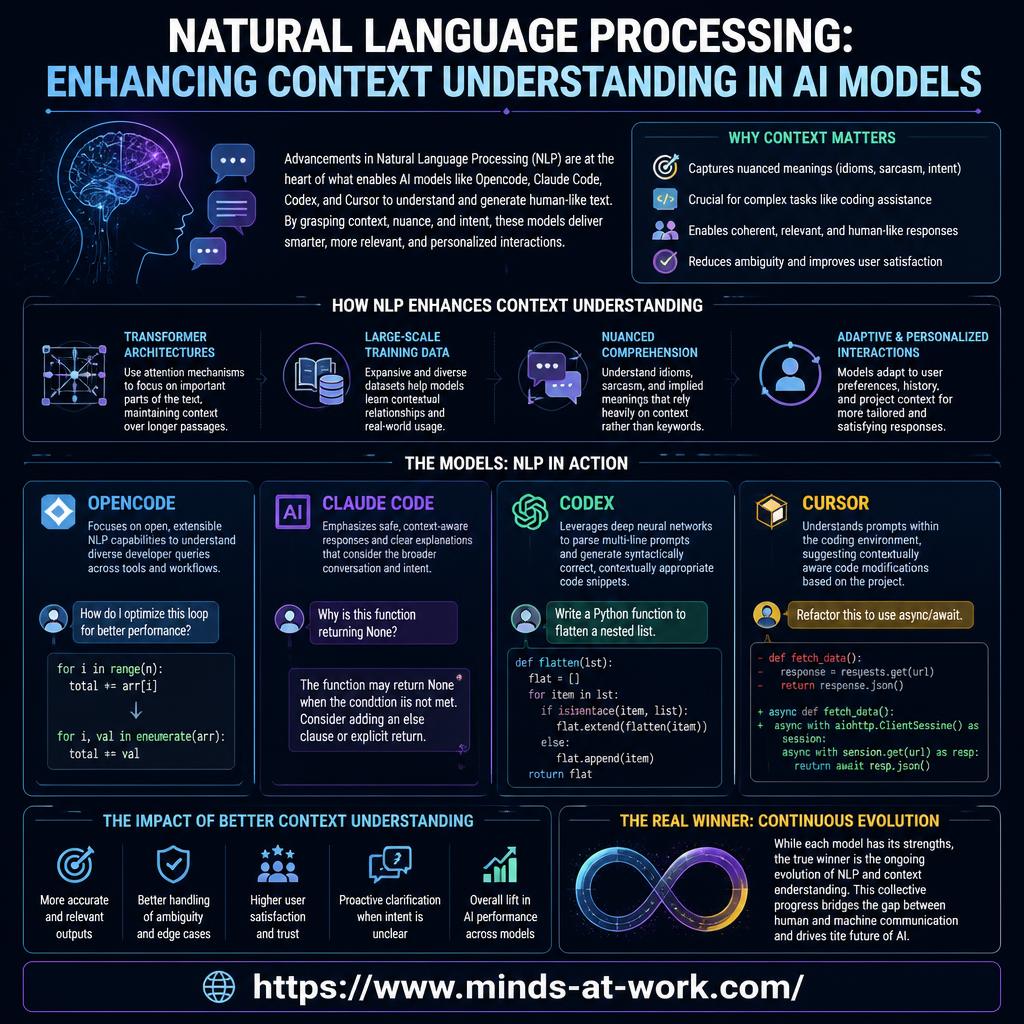
By Dr. Sanju Abraham, Fractional CTO, investor, multiple exits. Published October 24, 2026. Part 8 of a 15-part series: Comparing Opencode, Claude Code, Codex, and Cursor: Is There a Clear Winner?
New to the series? Part 1 — AI Code Generation and Developer Productivity. Part 2 — Overview of the four tools. Part 3 — The Role of Language Models. Part 4 — Deep Learning Foundations. Part 5 — Training Data and Code Quality. Part 6 — Code Completion Compared. Part 7 — Synthesis Techniques — the six-step synthesis pipeline. This part zooms into one specific slice of that pipeline: how well each tool actually understands what you say.
Key takeaways
- “NLP” inside a coding tool means six specific capabilities, not a vague “it understands you.” Prompt parsing, repository awareness, project awareness, conversation memory, ambiguity resolution, and multilingual handling — any serious comparison names them.
- Prompt parsing is nearly a solved problem across the four tools. Any frontier model behind Opencode, Claude Code, Codex, or Cursor will parse “add rate limiting to all public endpoints” correctly. The differentiation is downstream.
- Repository and project awareness are where the real divergence lives. Whether a tool “knows” your
tsconfig.json, your framework version, and your in-house naming conventions decides whether the generated code slots in or clashes.- Clarification behavior matters more than most teams admit. A tool that asks “do you mean the handler at X or the one at Y?” is often more useful than one that confidently picks the wrong answer.
- No one tool wins on every NLP axis. Pick the one whose strengths match the interactions you actually have — mostly short prompts, mostly long conversations, mostly multilingual team, mostly one framework.
The short answer: The “natural language processing” that matters for an AI coding tool in late 2026 is not the generic NLP of chatbots — it is a specific set of six capabilities that decide whether the tool understands your prompt in the context of your codebase. The four tools in this series — Opencode, Claude Code, Codex, Cursor — all ride transformer-based language models with strong baseline NLP, so simple-prompt parsing is nearly a non-issue. The real differentiation lives in repository awareness, project awareness, conversation memory, and clarification behavior. This piece defines each of the six capabilities, scores each tool on each one, and ends with the common pitfalls teams hit when they confuse “the model understands English” with “the tool understands my codebase.”
What are the six NLP capabilities that matter for AI coding tools?
Any honest comparison of context understanding across coding tools starts by naming the capabilities being compared. The six that matter in late 2026:
- Prompt parsing. The tool extracts intent from a natural-language instruction. “Add rate limiting to the public API” becomes a clear task with constraints. Nearly solved for simple prompts; still fragile for compound instructions with implicit scope.
- Repository awareness. The tool reads surrounding code, follows naming conventions, respects existing patterns (dependency injection style, error-handling idioms, logging format). The difference between “code that passes CI” and “code the reviewer merges without edits.”
- Project awareness. The tool knows the language version, framework version, lint rules,
tsconfig/pyproject.toml/Cargo.toml, and the shape of the dependency graph. This is why a Python 3.12 project does not get Python 2 syntax. - Conversation memory. The tool carries context across turns in a session — “the function we just discussed,” “the file you edited last,” “the error from three turns ago.” Different wrappers manage this very differently.
- Ambiguity resolution. The tool recognizes when a prompt could mean two things and either asks or picks defensibly. Silent wrong choices are more expensive than slow right ones.
- Multilingual handling. The tool parses prompts in Spanish, French, Mandarin, or code-mixed English+local as cleanly as pure English. Matters more for international teams than vendor demos suggest.
For the companion piece on the broader synthesis pipeline this NLP layer feeds, see Code Synthesis Techniques (Part 7).
Why is “the model understands English” not enough?
Because understanding English and understanding your codebase in English are different problems — and the second is where coding tools win or lose.
A frontier model can parse “add retry logic with exponential backoff” perfectly. What that becomes in your codebase depends on four things the model does not know from the prompt alone:
- Your retry library choice. Do you use
tenacity,backoff, a hand-rolled helper, or the framework’s built-in? The prompt does not say. - Your error taxonomy. What counts as “retryable” in your service? Timeouts? 5xx? A specific exception class?
- Your logging and metrics conventions. Does retry logic emit a metric? To which registry? With what labels?
- Your test patterns. Do you add a unit test that asserts the retry happens N times? An integration test? Both?
A tool with strong repository awareness answers these without being asked, by reading surrounding code and matching its style. A tool with weak repository awareness produces plausible, generic code that the reviewer sends back for a rewrite. This is the gap that separates “the model understands English” from “the tool understands my project.”
How well does each tool handle repository and project context?
Repository and project context are where the four tools diverge most visibly — and where the right answer depends on your repo size and your framework.
- Claude Code. Pulls files on demand into a long context window. Strong on reading many files at once; the agent decides what to read. Weaker on background indexing — if you want it to “just know,” you have to tell it where to look.
- Codex. Reads on demand with grep and file tools; the cloud agent gets a bigger working context budget than the local CLI. Strong once pointed at the right files; same “tell it where to look” quirk.
- Opencode. Pluggable — supports Model Context Protocol (MCP) servers for structured retrieval. You can wire it to an embeddings index, a repo-wide symbol graph, or an in-house context source. Quality tracks the setup.
- Cursor. Maintains a persistent semantic index of the open workspace. Composer and Agent consult the index without the user naming files. On large repos this is often the sharpest-feeling tool because the index is already there.
The practical implication for team shape: teams on very large monorepos usually feel Cursor’s semantic index first; teams on smaller repos with strong conventions feel Claude Code’s long-context reads first; teams with specialized retrieval needs (vector DB of docs, custom symbol graph) usually land on Opencode with a tuned MCP setup. For the training-data layer that shapes this behavior, see Part 5.
Why does conversation memory matter in a coding session?
Because real coding sessions span dozens of turns — and a tool that forgets what you discussed three turns ago makes you re-explain, which erases the productivity gain.
Three signals of good conversation memory:
- The tool knows what “it” refers to. “Make it async” works when the model remembers which function you just edited.
- The tool holds decisions across turns. “Use Postgres, not SQLite” said once at the top of a session should hold for every subsequent code suggestion in that session.
- The tool compresses gracefully as the session grows. Long sessions eventually exceed the context window; the wrapper has to summarize or forget. Good compression keeps load-bearing decisions; bad compression drops them silently.
Where the tools differ: Claude Code and Cursor both do explicit session management — the terminal session and the Composer thread, respectively, carry history until you reset. Codex’s cloud agent carries context through a long task but the local CLI resets more aggressively. Opencode’s memory behavior depends on the model and the wrapper configuration — a strong default pattern is possible, but you own the setup.
The honest consequence: for exploratory, back-and-forth work (“explore this file, then refactor it, then write tests, then run them”), tools with explicit session memory feel sharper. For one-shot tasks, the difference is small.
How does ambiguity handling separate the strong tools from the weak ones?
A tool that silently picks the wrong interpretation of an ambiguous prompt is worse than a tool that pauses to ask. This is the single most under-weighted NLP axis in most procurement decisions.
Three concrete ambiguity patterns coding tools face every day:
- “Fix the bug in the handler.” Which handler? The one you were just looking at? The one the stack trace points to? All of them?
- “Add tests for this.” Unit tests? Integration tests? What is “enough” coverage for your team’s standards?
- “Make it faster.” Optimize for latency, throughput, cold-start, or memory? Different optimizations are often mutually exclusive.
Strong behavior: the tool detects the ambiguity, picks a defensible default, and tells you what it picked. Weaker behavior: the tool picks silently and you discover the misinterpretation at review time. The weakest behavior: the tool asks about everything and turns a one-sentence prompt into a twenty-question interrogation.
In late 2026, no tool is perfect at this. Claude Code and Cursor tend to narrate their assumptions (“I’ll apply this to the handler at app/api/users.ts — let me know if you meant another one”). Codex and Opencode narrate when the model does; when the model does not, the wrapper mostly stays out of the way. Your team’s tolerance for narration vs. silent action should steer the pick.
When does multilingual handling actually matter?
Mostly for international teams who prompt in their native language, and for codebases where comments, docs, or UI strings are not in English. For English-only teams on English codebases, this axis is close to a tie.
Three real-world scenarios where it matters:
- Spanish-speaking team, English codebase. Developer prompts in Spanish (“añade validación al endpoint de registro”); the generated code and comments stay in English per repo convention. All four tools in this series handle this well because the underlying frontier models were multilingual-trained.
- Code review in a non-English language. The agent explains its diff in the reviewer’s language (“he añadido validación de email usando zod porque es la biblioteca que usas en otros endpoints”). Opencode shines here because you can point it at a model specifically fine-tuned for your language.
- Mixed-language docstrings or UI strings. The codebase has Spanish docstrings or French UI strings; the agent should preserve them when editing. This is where tools occasionally slip — Cursor and Claude Code are stronger because their default is “match surrounding style.”
For a related piece on team-level AI adoption that spans language and skill levels, see AI strategy for SMB owners.
What are the common pitfalls teams hit with context understanding?
Three pitfalls account for the majority of “this tool doesn’t understand us” complaints.
- Pitfall 1: Confusing “the model understands English” with “the tool understands my project.” The frontier models all parse English well. The gap teams actually feel is repository and project awareness, which is a wrapper problem, not a model problem.
- Pitfall 2: Over-indexing on first-prompt impressions. A tool that nails your first “write a function to…” prompt may struggle on your tenth-turn exploratory session. Evaluate on real workflows, not demos.
- Pitfall 3: Ignoring ambiguity cost. A tool that is 95% correct and silent on the 5% is often worse than a tool that is 85% correct and asks about the 15% — because the silent 5% ships to review and gets caught (or not) by a reviewer who assumed the model knew.
The practical move: in your pilot, deliberately test ambiguous prompts and multi-turn sessions, not just the clean ones. The tool that handles those well is the one worth the switching cost. For the deeper framing on how pilots-before-procurement decide these picks, see Your first decision model experiment.
A clean, product-forward three-row scorecard infographic on an off-white background with columns PITFALL, SYMPTOM, and MITIGATION. Row 1 pale slate: 'MODEL ≠ TOOL' — 'generic code the reviewer rewrites' — 'test repo awareness in pilot'. Row 2 pale emerald: 'FIRST-PROMPT BIAS' — 'tool nails demo, fails on turn 10' — 'test multi-turn sessions in pilot'. Row 3 pale sand: 'SILENT AMBIGUITY' — 'wrong-but-plausible code ships to review' — 'prefer tools that narrate assumptions'. Short tagline above: 'The three NLP pitfalls, honestly named'. Palette: off-white background, pale slate borders, pale emerald accent, pale sand accent, navy ink. Linear or Stripe editorial feel. No AI robots.
- Aspect ratio: 16:9
- Source size: 1280 × 720 px (sharp on retina at 760 px display width)
- Format: PNG
- Target file size: under 500 KB
Save to /public/images/blog/<slug>/, then set
src and alt on this <MediaFigure /> to swap it in. Keep the ratio prop so the browser reserves the right space.
Frequently asked questions
What is natural language processing in the context of AI coding tools?
Natural language processing (NLP) in AI coding tools is the set of capabilities that let the tool understand prompts, code, and conversations written in natural language. In late 2026 it covers six specific capabilities: prompt parsing, repository awareness, project awareness, conversation memory, ambiguity resolution, and multilingual handling. All four tools in this series — Opencode, Claude Code, Codex, Cursor — ride transformer-based language models with strong baseline NLP; the differentiation is in the wrapper around the model, not in the raw NLP of the model itself.
Why does context understanding matter so much for code generation?
Because the same English prompt can map to many different pieces of correct code depending on the surrounding codebase, framework, and conventions. “Add retry logic” is unambiguous as English and ambiguous as code — the tool needs to know your retry library, your error taxonomy, your logging conventions, and your test patterns. Tools with strong repository and project awareness produce code the reviewer merges; tools with weak awareness produce plausible-looking generic code that gets sent back for a rewrite.
Which AI coding tool has the best context understanding?
There is no single best tool across every NLP axis. Cursor usually feels sharpest on large repos because of its persistent semantic workspace index. Claude Code feels sharpest on medium repos because of its long-context reads. Codex feels strongest on long autonomous runs where context is accumulated across many steps in a sandbox. Opencode can match any of them with the right MCP setup, but the quality tracks the setup. Pick by your repo size and the shape of your sessions.
Do these tools understand prompts in languages other than English?
Yes, all four tools in this series inherit the multilingual capabilities of the frontier models they call. Spanish, French, German, Mandarin, Japanese, and most other widely-spoken languages are handled well on prompts; the generated code and comments stay in whatever language the codebase conventions dictate. For code reviews or explanations in a non-English language, Opencode has a small edge because you can point it at a model specifically fine-tuned for your target language.
How does conversation memory work across different AI coding tools?
Each tool manages memory differently. Claude Code holds history through a terminal session until you reset. Cursor holds Composer thread history across turns, with the editor as the primary surface. Codex holds state through a cloud-agent task but resets the local CLI more aggressively. Opencode memory tracks the model and the wrapper configuration. For exploratory, back-and-forth work, tools with explicit session memory feel sharper; for one-shot tasks the difference is small.
What happens when I give an AI coding tool an ambiguous prompt?
It depends on the tool. Claude Code and Cursor tend to narrate assumptions — “I’ll apply this to the handler at app/api/users.ts; let me know if you meant another one.” Codex and Opencode narrate when the underlying model does, which varies by model. In 2026 no tool is perfect at this. The failure mode to avoid is a tool that picks silently and lets you discover the wrong choice at review time, which is more expensive than a short pause to clarify.
How can I evaluate a tool’s context understanding before committing?
Run a two-day pilot on your own repository with real tasks and watch for four signals. First, does the tool follow your in-house naming and style conventions without being asked? Second, does it respect your framework and language versions? Third, does it carry context through a ten-turn session or does it forget? Fourth, does it narrate when a prompt is ambiguous or silently pick an interpretation? These four signals, run on your real repo rather than on a benchmark, are the clearest leading indicator of long-term fit.
If you are picking an AI coding tool for a team and the context-understanding differences between tools are what will make or break the week-two experience, that is the kind of nuance a one-hour Fractional CTO call is for. For more pieces in this series as it publishes, follow the AI Strategy archive; the broader frame on where AI fits in a small or mid-market software business sits in AI strategy for SMB owners.