Code Generation Speed and Efficiency: Opencode, Claude Code, Codex, Cursor (Part 9 of 15)
Part 9 of 15. The six real speed-and-efficiency metrics for AI coding tools — first-token latency, task completion time, token efficiency, cost per task, review burden, and code quality — scored across Opencode, Claude Code, Codex, and Cursor.
By Dr. Sanju Abraham, Fractional CTO, investor, multiple exits. Published October 25, 2026. Part 9 of a 15-part series: Comparing Opencode, Claude Code, Codex, and Cursor: Is There a Clear Winner?
New to the series? Part 1 — AI Code Generation and Developer Productivity. Part 2 — Overview of the four tools. Part 3 — The Role of Language Models. Part 4 — Deep Learning Foundations. Part 5 — Training Data and Code Quality. Part 6 — Code Completion Compared. Part 7 — Synthesis Techniques. Part 8 — NLP and Context Understanding — the six capabilities behind “the tool understands your project.” This part turns to the practical trade-off every procurement conversation reaches: how fast, and at what cost.
Key takeaways
- “Speed” is three different metrics, and “efficiency” is three more. First-token latency, streaming speed, and task completion time are the real speed axes; token cost, review burden, and code quality are the real efficiency axes. Confusing them is the single most common procurement error.
- Cursor wins on first-token latency. The purpose-built cursor-small models and in-editor pipeline put ghost text on screen in under 100 ms for most prompts. No terminal-first tool matches that.
- Codex wins on long autonomous task throughput. The cloud sandbox lets a single task run for 10–60 minutes without blocking the developer — which is a different kind of “fast” than low latency.
- Opencode wins on token-cost control. Model freedom means you can route easy tasks to a cheaper model (open-weight, Haiku, GPT-4o-mini) and reserve frontier models for hard work.
- Code quality is the one axis where the model matters more than the wrapper. All four tools can produce excellent code with a frontier model, and all four can produce mediocre code with a weak one.
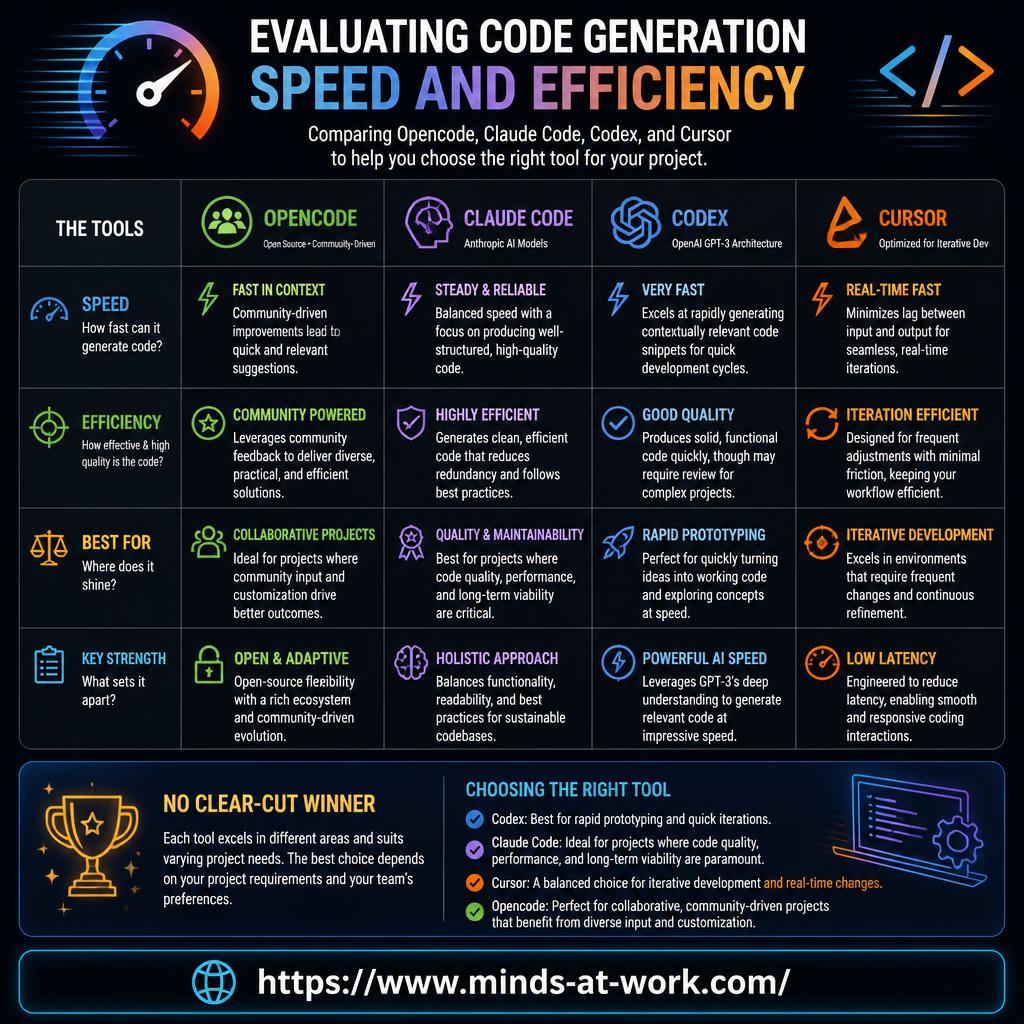
The short answer: AI coding tool “speed” and “efficiency” are not two numbers — they are six, and procurement teams that treat them as two end up buying the wrong tool. Speed splits into first-token latency (how fast ghost text appears), streaming speed (tokens per second), and task completion time (wall-clock for an agentic job). Efficiency splits into token cost per task, human review burden per PR, and code quality (how often the generated code actually ships without rewrite). The four tools in this series — Opencode, Claude Code, Codex, Cursor — each win on different metrics, and the honest pick depends on which of the six matters most for your workload. This piece defines each metric, scores the tools, and ends with the common pitfalls teams hit when they conflate the metrics.
What are the six real metrics behind “speed and efficiency”?
Every honest comparison starts with naming the metrics being compared — otherwise “speed and efficiency” degrades to vendor marketing. The six that matter in late 2026:
- First-token latency (TTFT). Time from prompt to first visible character. Dominates the feel of interactive work — inline tab completion, short chat edits. Under 300 ms feels instant; above 1 s feels sluggish.
- Streaming speed (tokens per second). How fast the model emits text after the first token. Matters for long outputs: multi-file generation, long explanations, test suites.
- Task completion time. Wall-clock from prompt to a reviewable diff for a full task (“add rate limiting to all public endpoints”). The honest metric for agentic work.
- Token cost per task. Dollars spent on API tokens to complete a typical task. Scales with how many files the agent reads, how many retries it does, and which model it calls.
- Human review burden. Minutes a human reviewer spends per PR before approving or asking for changes. Rarely measured, often the biggest hidden cost.
- Code quality. Does the generated code actually ship? Measured by review-approval rate, post-merge defect rate, and the frequency of “the agent made my test pass by deleting the assertion” surprises.
The honest ordering: first-token latency and task completion time dominate the feel. Token cost per task and human review burden dominate the bill. Code quality is the long-term differentiator, but is slower to measure and harder to attribute to a specific tool.
For the earlier parts that set this up, see Part 6 on completion modes and Part 7 on synthesis techniques.
How does first-token latency compare across the four tools?
Cursor is the clear leader on first-token latency in late 2026, by a wider margin than any other speed axis. The purpose-built cursor-small and cursor-tab models are optimized for interactive latency, not for raw capability.
- Cursor — inline tab completions typically appear in 50–150 ms in warm sessions; Composer first-token for chat edits is 200–500 ms depending on model.
- Claude Code — IDE plugin ghost text typically 200–400 ms; terminal chat first-token 400–800 ms depending on model variant.
- Codex — IDE extension and CLI first-token comparable to Claude Code’s; the cloud agent has higher startup latency because of sandbox cold-start.
- Opencode — depends entirely on the model you call. Pointed at a fast local model (Qwen Coder, DeepSeek-V3-Coder, or a hosted small model), latency is competitive; pointed at a frontier model, it inherits that model’s latency.
The practical implication: developers whose day is dominated by interactive back-and-forth should default to Cursor. Developers running mostly long agentic tasks won’t notice first-token latency at all — the next three metrics will matter more.
How does task completion time compare for agentic work?
Task completion time is where the four tools look most different — because they are optimizing for different task shapes.
- Cursor Composer / Agent — fast for mid-sized tasks inside the editor. The semantic workspace index means less time spent discovering context. Weaker on tasks that span many terminal commands.
- Claude Code — fast on plan-first tasks because the long-context read lets the agent pull in everything it needs in one pass. Weaker when the task requires many iterations of run-fail-fix.
- Codex — the local CLI is competitive with Claude Code on wall-clock. The cloud agent is the differentiator: it runs a 10–60 minute task in the background while you work on something else. That is a different kind of “fast” — not latency, but throughput.
- Opencode — tracks the model and context setup. On a strong configuration (Claude Sonnet via MCP context, aggressive tool use), it matches the vendor tools; on a weak configuration, it does not.
The common error: teams compare “task completion time” across tools by running the same prompt on each. That only measures the tool whose shape fits that prompt best. The honest comparison runs the tools against representative tasks from your actual backlog.
How does token cost per task actually scale?
Token cost per completed task is the metric that most often surprises teams after the first month on an AI coding tool. The input-token side is usually larger than the output-token side, and both scale with how aggressively the agent reads files and retries.
Three cost drivers teams underestimate:
- Context size. The agent reads files to understand the task; those files are input tokens. A task that touches 20 files in a 4K-token-each repo is 80K input tokens before the agent writes a single character.
- Retry depth. Reflexion-style self-correction (see Part 7) is a quiet multiplier. A task that fails three times and succeeds on the fourth is paid for all four attempts.
- Model routing. A tool that calls a frontier model for every subtask is more expensive than one that routes small jobs to a cheap small model. Cursor and Codex route opaquely; Opencode exposes the choice; Claude Code lets you pick per task.
Where each tool lands on cost:
- Opencode — lowest ceiling because you can pick any model, including open-weight ones you self-host. Best for cost-controlled production workloads.
- Claude Code — usage-based pricing on Claude’s model family; cost tracks the model you pick. Enterprise plans with volume discounts bring the effective rate down.
- Codex — usage-based on GPT models; cloud-agent runs can accumulate significant tokens on long tasks because the sandbox persists more context.
- Cursor — subscription with included frontier-model usage up to a limit; above the limit, usage-based. The subscription model is predictable; the overage model needs tracking.
For a related framing of how to think about cost in the broader AI-category purchase, see AI strategy for SMB owners.
Why does human review burden deserve its own metric?
Because a tool that generates code 3× faster but takes 3× longer to review has a net productivity gain of zero. Review burden is the under-measured half of the efficiency equation.
Three concrete review-burden factors:
- Diff size. A small, surgical diff is faster to review than a 400-line rewrite. Tools that favor diff synthesis over full-file rewrites (see Part 7) win here.
- Code style match. Code that matches the project’s conventions reviews quickly (“yep, same as everything else”). Code that doesn’t invites nitpicks (“why
letnotconsthere?”) that eat reviewer minutes. - Confidence in correctness. Agent-generated code that passes tests + static analysis + lint reviews faster than agent-generated code that only “looks right.” Tools that run checks inline before surfacing the diff save reviewer time.
The honest observation for late 2026: Claude Code and Cursor are the two tools whose default output most consistently respects project conventions, in large part because of their stronger repo awareness (see Part 8). Codex and Opencode close the gap when configured well.
How should teams actually measure speed and efficiency?
Run a two-week pilot that measures all six metrics on representative tasks from your own backlog, not on synthetic benchmarks. The four questions a pilot should answer:
- What is the median first-token latency and task completion time for our top three task shapes? Measure in your actual environment, not in a vendor demo.
- What is the median token cost per task, and how does it scale across the three task shapes? Pull from vendor dashboards or from your own token-counting instrumentation.
- How many reviewer-minutes per PR does each tool generate? Track this in your code-review tool for two weeks per tool.
- What is the review-approval rate — percentage of agent PRs that merge without a human-authored edit? The clearest single leading indicator of long-term fit.
Two pilot pitfalls to avoid:
- Don’t compare on synthetic prompts. HumanEval and MBPP are useful for frontier-model research; they are almost useless for picking a wrapper for your repo.
- Don’t ignore the human side. The “faster” tool is often the one that fits your team’s habits, not the one that wins the benchmarks.
For the deeper framing on pilots-before-procurement — including the dual-write pattern — see Your first decision model experiment.
When does each tool win on speed and efficiency?
Pick by the metric that matters most for your workload shape.
- Default to Cursor when you work inside an IDE and the day is dominated by interactive back-and-forth. First-token latency wins because that is what you feel every minute.
- Default to Codex when your workload includes long autonomous tasks you can hand off and come back to. The cloud agent’s throughput is the differentiator.
- Default to Claude Code when you want balanced wall-clock on mid-sized tasks, high code quality on first pass, and enterprise cost predictability. The long-context read saves retries.
- Default to Opencode when token cost control is a hard requirement — because volume is high, because budgets are tight, or because you want the option to self-host a cheaper open-weight model for the easy work.
For teams split across workloads, the common 2026 pairing is Cursor (for interactive latency) + Codex or Claude Code (for long tasks). The combined bill is justified when the two tools own non-overlapping metrics.
A clean, product-forward 'pick-by-metric' infographic on an off-white background. Four pill-shaped tiles arranged in two rows, each a soft shade: pale slate 'INTERACTIVE LATENCY → Cursor', pale emerald 'LONG BACKGROUND TASK THROUGHPUT → Codex', pale blue 'BALANCED WALL-CLOCK + QUALITY → Claude Code', pale sand 'TOKEN COST CONTROL → Opencode'. A thin emerald rule connects them. Short tagline above: 'Pick by the metric that matters most'. Palette: off-white background, pale slate borders, pale emerald accent, pale blue accent, pale sand accent, navy ink. Linear or Stripe editorial feel. No AI robots.
- Aspect ratio: 16:9
- Source size: 1280 × 720 px (sharp on retina at 760 px display width)
- Format: PNG
- Target file size: under 500 KB
Save to /public/images/blog/<slug>/, then set
src and alt on this <MediaFigure /> to swap it in. Keep the ratio prop so the browser reserves the right space.
Frequently asked questions
Which AI coding tool is the fastest?
There is no single “fastest” tool because “speed” is three different metrics. Cursor is fastest on first-token latency, with sub-150 ms ghost text in most interactive sessions. Codex is fastest on long autonomous tasks because its cloud agent runs for 10–60 minutes in the background while the developer works on something else. Claude Code sits in the middle with strong wall-clock on mid-sized tasks. Opencode tracks whichever model you plug in. Pick by which kind of “fast” matters for your day.
What is the token cost per task for AI coding tools?
Highly variable, driven by three factors: how many files the agent reads, how many retries it performs, and which model it calls. A single mid-sized task (10–20 files touched, 2–3 retries, frontier model) typically costs cents to low single-digit dollars on vendor-managed tools in late 2026. Opencode is lowest-ceiling because you can route easy tasks to cheap or self-hosted models. Cursor is most predictable because of its subscription model up to a limit. Teams at scale should track per-task cost in their vendor dashboards.
Why is review burden a speed metric?
Because the full productivity equation is generation time + review time, not just generation time. A tool that generates code twice as fast but produces diffs that take twice as long to review has a net productivity gain of zero. Review burden is the under-measured half of the equation; teams running serious pilots should track reviewer-minutes per PR for each tool over at least two weeks. Tools that match project conventions and favor small diffs over full-file rewrites usually win here.
Does faster code generation mean lower code quality?
Not necessarily in late 2026. The historical “fast = sloppy” trade-off has mostly dissolved: the fastest interactive models (Cursor Tab, cursor-small) are small and fast and good at the narrow job of in-editor completion, while the strongest agentic models (Claude Opus, GPT-5-codex) are slower but produce higher-quality long-form code. The real trade-off in 2026 is between latency (which favors small models) and capability (which favors large models) — and modern tools route per task to get both.
How can I measure speed and efficiency for my own team?
Run a two-week pilot that captures six numbers: median first-token latency, median task completion time, median token cost per task, median reviewer-minutes per PR, review-approval rate without human edits, and post-merge defect rate. Measure on representative tasks from your own backlog, not on synthetic benchmarks like HumanEval. Pull token-cost data from each vendor’s usage dashboard; pull review-burden data from your code-review tool. Those six numbers decide more than any marketing page.
Does Codex still use GPT-3?
No. The original 2021 Codex model was a GPT-3 derivative, retired in 2023. The current Codex product is OpenAI’s coding agent built around the GPT-5 model family (GPT-5-codex and siblings), with a CLI and a managed cloud sandbox. Any claim that “Codex is GPT-3” in 2026 is working from very old information — the agent product and the retired model share only the name.
What is the single biggest cost mistake teams make with AI coding tools?
Ignoring token cost per task until the first month’s bill arrives. Vendor dashboards report tokens, but most teams never set a per-task or per-developer budget alert; the first signal that costs are out of control is a surprise invoice. The fix is simple and front-of-pilot: pick a per-task budget during the pilot (“under $0.50 per completed task is green; above $2.00 is red”), instrument it with the vendor’s usage API, and alert when a team member crosses the red line twice in a day.
If you are picking an AI coding tool for a team in the next ninety days and the speed-vs-cost trade-off needs to be right the first time — because the overrun will show up as a budget line in Q1 — that is the kind of nuance a one-hour Fractional CTO call is for. For more pieces in this series as it publishes, follow the AI Strategy archive; the broader frame on where AI fits in a small or mid-market software business sits in AI strategy for SMB owners.