Code Accuracy of AI Coding Tools: Real-World Performance (Part 13 of 15)
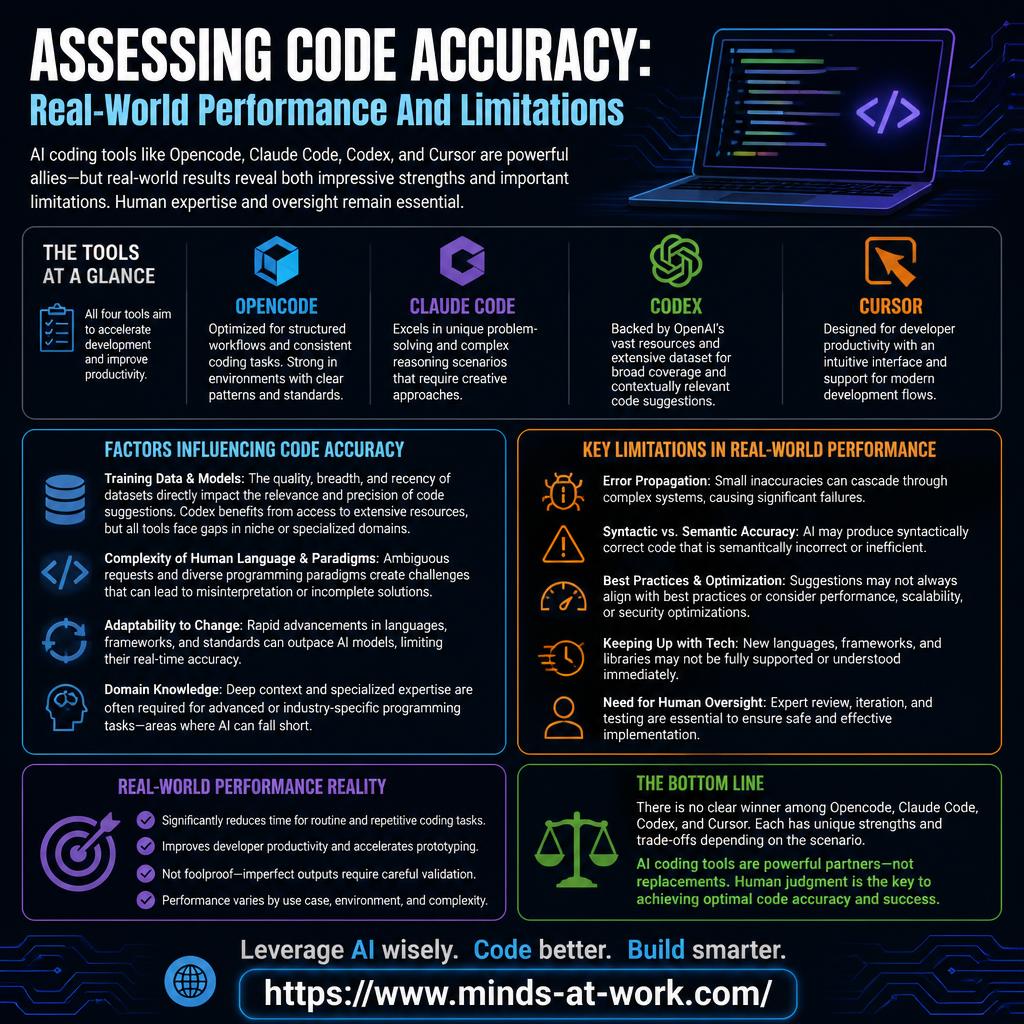
Part 13 of 15. The six axes of real-world code accuracy for Opencode, Claude Code, Codex, and Cursor — compile rate, test-pass rate, hallucination rate, semantic correctness, security defects, and the benchmark-vs-reality gap.
By Dr. Sanju Abraham, Fractional CTO, investor, multiple exits. Published October 29, 2026. Part 13 of a 15-part series: Comparing Opencode, Claude Code, Codex, and Cursor: Is There a Clear Winner?
New to the series? Part 1 — AI Code Generation and Developer Productivity. Part 2 — Overview of the four tools. Part 3 — The Role of Language Models. Part 4 — Deep Learning Foundations. Part 5 — Training Data and Code Quality. Part 6 — Code Completion Compared. Part 7 — Synthesis Techniques. Part 8 — NLP and Context Understanding. Part 9 — Speed and Efficiency. Part 10 — API Integration and Workflow Compatibility. Part 11 — Programming Languages Supported. Part 12 — Collaboration Features — the six real teamwork capabilities. This part turns to the question every procurement conversation eventually reaches: how accurate is the code these tools actually produce?
Key takeaways
- “Code accuracy” is six axes, not one. Compile/parse rate, test-pass rate, hallucination rate, semantic correctness, security defect rate, and the benchmark-vs-reality gap. A procurement conversation that treats accuracy as a single number ends up buying on vendor-run demos.
- Benchmarks like HumanEval and SWE-bench are useful signals, not procurement answers. All four tools in this series post strong numbers on the common public benchmarks; those numbers correlate only loosely with your repo.
- Hallucinated APIs are the single most common accuracy failure in late 2026. The agent confidently calls a function, flag, or header that does not exist. Mitigation is tool use — run the code, read the error — not better prompting.
- Semantic correctness is the hardest axis to measure. Code that compiles, tests, and reads cleanly can still do the wrong thing. Only human review catches “I did what you literally asked, not what you meant.”
- Security correctness has no good public benchmark yet. All four tools can produce code with SQL injection, path traversal, or secret-leaking logs — the mitigation is static analysis in CI, not vendor choice.
The short answer: Code accuracy from AI coding tools in late 2026 is a six-axis measurement, not a one-number verdict. Compile/parse rate and test-pass rate are the easiest to measure and the most commonly reported. Hallucination rate — fabricated APIs, flags, and imports — is the single most common failure mode in production. Semantic correctness (did the code do what you meant?) is the hardest to measure. Security correctness has no mature public benchmark. The benchmark-vs-reality gap — the difference between HumanEval or SWE-bench scores and performance on your own repo — explains most of the “it looked great in the demo and failed in week two” stories. All four tools in this series — Opencode, Claude Code, Codex, Cursor — are competitive on compile and test rates; the differentiators sit elsewhere. This piece walks each axis, scores the tools honestly, and ends with the two-week pilot that measures what actually matters.
What are the six real axes of code accuracy?
Any serious comparison of AI coding tool accuracy names the axes being compared — otherwise “accurate” collapses into vendor marketing. The six that matter in late 2026:
- Compile and parse rate. Does the generated code compile (for compiled languages) or parse without a syntax error (for interpreted ones)? Baseline capability; all frontier models clear this most of the time on Tier 1 languages (see the three-tier ranking in Part 11).
- Test-pass rate. Does the generated code pass the tests the agent generated for it, and the existing tests already in the repo? This is where reflexion-style self-correction earns its keep (see Part 7).
- Hallucination rate. Does the agent fabricate functions, flags, HTTP headers, or imports that look plausible but do not exist? The single most common failure mode in late-2026 agentic coding.
- Semantic correctness. Does the code do what the developer meant, not just what they literally asked for? The hardest axis to measure and the one that reviewer judgment catches most of.
- Security defect rate. How often does the agent introduce real security vulnerabilities — SQL injection, path traversal, broken crypto defaults, secret-leaking logs? No mature public benchmark; teams measure this via SAST in CI.
- Benchmark-vs-reality gap. How far does the tool’s public benchmark score fall when it meets your repo? Usually a lot further than vendor marketing suggests.
For the training-data layer that shapes most of these axes, see Part 5 on training data and code quality.
How accurate is the code in practice? What the benchmarks actually tell us
All four tools post strong numbers on the common public benchmarks — and those numbers tell you less than they appear to. The honest 2026 ranking of public benchmarks by usefulness:
- HumanEval (OpenAI, 2021) — 164 small Python problems. Nearly saturated by frontier models in 2024; a score below 90% in 2026 is a red flag, a score at 95% is uninformative.
- MBPP (Google, 2021) — 974 crowd-sourced Python problems. Similar saturation; useful as a sanity check, not a decider.
- SWE-bench (Princeton, 2023) — real GitHub issues from popular Python repos, graded by whether the fix passes the project’s own tests. Much more realistic than HumanEval; frontier agents in late 2026 score 50–70% on SWE-bench Verified. This is the benchmark that correlates best with production usefulness.
- LiveCodeBench (community, 2024) — competitive-programming problems updated monthly, with contamination controls. Useful for measuring reasoning on novel problems.
- BigCodeBench (BigCode, 2024) — 1,140 practical Python tasks that use real libraries. Fills the gap between HumanEval and SWE-bench.
The honest reading: aggregate benchmark scores for the frontier models behind Opencode, Claude Code, Codex, and Cursor are close enough that benchmarks alone cannot pick a winner. The real variation is in the wrapper’s agent loop (see Part 7) and in how the tool handles your repo (see Part 8).
Why do hallucinated APIs cause so many real-world accuracy failures?
Because the model’s job is to predict plausible tokens, and plausible-looking function calls are easy to generate even when the function does not exist. Hallucinated APIs are the single most common failure mode in production agentic coding.
Three patterns worth naming:
- Fabricated library functions. “Call
logger.log_json()” when the library only haslogger.log(). The method name is plausible; the model guessed. Catch rate without tool use: low. Catch rate with “actually run the import and call”: high. - Fabricated CLI flags. “Run
aws s3 cp --parallel” when--parallelis not a real flag. Catch rate without tool use: very low — the agent writes shell that looks right but errors at runtime. - Fabricated HTTP headers or API fields. “Set
X-Rate-Limit-Policy” when the vendor’s spec has no such header. Catch rate without tool use: often zero until a user reports the API returning an error.
The mitigation is tool use, not better prompting. An agent that actually runs the generated code, reads the error output, and iterates — the reflexion pattern — catches hallucinations the prompt alone cannot prevent. All four tools in this series support reflexion; Codex and Claude Code are the most aggressive about using it in long tasks.
What is the benchmark-vs-reality gap, and why does it matter?
The gap between a tool’s public benchmark score and its performance on your repo is almost always larger than vendor marketing suggests — and the gap is where procurement decisions go wrong.
Three concrete reasons the gap exists:
- Benchmark problems are self-contained. HumanEval and MBPP tasks come with their own tests and no surrounding codebase. Real tasks require reading surrounding code, respecting conventions, and matching project patterns — none of which the benchmarks measure.
- Benchmark problems have been seen. Any benchmark published before a model’s training cutoff is partially memorized. SWE-bench Verified mitigates this with careful contamination controls, but even then the agent has often seen the repos.
- Benchmark problems are English-first and Tier-1-language-first. Real workloads span Spanish-speaking teams on Tier 2 and Tier 3 languages (see Part 11); benchmarks optimize for the easy case.
The practical rule: halve the benchmark score when forecasting real-world performance on your repo. A tool reporting 65% on SWE-bench will likely land around 30–40% on first-try task success on your actual tickets, and that is before you factor in your team’s conventions.
For the companion piece on how to read vendor-reported quality claims — equally applicable to coding benchmarks — see Be careful with “beats Jev”.
How dangerous is error propagation across agent runs?
Error propagation — the agent builds on a wrong assumption, which produces more wrong code, which the next step builds on — is the second-biggest source of production accuracy failures. The failure mode: a single misread of surrounding code becomes a 400-line diff that is internally consistent and externally wrong.
Three patterns teams see in late 2026:
- Wrong library assumption. The agent assumes you use
requests; you actually usehttpx. The whole generated module usesrequests.get(...), which looks right in isolation and fails on the firstpip install. - Wrong framework version. The agent writes code for Pydantic v1; you use v2. Half the imports break; the fix touches every file the agent wrote.
- Wrong error-handling convention. The agent catches generic
Exception; your repo convention is specific exception classes with structured logging. Code works, but reviewer sends it back for the full rewrite.
Mitigation lives in context assembly (see Part 7) and in reflexion loops that run tests early. Tools with strong repo awareness (Cursor’s semantic index, Claude Code’s long-context reads) catch wrong-library assumptions earlier; tools with aggressive test-first iteration (Codex, Claude Code) catch wrong-version assumptions in the retry loop.
When does code accuracy actually decide the tool pick?
Accuracy differences between the four tools matter most on long autonomous runs and least on short interactive edits. The pick depends on the shape of the work.
- For short interactive edits (inline tab completion, one-shot chat edits), all four tools are competitive on accuracy. Pick on surface, latency, and cost — covered in Parts 6 and 9.
- For medium-sized agentic tasks (one PR per task), accuracy differences become visible but are often smaller than the gap between a strong prompt and a weak one. Pick on synthesis technique — covered in Part 7.
- For long autonomous runs (ten-plus minutes of agent work), error propagation and hallucination resistance dominate. Claude Code and Codex currently have the strongest default behaviors here; Opencode matches when configured with a strong model and aggressive reflexion; Cursor’s background modes are competitive but less emphasized.
- For security-sensitive code, no tool is “safe by default.” SAST in CI, security review, and secret scanning are mandatory regardless of which tool you pick.
The procurement test: run a two-week pilot on your own repo, with your own prompts, and measure the three numbers that actually predict long-term fit — review-approval rate, post-merge defect rate, and reviewer-minutes per PR. Those numbers do more work than any benchmark page.
A clean, product-forward three-row scorecard infographic on an off-white background with columns ACCURACY FAILURE, HOW YOU SEE IT, and MITIGATION. Row 1 pale slate: 'HALLUCINATED API' — 'ModuleNotFoundError or wrong-method AttributeError' — 'tool use + run the code'. Row 2 pale sand: 'ERROR PROPAGATION' — 'internally consistent 400-line diff that is externally wrong' — 'strong context assembly + test-first iteration'. Row 3 pale emerald: 'SILENT SEMANTIC MISS' — 'code compiles, tests pass, but it does the wrong thing' — 'human review of intent, not just syntax'. Short tagline above: 'The three accuracy failures that bite in production'. Palette: off-white background, pale slate borders, pale emerald accent, pale sand accent, navy ink. Linear or Stripe editorial feel. No AI robots.
- Aspect ratio: 16:9
- Source size: 1280 × 720 px (sharp on retina at 760 px display width)
- Format: PNG
- Target file size: under 500 KB
Save to /public/images/blog/<slug>/, then set
src and alt on this <MediaFigure /> to swap it in. Keep the ratio prop so the browser reserves the right space.
Frequently asked questions
Which AI coding tool produces the most accurate code?
There is no single most-accurate tool across every workload. On aggregate benchmarks (HumanEval, MBPP, SWE-bench), the frontier models behind the four tools score close enough that benchmarks cannot pick a winner. On long autonomous runs, Claude Code and Codex currently have the strongest default behavior for reflexion-based self-correction. On interactive edits, all four are competitive. On security-sensitive code, no tool is “safe by default” — SAST in CI is mandatory regardless.
Are AI coding tool benchmarks like HumanEval useful?
Partially. HumanEval is a 164-problem Python benchmark saturated by frontier models in 2024; a score below 90% is a red flag, a score at 95% is uninformative. SWE-bench Verified is the most useful public benchmark in late 2026 because the problems are real GitHub issues from popular Python repos. All benchmarks correlate loosely with your repo — the practical rule is to halve the benchmark score when forecasting real-world first-try task success on your own code.
What is the biggest source of inaccuracy in AI-generated code?
Hallucinated APIs — functions, flags, HTTP headers, and imports that look plausible but do not exist. The model’s job is to predict plausible tokens, and plausible-looking function calls are easy to generate. The mitigation is tool use (actually run the code, read the error, iterate) rather than better prompting. All four tools in this series support this reflexion pattern; Codex and Claude Code are the most aggressive about using it in long autonomous tasks.
Why does the same AI coding tool work well in a demo but poorly on my repo?
Because the benchmark-vs-reality gap is real. Benchmark problems are self-contained, often memorized, and English-first-Python-first; your repo has conventions, surrounding code, framework versions, and in-house patterns the benchmarks do not measure. The gap narrows if the tool has strong repo awareness (Cursor’s semantic index, Claude Code’s long-context reads), MCP context providers for your internal docs, and in-repo rules/prompts that encode “how we do things here.”
How often do AI coding tools produce insecure code?
More often than teams realize. All four tools can produce code with SQL injection, path traversal, broken crypto defaults, insecure deserialization, or secret-leaking logs — because the training corpora include that pattern alongside the safe one. No mature public benchmark measures this; the mitigation is static application security testing (SAST) in CI, security review of agent-generated PRs, and never giving an agent irreversible shell access without a human sign-off.
Can I rely on AI coding tools to catch their own mistakes?
Partially, through reflexion-style self-correction (the agent writes code, runs tests, reads failures, revises, retries). This catches many compile and test failures, especially on well-structured codebases with existing tests. It does not catch semantic errors (code that compiles and tests but does the wrong thing), security defects, or hallucinations that don’t trip a runtime error. Human review remains the highest-leverage mitigation for the failures the reflexion loop misses.
How should I measure code accuracy for my team?
Run a two-week pilot on your own repo and track three numbers: review-approval rate (percentage of agent PRs that merge without a human-authored edit), post-merge defect rate (bugs attributed to agent output in the first 30 days after merge), and reviewer-minutes per PR (how long a human spends reviewing each agent PR). Measure on representative tasks from your actual backlog, not on synthetic benchmarks. Those three numbers predict long-term fit far better than any vendor-reported HumanEval score.
If you are picking an AI coding tool for a team in the next ninety days and the accuracy trade-offs — hallucination tolerance, security review burden, benchmark-vs-reality gap — need to be understood before procurement, that is the kind of nuance a one-hour Fractional CTO call is for. For more pieces in this series as it publishes, follow the AI Strategy archive; the broader frame on where AI fits in a small or mid-market software business sits in AI strategy for SMB owners.