Unique Strengths of Opencode, Claude Code, Codex, and Cursor (Part 14 of 15)
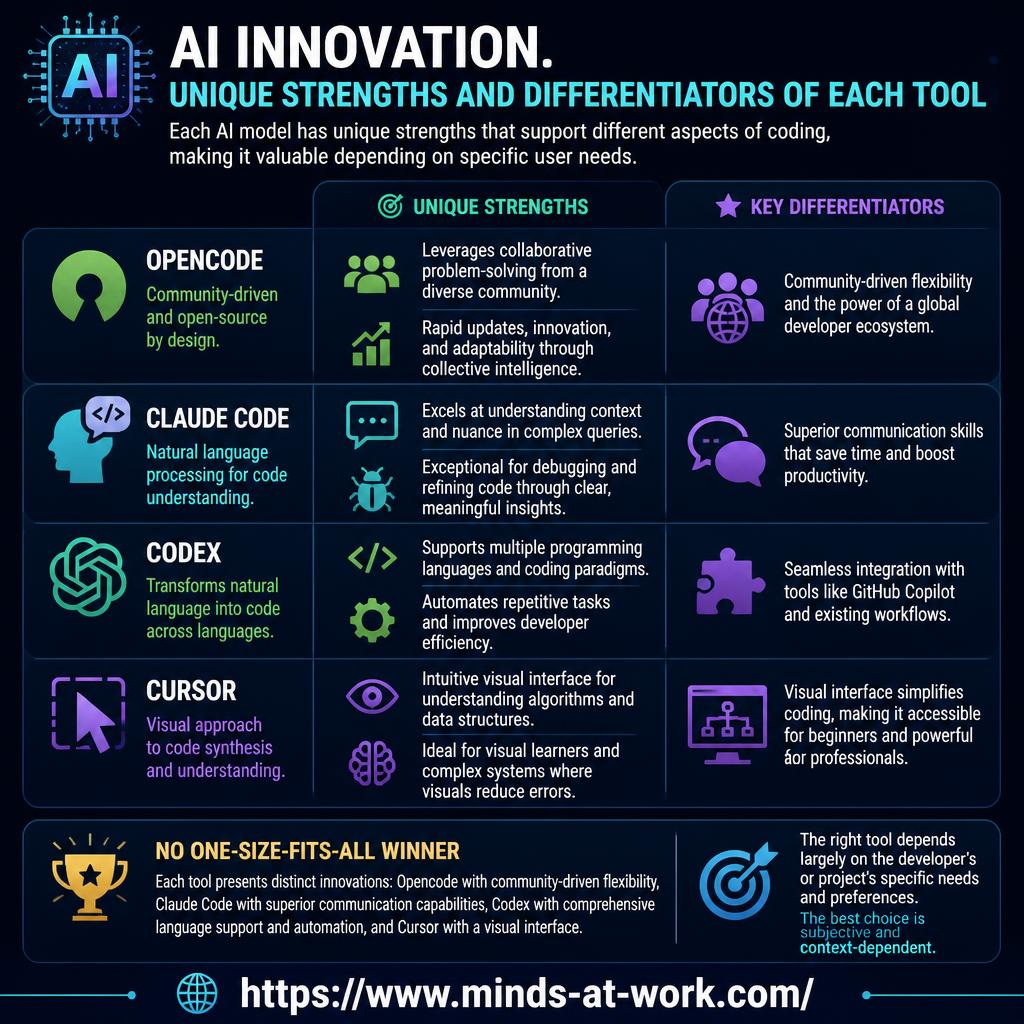
Part 14 of 15. One sentence per tool: the real differentiator that remains after thirteen parts of comparison — model freedom for Opencode, long-context plans for Claude Code, cloud background runs for Codex, in-editor Tab for Cursor.
By Dr. Sanju Abraham, Fractional CTO, investor, multiple exits. Published October 30, 2026. Part 14 of a 15-part series: Comparing Opencode, Claude Code, Codex, and Cursor: Is There a Clear Winner?
New to the series? Part 1 — AI Code Generation and Developer Productivity. Part 2 — Overview of the four tools. Part 3 — The Role of Language Models. Part 4 — Deep Learning Foundations. Part 5 — Training Data and Code Quality. Part 6 — Code Completion Compared. Part 7 — Synthesis Techniques. Part 8 — NLP and Context Understanding. Part 9 — Speed and Efficiency. Part 10 — API Integration and Workflow Compatibility. Part 11 — Programming Languages Supported. Part 12 — Collaboration Features. Part 13 — Code Accuracy — the six measurable axes. This part is the before-the-verdict capstone: one sentence per tool on the differentiator that actually remains after thirteen parts of comparison. Part 15 names the winners per scenario.
Key takeaways
- Opencode’s real differentiator is model freedom + MIT license. The agent runs on your machine against any model you point it at — the only tool in the series where swapping models or self-hosting is a config change, not a migration.
- Claude Code’s real differentiator is long-context planning + enterprise defaults. Hundreds of thousands of tokens of code in a single prompt, plan-first synthesis with explicit diffs, SSO and audit on day one.
- Codex’s real differentiator is the managed cloud sandbox for background runs. Hand off a 10-minute to 1-hour task via API or web, come back to a PR — the only tool in the series that treats long autonomous work as a first-class product surface.
- Cursor’s real differentiator is Cursor Tab in an AI-native IDE. A purpose-built small model that predicts the next edit across lines and files, inside a VS Code fork where every AI feature shares the editor’s context.
- Three widespread myths that the source essay for this part repeats, and that this series has corrected: Claude is not confirmed to be named after Claude Shannon; today’s Codex is OpenAI’s agent product, not the 2021 model inside the original GitHub Copilot; Cursor is not a visual/no-code tool — it is a text-based AI-native IDE.
The short answer: After thirteen parts of comparison, each of the four tools in this series has exactly one differentiator that is both verifiable and load-bearing. Opencode owns model freedom — MIT license, agent runs locally, bring any model including open-weight. Claude Code owns long-context planning + enterprise defaults — hundreds of thousands of tokens in one prompt, plan-first synthesis, SSO on day one. Codex owns the managed cloud sandbox — hand off a long autonomous task, come back to a PR. Cursor owns Cursor Tab in an AI-native IDE — a purpose-built small model that predicts the next edit across lines and files. Everything else — language coverage, chat quality, basic agent behavior — has largely commoditized in 2026. The real differentiators are the four above. This piece makes the case for each in one section, corrects three widespread myths, and sets up Part 15’s verdict.
What is Opencode’s real differentiator?
Model freedom plus a permissive license. Opencode is the only tool in this series where swapping the underlying model — from Claude to GPT to Gemini to a local DeepSeek-V3-Coder — is a config change, not a migration.
Three concrete consequences:
- No model-level lock-in. When Anthropic ships a new Sonnet or OpenAI deprecates a GPT variant, Opencode users point
opencode.jsonat the new model and move on. Users of the vendor-locked tools wait for the vendor to catch up. - Self-hosting is a first-class option. Pointed at a local model via Ollama or an OpenAI-compatible local endpoint, Opencode runs end-to-end in your perimeter. For regulated industries, this is often the only acceptable path.
- MIT license. Audit the code, fork it, embed it in your own tooling. SST maintains the project (github.com/sst/opencode), but your fork of it never depends on their continued existence.
Where it costs you. No managed cloud, no vendor SSO, no polished billing dashboard. Enterprise administration is DIY. If “turn on SSO by lunch” is a procurement requirement, Opencode is a hard sell — Claude Code or Codex clears that bar out of the box.
For the collaboration-side treatment of these trade-offs, see Part 12 on collaboration features.
What is Claude Code’s real differentiator?
Long-context planning with explicit diffs, plus enterprise defaults on day one. Claude Code is the tool that most consistently reads a lot of your repo at once, plans the change out loud, and surfaces the edit in a form that reviews quickly.
Three concrete pieces:
- Long context in production. Claude’s Opus and Sonnet variants carry hundreds of thousands of tokens of code in a single prompt. The agent reads what it needs rather than relying on a precomputed index — strong on medium-to-large repos where “which file matters here” is itself an open question.
- Plan-first synthesis. For multi-step work, the agent produces an explicit plan before touching files; the developer approves, revises, or rejects before anything runs. The failure mode “I accepted a 400-line diff before realizing it was the wrong approach” happens less here than elsewhere.
- Enterprise defaults. SSO (SAML, OIDC), SCIM user provisioning, usage reports per user, audit logs, seat-based billing — all on team and enterprise plans at claude.com/claude-code.
Where it costs you. Single-model, single-vendor lock-in. You buy into the Claude family, which is strong but closed. No managed cloud agent for background runs (that is Codex’s lane). If model freedom is a hard requirement, Opencode wins.
What is Codex’s real differentiator?
The managed cloud sandbox for long autonomous runs. Codex is the only tool in this series where you can hand off a task that will take 10–60 minutes and come back to a PR — because OpenAI runs the sandbox.
Three concrete pieces:
- Cloud agent as a first-class product surface. Submit a task via web, API, or CLI; Codex spins up an isolated sandbox, runs the agent with execution feedback, and surfaces a PR when done. Documented at openai.com/codex.
- Aggressive execution feedback. The cloud agent iterates with a bigger retry budget than any local CLI — it will try, fail, read the error, and try again until the task completes or the budget runs out.
- ChatGPT Enterprise tie-in. Teams already on ChatGPT Enterprise inherit SSO, SCIM, and audit for Codex; usage lands in the same billing surface. Procurement overhead for teams in the OpenAI ecosystem is near zero.
Where it costs you. Single-model, single-vendor lock-in on the GPT family. Interactive-latency work (inline tab completion) is competent but not Cursor-grade. Teams with “fully offline” or “fully self-hosted” requirements have to pick Opencode instead.
What is Cursor’s real differentiator?
Cursor Tab inside an AI-native IDE. Cursor is the only tool in this series where the editor itself is the product — and where a purpose-built small model (Cursor Tab) predicts the next edit across lines and files, not just the next token on the current line.
Three concrete pieces:
- Cursor Tab predicts jumps. Anysphere trained a small, fast model specifically for in-editor completion that knows when the next useful action is three lines down, or in a different function, or in another file. Tab accepts the jump; typing continues from the predicted spot. No other tool in the series ships an equivalent, documented at cursor.com/features.
- Persistent semantic workspace index. Composer and Agent both consult a semantic index of the open workspace, so the model “knows” where symbols live without the user naming files. On large repos this is where Cursor often feels sharpest.
- One editor, every AI feature. Inline tab, inline ⌘K chat, Composer, Agent — all share the editor’s context and project state. No window-switching to a terminal or a separate chat surface.
Where it costs you. IDE-only; no first-class terminal story. Highest switching cost in the series — editor state, custom rules, trained user preferences accumulate inside Cursor’s config. If your team lives in a terminal or wants to script the agent into CI, pick differently.
Which claimed differentiators do not actually hold up?
Three widely-repeated claims about these tools do not survive a careful read in late 2026. Fixing them matters because they drive bad procurement decisions.
- “Claude is named after Claude Shannon.” Not confirmed by Anthropic. The source essay for this part states it as fact; Anthropic has not publicly tied the name to any single person. Shannon is a plausible inspiration — he is the father of information theory — but the attribution is folk etymology, not official history. The Claude Code product is Anthropic’s reference agent for the Claude model family, regardless of where the name came from.
- “Codex is integrated into platforms like GitHub Copilot.” This describes the 2021 Codex model that was retired in 2023. The 2026 Codex is OpenAI’s standalone agent product (CLI + managed cloud + IDE extension) built on GPT-5-codex. GitHub Copilot in 2026 runs on separate OpenAI and Anthropic model lines, not on “Codex.” If a procurement conversation treats these as the same product, something is wrong. Addressed in detail in Part 2 — Overview of the four tools.
- “Cursor is a visual coding interface.” False. Cursor is a text-based AI-native IDE — specifically, a fork of VS Code. There is no drag-and-drop or block-based visual programming in Cursor. The claim appears to confuse Cursor with no-code tools like Scratch, Blockly, or Microsoft Power Platform. Cursor’s actual differentiator is Cursor Tab + semantic workspace index inside a VS Code shell — not a visual programming surface.
For the fuller correction of each tool’s actual positioning, see Part 2 — Overview.
Why has so much of the category commoditized by late 2026?
Because the frontier models that each tool rides have converged on similar capability on most mainstream tasks, and the wrappers around them have adopted similar patterns. The result: nine of the ten axes in this series are close to a wash across the four tools. The tenth — the specific differentiator above — is where the real decision lives.
Three forces drove the commoditization:
- Frontier models reached similar quality on Tier 1 and 2 languages. HumanEval, MBPP, and even most of SWE-bench Verified are a near-tie across GPT-5-codex, Claude Opus, and the frontier open-weight coders. See Part 11 on language coverage and Part 13 on accuracy.
- Agentic patterns converged. Reflexion, tool use, plan-first synthesis, MCP, and
AGENTS.md-style in-repo config are now near-universal. See Part 7 on synthesis techniques. - Enterprise defaults became table stakes. SSO, SCIM, audit, usage reporting — the enterprise bar that Claude Code and Codex reached is now the baseline, with Cursor’s Teams plan close behind. See Part 10 on API integration.
The practical consequence: in a world where nine axes are close, the one differentiator per tool is what should drive the pick. Match the differentiator to the shape of the work, and you have your answer. Part 15 makes that explicit scenario by scenario.
A clean, product-forward 'match-the-differentiator-to-the-work' infographic on an off-white background. Four pill-shaped tiles arranged in two rows, each a soft shade: pale emerald 'MODEL FREEDOM → Opencode (regulated / cost-sensitive / A/B teams)', pale blue 'LONG-CONTEXT PLANS + ENTERPRISE → Claude Code (terminal-first / audit required)', pale slate 'CLOUD BACKGROUND RUNS → Codex (long tasks / OpenAI ecosystem)', pale sand 'IN-EDITOR CURSOR TAB → Cursor (IDE-first / interactive velocity)'. Short tagline above: 'The pick is the match between differentiator and shape of work'. Palette: off-white background, pale slate borders, pale emerald accent, pale blue accent, pale sand accent, navy ink. Linear or Stripe editorial feel. No AI robots.
- Aspect ratio: 16:9
- Source size: 1280 × 720 px (sharp on retina at 760 px display width)
- Format: PNG
- Target file size: under 500 KB
Save to /public/images/blog/<slug>/, then set
src and alt on this <MediaFigure /> to swap it in. Keep the ratio prop so the browser reserves the right space.
Frequently asked questions
What is Opencode’s unique strength?
Model freedom and a permissive MIT license. Opencode is the only tool in this series where swapping the underlying model — Claude, GPT, Gemini, DeepSeek-V3-Coder, Qwen Coder, or a local model via Ollama — is a config change rather than a migration. The agent is MIT-licensed and runs on your machine. Self-hosting is a first-class option, which matters most for regulated industries, cost-sensitive teams, and anyone who wants to A/B test models without changing tools.
What is Claude Code’s unique strength?
Long-context planning plus enterprise defaults on day one. Claude Code reads hundreds of thousands of tokens of code in a single prompt, plans multi-step work explicitly before executing, and surfaces changes as reviewable diffs. On team and enterprise plans it ships SSO (SAML, OIDC), SCIM provisioning, usage reporting, and audit logs — the enterprise baseline most organizations need. Documented at claude.com/claude-code.
What is Codex’s unique strength?
The managed cloud sandbox for long background runs. Codex is the only tool in this series that treats “hand off a 10–60 minute task to an agent that runs while you do something else” as a first-class product surface. OpenAI operates the sandbox; the developer submits a task and comes back to a PR. Teams already on ChatGPT Enterprise inherit the identity, audit, and billing surface for Codex at no extra procurement overhead.
What is Cursor’s unique strength?
Cursor Tab inside an AI-native IDE. Cursor is a fork of VS Code built by Anysphere where a purpose-built small model predicts the next edit — including jumps across lines and files — not just the next token. Composer, Agent, and inline ⌘K chat all share a persistent semantic workspace index. The practical result: for developers who live in an IDE and value tab-key velocity, no other tool in this series matches the latency and context awareness of in-editor Cursor.
Is Claude Code named after Claude Shannon?
Not confirmed. Anthropic has not publicly stated that the Claude model line is named after Claude Shannon, the father of information theory, even though that is a popular folk etymology. The name’s origin remains unofficial. Whether Shannon inspired it or not does not change what Claude Code is: Anthropic’s official terminal and IDE agent built around the Claude model family.
Is Codex the model behind GitHub Copilot?
Not in 2026. The original Codex model (2021) was retired in 2023; it powered the first version of GitHub Copilot. The current Codex is OpenAI’s standalone agent product built on the GPT-5 model family. GitHub Copilot in 2026 runs on separate OpenAI and Anthropic model lines, not on anything called “Codex.” Any procurement conversation that treats “Codex” and “GitHub Copilot” as the same product is working from very outdated information.
Is Cursor a visual or no-code programming tool?
No. Cursor is a text-based AI-native IDE — specifically, a fork of VS Code. There is no drag-and-drop, no block-based visual programming, no “no-code” surface. The source essay for this part gets this wrong. Cursor’s actual differentiator is the combination of Cursor Tab (a small model that predicts the next edit) and a semantic workspace index that Composer and Agent both consult, inside an otherwise standard VS Code-based editor.
If you are picking an AI coding tool for a team in the next ninety days and the right pick depends on matching one load-bearing differentiator to the shape of your work, that is the kind of nuance a one-hour Fractional CTO call is for. For the final verdict in this series — three scenarios, three per-scenario winners — Part 15 publishes next. In the meantime, follow the AI Strategy archive; the broader frame on where AI fits in a small or mid-market software business sits in AI strategy for SMB owners.