The Real Cost of AI: Model Routing to Spend Less (Part 2 of 5)
Send easy requests to cheap models and hard ones to strong models. How routing works, a worked example, and when it backfires. Prices read November 24, 2026.
By Dr. Sanju Abraham, Fractional CTO, investor, multiple exits. Published November 25, 2026.
This is Part 2 of 5 in The Real Cost of AI series. Part 1 covers seats, token prices and hidden costs.
The short answer: Model routing means sending each AI request to the cheapest model that can handle it. The expensive model is saved for work that needs it. In my invented example, priced from Anthropic’s published rates, it cuts a $400 monthly bill to about $81 in the best case. It only pays if you test quality on your own tasks, because a cheap model that fails costs you twice.
In Part 1 we met an imaginary ten-person team. Its support assistant costs $400 a month on a large model, Claude Opus 5.5, at the list prices I used there, or about two cents per ticket. Part 1 also showed that the price list for AI models is wide. The dearest model on the table cost 80 times the cheapest, for input and for output alike.
That gap is the opportunity. Most of what a support assistant sees is easy. Two examples are “where is my order” and “how do I reset my password.” A small, cheap model may handle those perfectly well.
The occasional tricky complaint is where a larger model earns its price. Sending each request to a model that matches its difficulty is usually the biggest single saving available. It also has ways to go wrong, which I’ll cover honestly.
As in the rest of the series, prices come from providers’ own pages, which I read on November 24, 2026. The worked example uses invented numbers for a made-up team, and I label them. I haven’t benchmarked these models myself.
Model routing at a glance
These are the facts most readers look for first, as of November 24, 2026, when I read each price. The list covers what routing is, the three ways to do it, the price gap behind it and when it does not pay. The sections below give the sources and the caveats. The savings figures come from my invented example.
- What it is: Sending each AI request to the cheapest model that can do the job, which I call the cheapest-model-that-passes rule
- Three ways to route: Fixed rules by task type, try cheap first and escalate failures, or rent a router that decides for you
- Price gap: The top tier costs 80 times the small tier, for input and for output, according to Anthropic’s pricing page and OpenAI’s API pricing page
- Best case in my invented example: A $400 monthly bill falls to about $81, priced from Anthropic’s rates
- If cheap answers fail: About $123 a month when three in ten easy tickets fail and are redone, in the same invented example
- Second dial: Running one model at lower effort sometimes beats a multi-model setup, according to Anthropic’s cost guide
- Main risk: A cheap model that fails costs you twice, and helper models sometimes save nothing
- First step: Test quality on 50 to 100 of your own tasks before routing anything
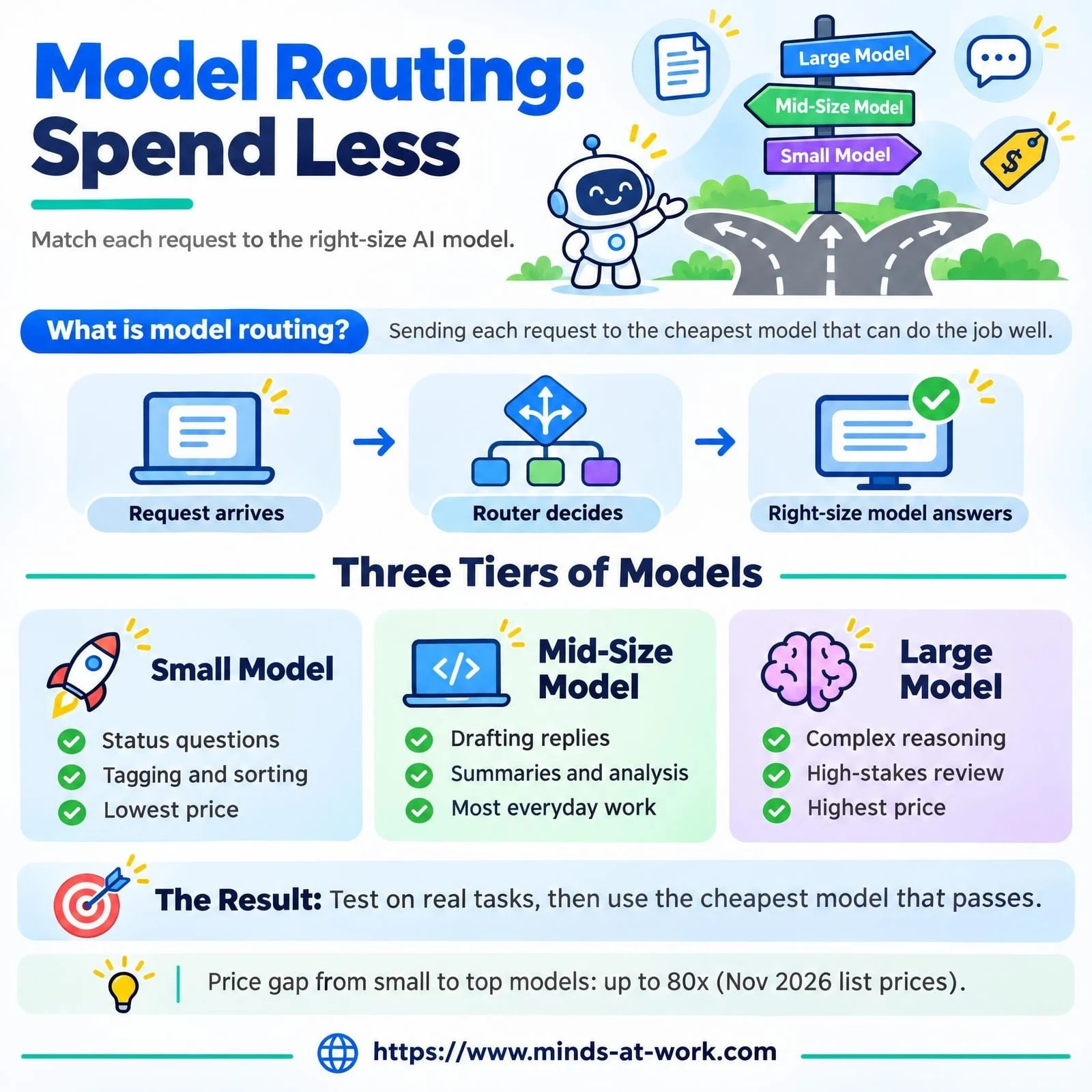
What is model routing?
Model routing is the practice of choosing which AI model answers each request. Think of a clinic. A nurse sees most patients, and a specialist sees the few who need one. Nobody sends every sore throat to the specialist, and nobody lets the nurse perform surgery. Routing is the front desk that decides who sees whom.
In AI terms, a router looks at a request and picks the model that answers it. The router can be a short list of rules, a small AI model, or a service you rent. The goal is what I call the cheapest-model-that-passes rule. Use the cheapest model that does the job well enough, and keep the expensive one for work that needs it. “Passes” has to be something you can check, which is why the testing steps near the end matter most.
Why is the price gap between models so wide?
The smallest model costs one eightieth of the largest, for input and for output. Here are the rows from Part 1’s table that matter for this idea, as read from Anthropic’s pricing page and OpenAI’s API pricing page on November 24, 2026. The tier names are my own labels, not the providers’.
| Tier | Model | Input per million tokens | Output per million tokens |
|---|---|---|---|
| Small | Claude Haiku 5.5 (prompts up to 100,000 tokens) | $0.10 | $0.50 |
| Small | OpenAI gpt-6-luna | $0.10 | $0.50 |
| Mid | Claude Sonnet 5.5 | $2 | $10 |
| Mid | OpenAI gpt-6.2-sol | $2.00 | $10.00 |
| Large | Claude Opus 5.5 | $4 | $20 |
| Top | Claude Fable 5.2 | $8 | $40 |
| Top | OpenAI gpt-6.2-astra | $8.00 | $40.00 |
From the small tier to the top tier is 80 times in both columns.
What starting points does Anthropic suggest?
Anthropic’s pricing page points the same way. It suggests choosing Haiku for simple tasks, Sonnet for most production workloads and Opus for the most complex reasoning. Its model-selection guide offers two starting points.
One is efficiency-first: start with Haiku 5.5, test thoroughly and upgrade only if you find a capability gap. That suits high-volume, straightforward tasks. The other is capability-first: start with Opus 5.5 and move down later. Both end in the same place, a model chosen by test results. Either way, the 80-fold gap is what makes the testing worth doing, because a wrong tier costs you far more per token than a right one.
What are the three ways to route?
You can route by fixed rules, by escalation, or with a router that decides for you. I find it useful to sort the three by how much work they take to set up. Fixed rules take the least. Escalation needs a check on every result. A rented router moves the decision to a service, so you trade some control for convenience.
1. Can you route with fixed rules by task type?
Yes, and it is the simplest approach because it needs no AI to decide. You choose in advance: summaries and tagging go to the small model, draft replies go to the mid model, and contract review goes to the large one. The routing lives in your workflow settings or a few lines of code.
It works well when your tasks fall into clear types, and it is easy to explain to a colleague. Its weakness is that difficulty varies inside a type. Most summaries are easy, but a 90-page legal document isn’t. So review the rules now and then, and move a task type up a tier if the checks show it failing.
2. What does “try cheap first, then escalate” mean?
The small model attempts the task, something checks the result, and a failure goes to a bigger model. To escalate means to hand a failed request up to a more capable model. Picture the flow: a ticket enters a sorting step and goes to a small, mid-size or large model. Failed answers from the small model loop back to the mid-size one.
The check can be simple. Did the answer include an order number, does it match the required format, did the model say it was unsure?
Anthropic’s guide to optimizing for cost and intelligence describes two related patterns. In its advisor pattern, a smaller model runs the loop and escalates to a frontier model on demand. In its orchestrator pattern, a frontier model runs the loop and delegates the bulk work to cheaper workers. A frontier model is one of the most capable models available.
The catch is that a failed attempt is still billed. If the cheap model fails often, you pay for the cheap attempt and the expensive one.
3. Can a router decide the model for you?
Yes, some services pick the model automatically. OpenRouter’s Auto Router, for example, uses a fast decision model to rate each request. It then weighs that rating against live prices, cache status and benchmark performance, within your cost tier. That picks both the model and the reasoning effort. You can see why it picked a model by opting in to router metadata.
In the research world, the RouteLLM paper by Ong and colleagues trains routers on human preference data. Its abstract reports reducing costs by over two times in certain cases without compromising response quality, on widely used public benchmarks. That is a result on benchmarks, not on your tickets, but it shows the idea works in principle.
Open-source tools such as LiteLLM’s router cover a related job. They load-balance across several deployments, with cooldowns, fallbacks, timeouts and retries. That is about reliability and load as much as cost, but it is where many teams keep their routing rules.
Is lowering effort a cheaper alternative to routing?
Often yes, because effort is a second dial you can turn without changing models. Many current models let you set effort, a setting that controls how long the model thinks before it answers. Anthropic’s model-selection guide describes its effort parameter as trading intelligence for latency and cost within a single model. It also says tuning effort is often a better lever than switching models. Part 1 explained why: thinking tokens are billed as output.
So a good first experiment is to run the model you already use at lower effort. Anthropic’s cost guide reports a test on DeepWideSearch, a benchmark of 220 questions that combine collecting many rows with multi-hop retrieval. There, Claude Fable 5 at low effort matched an orchestrator with a Claude Sonnet 5 worker at 29 percent lower cost.
The figure sits in a footnote and uses Claude Fable 5, not the current 5.2, so treat it as a pattern, not a promise. If one model at lower effort wins, you can skip the routing system entirely.
What does routing save for our example team?
In my invented example, routing cuts the bill from $400 to about $81 in the best case, using Anthropic’s published prices. Back to the ten-person team and its 20,000 tickets a month, at about 3,000 tokens in and 400 out per ticket. The prices are real. The ticket sizes are my invention, and so is the split between easy and hard. In practice the split is the thing you must measure.
How much does one ticket cost on each model?
From the token prices above, one ticket costs the amounts below. The 20,000-ticket column is the monthly bill if every ticket went to that one model.
| Model | Cost per ticket | 20,000 tickets |
|---|---|---|
| Claude Haiku 5.5 | $0.0005 | $10 |
| Claude Sonnet 5.5 | $0.01 | $200 |
| Claude Opus 5.5 | $0.02 | $400 |
What does the routed bill look like?
Now suppose we sort the tickets with a small model first. The sorting step reads about 2,000 tokens of each ticket and writes about five. That costs a fraction of a cent per ticket. Over a month, 20,000 × (2,000 × $0.10 ÷ 1,000,000) = about $4.
Suppose the sorter rates 14,000 of the 20,000 tickets easy, 5,000 medium and 1,000 hard. Then the routed bill comes out as follows.
| Route | Tickets | Cost |
|---|---|---|
| Easy, to Haiku 5.5 | 14,000 | $7 |
| Medium, to Sonnet 5.5 | 5,000 | $50 |
| Hard, to Opus 5.5 | 1,000 | $20 |
| Sorting step, Haiku 5.5 | 20,000 | about $4 |
| Total | about $81 |
Against Opus-only, that is $400 − $81 = $319 less, about four-fifths of the bill. Against Sonnet-only, it is $200 − $81 = $119 less, roughly three-fifths. This is the best case. It assumes the sorter is right and the small model gets every easy ticket right.
What happens when the cheap model fails?
Now the honest version. Suppose some share of the 14,000 easy tickets turn out wrong and have to be redone on Sonnet. Each redo costs another $0.01, the Sonnet 5.5 rate from Anthropic’s pricing page. Failures add the cost of a second attempt, and they add a quality risk the bill does not show.
| Share of Haiku tickets that fail and escalate | Monthly total |
|---|---|
| 0% | about $81 |
| 10% | about $95 |
| 20% | about $109 |
| 30% | about $123 |
Even if three in ten easy tickets fail, the routed bill is $81 + 0.3 × 14,000 × $0.01 = $123, far below $400.
Where does the routed setup stop being cheaper?
The routed setup stays cheaper than Sonnet-only until 11,900 of the 14,000 easy tickets fail, because 11,900 × $0.01 = $119 and $119 + $81 = $200. That is a failure rate of about 85 in every 100 easy tickets. I call it the break-even failure rate. No customer would tolerate a rate that high, which is the point. Cost rarely stops you. Quality does.
The table hides a bigger risk. A wrong answer that reaches a customer is not a line in it. A sorter that sends a hard ticket to the small model is a second failure the table leaves out. Cost is only half of the comparison. The other half is quality, and you only know the quality if you measure it.
When does model routing not pay?
Routing does not pay when helper models add overhead or the job is one chain of steps. Anthropic’s cost guide is candid about this, and I think the caveats deserve as much space as the savings. The first three cases below are about helper models. The last three are about size, tokens and price cliffs.
When do helper models fail to save money?
- One chain of dependent steps. In Anthropic’s measurements, when work is one dependent chain, or fits in a single context without a long tail of costs, the main model alone at lower effort came out ahead in every case measured on earlier models.
- Small helpers can be a wash. On an internal coding benchmark, adding Claude Haiku 5.5 helpers to Claude Opus 5.5 at medium effort cut cost per attempt by 32 percent, according to the cost guide. The same guide says it lowered the pass rate by about 4 percentage points. Anthropic says that is roughly what a mix of low and medium effort without helpers would give at that cost.
- Consulting costs money even when unused. The advisor tool’s definition adds about 1,000 prompt tokens per request, even when the executor never asks for advice.
Taken together, these three cases say the same thing. A helper model is not free just because it is small.
What still helps, and what traps remain?
- Big, splittable jobs do benefit. For work larger than one context window, split into parts, Opus 5.5 with Sonnet 5.5 helpers cost about a third less than one Opus 5.5 session per part at default effort. It scored about the same on Anthropic’s defect-search benchmark. A context window is the amount of text a model can handle in one request.
- Cheaper per token isn’t always cheaper per task. OpenAI’s help center notes that models can tokenize the same text differently and generate different amounts of output or reasoning. So test representative tasks instead of comparing visible response length.
- Watch the size cliffs. Haiku 5.5’s price rises fivefold for prompts over 100,000 tokens, and Anthropic counts cache reads and writes toward that length. A ticket history that grows quietly can push you over.
How do you start routing without breaking anything?
Start with a test set of real tasks, and let the results choose the model. Anthropic’s cost guide lays out a method that doesn’t depend on any provider. I’d follow it in plain terms, one step at a time, and stop at any step where the numbers say routing is not worth the extra moving parts.
What are the six steps?
- Collect real examples. Pull tasks from your real logs, weighted like your real traffic, not just the easy ones. Anthropic doesn’t give a number. I’d start with 50 to 100.
- Define pass or fail. For each one, write down what a good result looks like: right order number, right policy, right tone. Record cost per task next to the score.
- Test the tiers and the effort settings. Run all three tiers at more than one effort level, and compare score against spend. A multi-model setup has to beat a single model’s whole curve to be worth it.
- Pick the cheapest that passes. Add escalation only for the cases it misses.
- Run in shadow first. Let the routed setup answer in the background on a slice of traffic while the old one still serves customers. Compare before you switch.
- Re-check at every new release. Anthropic’s guide says to recheck at every model release, because releases move both the capability gap and the price ratio. Your best routing today may not be the best next quarter.
Where can you get a second opinion?
If you want a second pair of eyes on which of your workflows deserve a cheaper model, that is the kind of work a Fractional CTO takes on. My AI strategy guide for SMB owners covers where AI belongs before you tune what it costs. The AI strategy archive has more posts like this.
What comes next in the series?
Part 3 changes how often you pay full price to send the same text. Model routing changes which model reads a ticket. The next part covers prompt caching, which charges a fraction of the usual input price to re-read repeated material. It also covers batch processing, which gives a discount for work that can wait.
Frequently asked questions
These are the questions readers ask most often about model routing. The answers cover what it is, how much it can save, when it does not pay, whether lowering effort is better and how to test a setup safely. They use the same sources and the same November 24, 2026 prices as the sections above.
What is model routing in AI?
Model routing is choosing which AI model answers each request. A router, which can be a few rules, a small model or a rented service, sends easy requests to a cheap model and hard ones to a stronger model. The aim is to pay for strength only where the task needs it. It also keeps quality where customers can see it.
How much can model routing save?
It depends on your mix of easy and hard work, so measure it. In my invented support-team example, routing cut a $400 monthly bill to about $81 in the best case, using Anthropic’s list prices. If three in ten easy tickets failed and were redone, the bill was about $123 at those same prices. Those numbers are illustrations. Your savings could be smaller, and quality still has to be checked.
When should I not use model routing?
Skip it when the work is one dependent chain of steps, or fits in a single context without a long cost tail. Anthropic’s measurements found the main model alone at lower effort came out ahead in those cases on earlier models. Helper models also add overhead, such as about 1,000 prompt tokens per request for the advisor tool. Try lowering effort first.
Is lowering effort better than switching models?
Often, but not always. Anthropic’s model-selection guide says tuning effort is often a better lever than switching models, because it trades intelligence for latency and cost within one model. It costs nothing to try, since you change a setting, not your architecture. Test both against your own pass or fail checks and compare cost per task.
How do I test a routing setup safely?
Pull a set of real tasks weighted like your traffic, define pass or fail for each, and record cost per task next to the score. Compare tiers and effort levels. Then run the winning setup in shadow on a slice of traffic before switching customers over. Repeat the test whenever a new model release changes prices or capability.