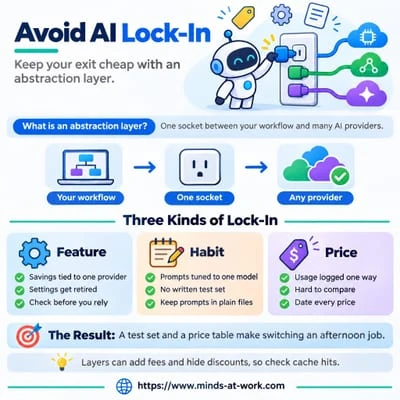
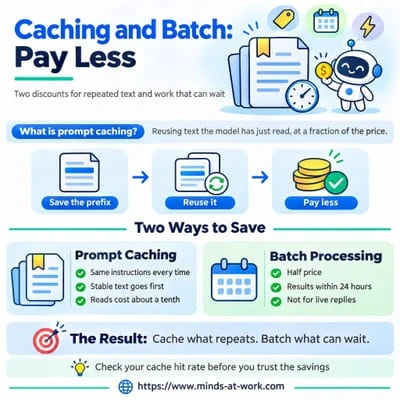
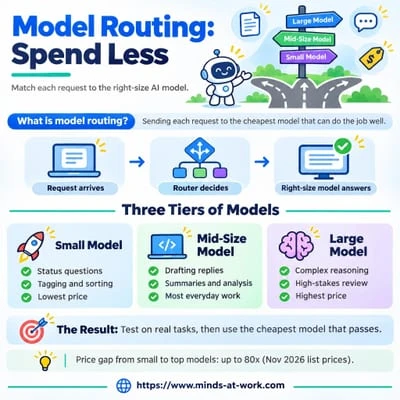
The Real Cost of AI: Tokens, Seats and Hidden Costs (Part 1 of 5)
Where AI money really goes: per-person seats, per-token API prices, and six hidden costs that make real bills bigger. Prices read November 24, 2026.
By Dr. Sanju Abraham, Fractional CTO, investor, multiple exits. Published November 24, 2026.
This is Part 1 of 5 in The Real Cost of AI series.
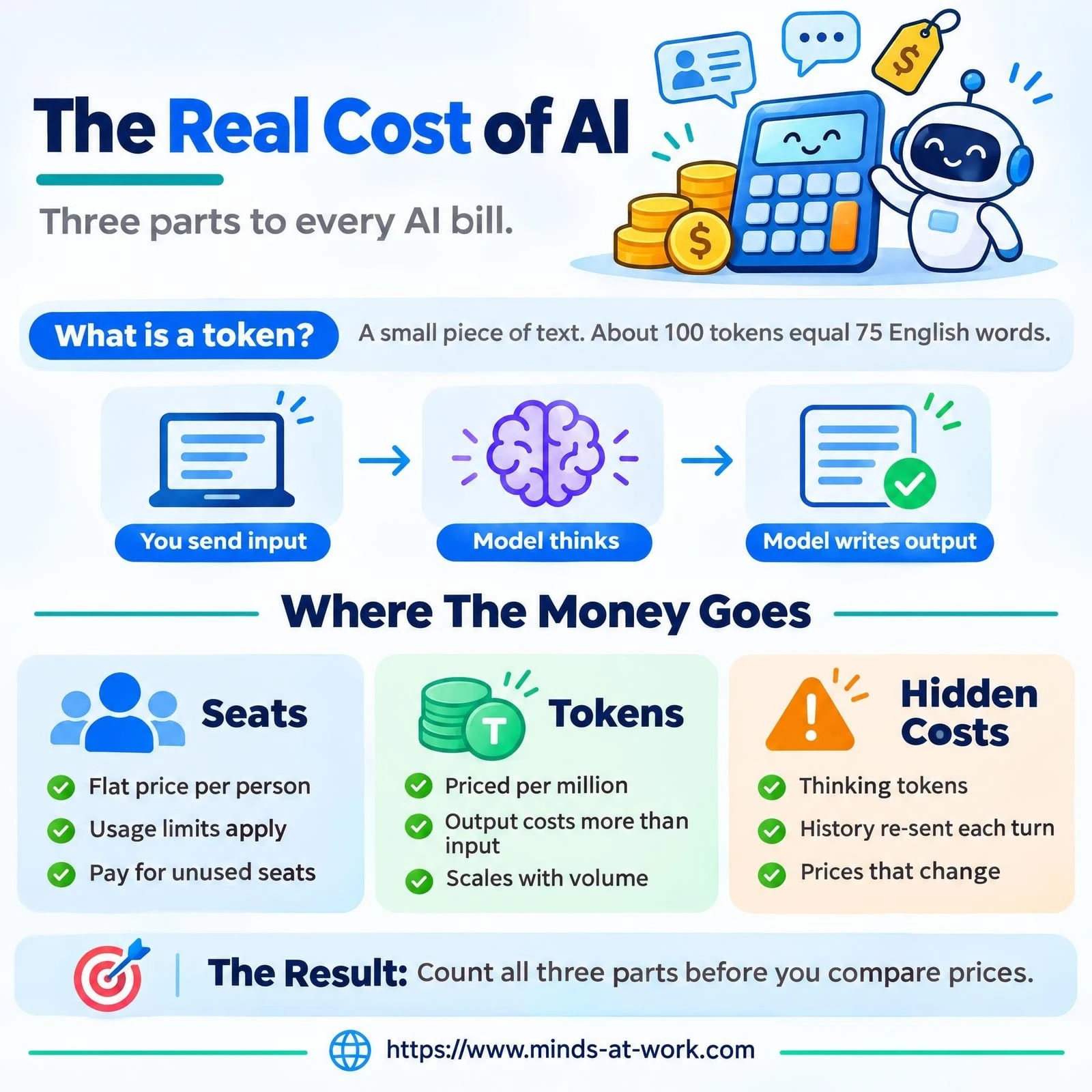
The short answer: AI money goes to two places you can see and one you cannot. You pay a fixed fee per person, which is a seat. You pay a variable fee per token if software calls a model through an API. You also pay hidden costs that never appear on the pricing page. I call this the three-part AI bill. Add the three parts up per finished task, not per month, and you get the real number.
Most people first meet the cost of AI as a number on a pricing page, such as the $20 to $25 a month for a Standard seat. That number is real, but it is only one place the money goes.
Your team may also use AI inside its own tools through an API, which is a way for one piece of software to ask another to do work. Then there is a second bill, measured in tokens. On top of both sit a few costs that no pricing page lists.
This is Part 1 of a five-part series on what AI really costs and how to spend less without making it worse. Part 1 is the map. It covers the two ways you pay, how to read a token price and the hidden costs that make real bills larger than the back-of-envelope version. Parts 2 to 5 cover model routing, caching and batch processing, avoiding lock-in and a cost dashboard.
You don’t need to be technical. If you can read a restaurant bill, you can follow this. AI prices change often, and some change on a schedule, so I read every price below from the provider’s own page on November 24, 2026, and I name the page. I haven’t run benchmarks for this series. Where I give a worked example, the numbers are illustrative and labelled.
The real cost of AI at a glance
These are the facts most readers look for first, as of November 24, 2026. I read each price from the provider’s own page that day. The list covers seat prices, token prices, the hidden costs and the one number to track. The sections below give the sources and the caveats.
- Three parts of the bill: Seats, tokens and hidden costs
- Standard seat: $20 per person per month on annual billing, $25 on monthly billing, for both ChatGPT Business and Claude Team, according to OpenAI’s ChatGPT Business overview and Anthropic’s Team plan help page
- Premium seat: $100 annual, $125 monthly, five times a Standard seat, according to the same two pages
- Token prices: From $0.10 input and $0.50 output per million tokens (Claude Haiku 5.5, OpenAI gpt-6-luna) to $8 input and $40 output (Claude Fable 5.2, OpenAI gpt-6.2-astra), according to Anthropic’s pricing page and OpenAI’s API pricing page
- Price spread: The most expensive row costs 80 times the cheapest, for input and for output
- Hidden costs: Reasoning tokens, re-sent history, tool overhead, tokenizer changes, price jumps and review time
- Example team: In my invented example, ten Standard seats ($200 a month) plus 20,000 tickets ($400 a month) come to $600 a month
- What to measure: Cost per finished task
How do you pay for AI: seats or tokens?
You pay for AI either per person or per piece of text, and many teams end up paying both. A seat is a fixed amount per person per month, and that person can use the product up to a usage limit. Seats are typical for staff who use a chat app.
A token charge is the other kind. You pay for what your software sends to an AI model and gets back, measured in small chunks of text. Tokens are typical when a developer connects a model to your own workflow, such as a support assistant that drafts replies.
The two behave differently. A seat bill is flat and predictable. A token bill moves with how much work you push through, so it can surprise you.
What do AI seats cost?
Here is what the main business seats cost at US list prices, read from each provider’s own pages.
| Plan | Monthly billing, per person | Annual billing, per person, per month |
|---|---|---|
| ChatGPT Business, Standard seat | $25 | $20 |
| ChatGPT Business, Premium seat | $125 | $100 |
| Claude Team, Standard seat | $25 | $20 |
| Claude Team, Premium seat | $125 | $100 |
| Claude Pro (individual) | $20 | $17 |
Sources: OpenAI’s ChatGPT Business overview, Anthropic’s Team plan help page, and Claude’s pricing page, all read November 24, 2026. Anthropic says its prices exclude applicable taxes. OpenAI says pricing may vary by country and currency.
Which three seat details matter more than the price?
Three details on those pages matter more than the headline price.
First, a Premium seat is not a discount tier. It costs five times a Standard seat. Anthropic’s help page says Standard seats include 1.25 times the Pro plan’s per-session usage, while Premium seats include 6.25 times. You are buying capacity, so Premium only makes sense for someone who runs into the Standard limit.
Second, seats have limits. Both OpenAI and Anthropic let an organization buy extra usage credits once a person reaches the included limit. OpenAI calls this flexible pricing. A seat price is therefore a floor, not a ceiling, for heavy users.
Third, a seat belongs to one named person. Anthropic’s help page says usage limits can’t be transferred or shared between team members. If someone leaves or never logs in, you pay for capacity nobody uses until you reassign or remove the seat. OpenAI’s page lists usage visibility and spend controls among the Business features, so check what your plan shows before each renewal.
What is a token, and how do you read a token price?
A token is a piece of text, often a short word or part of a longer one. OpenAI’s help center gives these rules of thumb for English: one token is about four characters, and 100 tokens are about 75 words. By that estimate a 750-word email is roughly 1,000 tokens. The same page says token counts differ by model, encoding and language, so treat these as estimates.
How are input and output prices quoted?
API prices are quoted per million tokens, abbreviated MTok. Input tokens are what you send in: your question, any documents and the instructions. Output tokens are what the model writes back. They are priced separately, and in every row of this table the output price is five times the input price.
| Model | Input per million tokens | Output per million tokens |
|---|---|---|
| Claude Haiku 5.5 (prompts up to 100,000 tokens) | $0.10 | $0.50 |
| Claude Sonnet 5.5 | $2 | $10 |
| Claude Opus 5.5 | $4 | $20 |
| Claude Fable 5.2 | $8 | $40 |
| OpenAI gpt-6-luna | $0.10 | $0.50 |
| OpenAI gpt-6.2-sol | $2.00 | $10.00 |
| OpenAI gpt-6.2-astra | $8.00 | $40.00 |
| Google Gemini 4 Hydrogen | $1.50 | $7.50 |
| Google Gemini 4 Argon | $2.00 through Nov 30, 2026; $4.00 from Dec 1, 2026 | $10.00 through Nov 30, 2026; $20.00 from Dec 1, 2026 |
Sources: Anthropic’s pricing page, OpenAI’s API pricing page and Google’s Gemini API pricing page, all read November 24, 2026. OpenAI’s rows are standard short-context rates, for inputs up to 272,000 tokens, and Google’s are the paid standard tier. I lined the rows up by price, not by quality. A price tells you nothing about which model is better at your task.
What stands out in the price table?
Two things stand out. The first is the spread: on the pages cited above, the most expensive row costs 80 times the cheapest, for input and for output. That gap is what Part 2 is about.
The second is the date on one row. Google’s page lists Gemini 4 Argon at double the price from December 1. So write the date next to any price you save, because a price you copied last month may no longer be the price you pay.
What does a token bill look like for a small team?
To make this concrete, I’ll invent a team and keep using it through the series. It has ten people, each on a Standard seat on an annual plan: 10 × $20 = $200 a month. It also runs a support assistant that drafts replies to customers. Say each ticket sends in about 3,000 tokens (the customer’s message, the history and the instructions) and gets back about 400 tokens. These figures are mine, for illustration.
On Claude Opus 5.5, input costs 3,000 × $4 ÷ 1,000,000 = $0.012 and output costs 400 × $20 ÷ 1,000,000 = $0.008. One ticket costs $0.012 + $0.008 = $0.02, or two cents. At 20,000 tickets a month, 20,000 × $0.02 = $400. So on paper the team’s AI spend is $200 for seats plus $400 for tickets, which is $200 + $400 = $600 a month.
What are the six hidden costs of AI?
Six costs sit outside the headline price, and each one can change a real bill. They are reasoning tokens, re-sent history, tool overhead, tokenizer changes, price jumps and review time. The team’s visible bill is $200 + $400 = $600 a month, and the parts that aren’t on the pricing page come next. Each one gets a plain answer first, then the source. Where it helps, I add a worked number from our example team to show how a two-cent ticket grows.
1. Do reasoning tokens count as output?
Yes. Many current models “think” before they answer, and those thinking tokens are not part of the reply you read. OpenAI’s help center says reasoning tokens are not visible as answer text but are billed as output tokens. Anthropic’s documentation says thinking tokens are billed as output tokens too.
In the example, suppose the model spends 1,000 tokens thinking before it writes its 400-token reply. The output is now 1,400 tokens, which costs 1,400 × $20 ÷ 1,000,000 = $0.028. Adding the $0.012 for input gives $0.012 + $0.028 = $0.04, so the ticket costs four cents, double the original. The 1,000 is my assumption. The mechanism is documented, though, and it is the reason to look at billed tokens and not just at the length of the reply.
2. Do long conversations re-send the whole history?
Yes. A model doesn’t remember your last message on its own. In the Claude API, as Anthropic’s context window documentation describes it, each turn’s input contains the whole earlier conversation plus the new message. The reply then becomes part of the next turn’s input, so you pay for that history again every turn. A context window is the total amount of text a model can work with in one request.
Here is a ten-turn chat where each new message and each reply is about 500 tokens (my illustrative numbers).
| Turn | Input tokens billed |
|---|---|
| 1 | 500 |
| 2 | 1,500 |
| 3 | 2,500 |
| 5 | 4,500 |
| 10 | 9,500 |
| All ten turns | 50,000 |
Ten turns of 500-token messages sound like about 5,000 input tokens. The real figure is 50,000, ten times that. On Claude Sonnet 5.5, input costs 50,000 × $2 ÷ 1,000,000 = $0.10. Output costs 5,000 × $10 ÷ 1,000,000 = $0.05, so the chat costs $0.15 in all. If history were free, it would cost 5,000 × $2 ÷ 1,000,000 + $0.05 = $0.06. Part 3 covers how caching softens this.
3. Do tools and instructions add tokens you never typed?
Yes. When a model can use tools, such as searching the web or controlling a browser, extra text goes into every request. That text describes the tools and how to use them. Anthropic’s pricing page lists these overheads. Using any tool on Claude Sonnet 5.5 adds 286 tokens of system prompt. Declaring the default browser-use toolset adds about 6,600 input tokens to a request, according to the same page.
Web search on the Claude API costs $10 per 1,000 searches on top of the tokens, and search results count as input tokens too. Each of these overheads is small alone. In a workflow that makes many calls, they are in every call, so a small overhead is multiplied by the number of calls.
4. Can the same text cost more tokens on a newer model?
Yes. On Anthropic’s pricing page, the newer tokenizer in Claude 4.7 and later produces approximately 30 percent more tokens for the same text. A tokenizer is the part that splits text into tokens. So if the price per million tokens stays flat across an upgrade, your bill can still rise.
As an illustration, a task that used 10,000 tokens would use 10,000 × 1.3 = 13,000 at the same price per token. OpenAI’s help center makes a related point: a lower price per million tokens does not necessarily produce a lower total cost. The token count also changes from one model to the next, so compare cost per finished task, not cost per million tokens.
5. Do prices jump with prompt size or the calendar?
Yes. Some prices change with the size of your request. On Anthropic’s pricing page, Claude Haiku 5.5 costs $0.10 input and $0.50 output for prompts up to 100,000 tokens. Above that, the same page lists $0.50 and $2.50, which is five times as much. OpenAI’s pricing page lists separate long-context rates too, for inputs above 272,000 tokens. For gpt-6.2-sol it lists $4 input and $15 output, against $2 and $10 for short context.
Others change with the date. Besides Gemini 4 Argon doubling on December 1, Google’s page lists Gemini 3.8 Flash at $0.75 input through December 31, 2026 and $1.50 from January 1, 2027. Anthropic’s page records a case that went the other way. Claude Sonnet 5 launched with introductory pricing, and the scheduled increase to $3 and $15 will not occur. A budget built on a promotional price has a shelf life.
6. Is free really free, and does your time count?
Not always, and your time counts. Google’s pricing page marks the content on its free Gemini API tier as used to improve its products, and the paid tier’s as not used. Free can be the right choice for experiments. But it is a different bargain from paying, so know it before anyone pastes customer data in.
The last hidden cost isn’t on any page. It is the time people spend checking what the AI produced. If every drafted reply needs a minute of review, that minute probably costs more than the tokens that wrote it. This is my own observation, not a figure from a source. Measure it for your team before you decide which savings matter.
What should you do this week?
You can learn a lot about your own AI spend in one afternoon. These four steps need no code, only access to your billing pages and a spreadsheet.
- List your seats. For each one, note who has it and whether they used it last month. OpenAI lists usage visibility and spend controls among its Business features, and Anthropic’s Team plan includes centralized access and billing management.
- Find your token usage. OpenAI points to its Usage Dashboard, and Anthropic’s pricing page says usage tracking is available in the Claude Console. Each API response also reports the tokens it used, which is what Part 5’s dashboard will be built from.
- Calculate cost per task. Divide a month’s spend by the number of tickets, summaries or reports it produced. That one number lets you compare models, settings and tools fairly.
- Date your prices. Put the date and the page you read it on next to every price in your budget.
Want a second opinion on where AI belongs in your business before you set a budget? My AI strategy guide for SMB owners covers what to do and what to skip. A Fractional CTO can help turn these numbers into a plan. If you are comparing personal assistants rather than team plans, Part 18 of my Personal AI Agents series sorts sixteen agents by how they charge. More posts like this are in the AI strategy archive.
What comes next in the series?
Part 2 covers model routing, and the example team is where it starts. For that team, the per-token rates put the ticket assistant at $400 a month on a top-tier model.
Part 2 shows how sending each ticket to a model that matches its difficulty can bring that down. It also shows where routing can backfire, so you can decide whether the saving is worth the extra moving parts.
Frequently asked questions
These are the questions readers ask most often about what AI costs. Each answer stands on its own and uses the same sources and the same November 24, 2026 price pages as the sections above. Treat every price as a snapshot: record the date next to it, and check the provider’s own page before you commit a budget.
How much does AI cost for a small business?
It depends on how you use it. On the Claude pricing page I read in November 2026, a Standard seat costs $20 to $25 per person per month. The same page lists Premium at $100 to $125. API use is billed per token on top, so a team with a support assistant adds a variable bill. Both numbers are floors, because heavy users can buy extra capacity.
What is a token in AI pricing?
A token is a small piece of text that a model reads or writes, often a short word or part of a longer one. OpenAI’s rule of thumb for English is that one token is about four characters. APIs charge per million tokens, with separate prices for input (what you send) and output (what the model returns).
Why is an AI bill bigger than the price list suggests?
Several costs sit outside the headline price. Reasoning tokens are billed as output. Long chats re-send the whole history every turn. Tool descriptions add tokens to each request. Anthropic says newer tokenizers can produce about 30 percent more tokens for the same text. Some prices depend on prompt size or the date. Reviewing the output also takes people’s time.
Are seats or API tokens cheaper?
Neither wins in general. Seats are flat and predictable, which suits staff using a chat app. Tokens suit workflows you build yourself and scale with volume, so they can climb quickly. Many teams use both. The fair comparison is cost per finished task. Divide a month’s spend by the tickets, summaries or reports it produced, then compare.
How often do AI prices change?
Often, and some changes are scheduled in advance. On Google’s pricing page, which I read on November 24, 2026, Gemini 4 Argon doubles from $2 to $4 per million input tokens on December 1, 2026. Record the date and the page next to every price in your budget, and re-check before each renewal.