Claude Duet Review: Anthropic's Proactive Agent (Part 4 of 18)
A plain-English look at Anthropic's Claude Duet: what it does, how approvals work, what it costs in usage limits, and what reviewers found.
By Dr. Sanju Abraham, Fractional CTO, investor, multiple exits. Published November 9, 2026.
The short answer: Claude Duet is Anthropic’s proactive agent for professionals and small business owners. It reads your connected email, calendar, documents and Slack, tells you what needs attention, and drafts or runs routines while you are away.
As of November 9, 2026, Duet is a research preview, which means an early release its maker calls unfinished. It is open to US subscribers on a waitlist, and its real cost is the usage allowance it consumes. Reviewers found it good at connecting scattered messages and sometimes too anxious about urgency.
This is Part 4 of 18 in the Personal AI Agents series. Missed the last one? Read Part 3, on OpenAI’s dots.
Anthropic’s Claude Duet is the newest of the big-company agents so far, and it is the one that most openly says it is unfinished. Anthropic calls it a research preview, and access is limited. The Verge reported that it is open to Pro, Max and Ultra subscribers in the US, with a waitlist to join.
Duet is also aimed at a narrower audience than Meta’s Muse, which I covered in Part 2. According to The Verge, it is for “professionals and small business owners” rather than someone who wants a burrito ordered.
Claude Duet at a glance
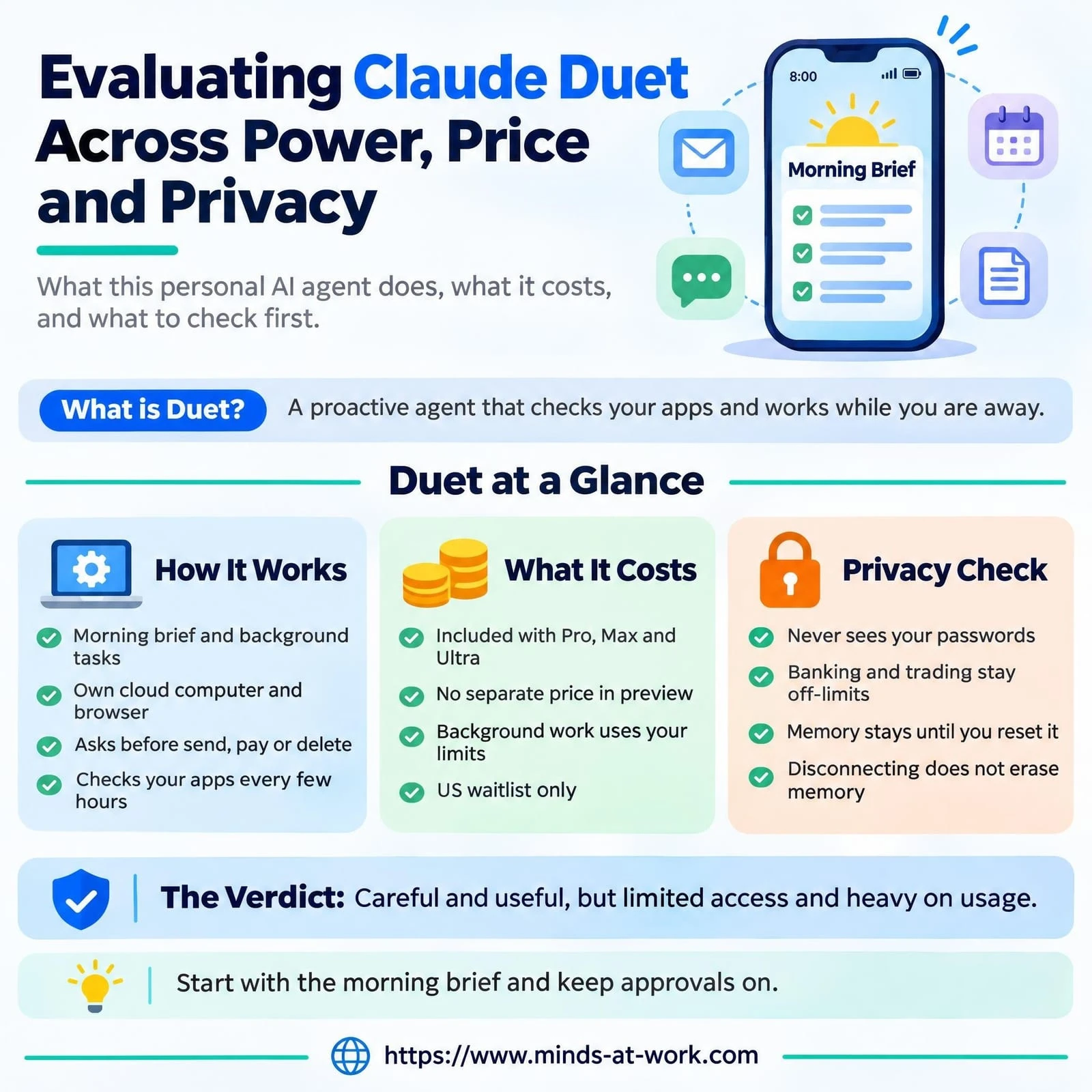
These are the facts most readers look for first, as of November 9, 2026. Claude Duet is Anthropic’s always-on agent that reads your connected email, calendar, documents and Slack. The list covers the maker, the status, the access, the cost, the approvals and the security evidence. The sections below give the sources and the caveats.
- Maker: Anthropic
- Status: A research preview, an early release its maker calls unfinished
- Access: Claude Pro, Max and Ultra subscribers in the US, on a waitlist; not yet on Team or Enterprise plans
- Price: No separate price; included in Claude Pro ($20 per month), Max ($100) and Ultra ($200), according to Anthropic’s pricing page
- Real cost: It draws on your plan’s five-hour and weekly usage limits, so background work uses allowance
- Approvals: Before a sensitive message, a payment or a deletion, it shows the action, destination and content and waits
- Reviewer verdict: Good at connecting scattered messages, and sometimes too anxious about urgency
- Security evidence: No independent security test found; the safeguards are Anthropic’s own statements
What is Claude Duet?
Claude Duet is an always-on AI agent from Anthropic that works on your behalf without waiting for a prompt. Zapier’s Wade Burrell describes it this way. Duet sends a morning brief and checks your connected apps to see where it can help. It also works on tasks in the background while you do something else.
You sign in with your existing Claude account, but Duet is a separate app. It is available on iOS, Android and claude.ai.
Anthropic’s own safety and privacy page calls Duet a proactive agent that uses a cloud-based computer. The page says it “runs continuously even after you close the app.” It can read your inbox, draft replies, book things and run routines while you are away.
How does Claude Duet work?
The app has three tabs, per Zapier’s walkthrough, and Duet looks at your accounts on a schedule rather than all the time. It messages you only when something needs attention. Here is what each tab does.
- Chat, where you talk to Duet by text or voice in one continuous thread.
- Tasks, which lists the work Duet runs in the background.
- Make, where you build projects from templates such as a daily to-do list or email triage.
Duet checks your connected accounts every few hours, according to Zapier. You can set what you want to hear about and how often. Whatever you have already connected to Claude, plus its memory and skills, carries over. Anthropic says Duet runs on a cloud computer with a browser, so your phone does not need to stay awake.
One detail is worth knowing. Forward Future’s Nick Wentz noted that, according to Anthropic, Duet checks connected accounts periodically rather than continuously. So it will not catch every last-minute change.
What can Claude Duet actually do?
Duet’s design is built around judgment about what needs your attention. Reviewers tested it mostly on email, calendar, documents and Slack. They found real strengths and some clear misses, and usage limits drew the loudest complaints. The three reviews below cover what each reviewer tried and where Duet fell short.
What did The Verge’s reviewer find?
The Verge gave Duet a work email, calendar, Google Docs and Slack. Duet connected a meeting summary in email to a direct message in Slack. It worked out who the reviewer’s boss was from a shared document. It also noticed that upcoming time off would leave only a couple of working days before a deadline.
Duet then proposed a fix and drafted a Slack message. The message copied her lowercase writing style, the reviewer said, and carried a “sent with Claude” tag. She also called Duet “slightly neurotic” because it fretted over a story waiting for an edit. The deadline was soft and the editor was still asleep. She did not want help with creative drafting at all. She called Duet a good backstop rather than a replacement for her own organizing.
What did Forward Future and Zapier find?
Forward Future reported that Duet followed up on unfinished work from an earlier Claude project without being asked. It also flagged that a meeting had been canceled before the reviewer noticed. On the downside, when the reviewer uploaded a PowerPoint, Duet received only the words as a text file. Its workaround was to suggest emailing the file to himself, so it could fetch the attachment from Gmail.
Zapier’s reviewer connected Gmail, Calendar and Drive and asked for nothing. The next morning Duet had looked through the inbox, matched Google’s security alerts to the new connections, and summarized them. The same reviewer reported that the native Gmail connector sees only one account. Duet also missed the mark on urgency at times.
What did reviewers say about usage limits?
Usage limits were a common complaint. Zapier said Duet burned through its session limits in the first couple of days. That fits Anthropic’s own help center. Duet shares your plan’s five-hour and weekly limits, and background work such as the morning brief counts toward them.
What does Claude Duet cost, and who can use it?
Claude Duet has no price of its own, so the cost question is really about plans and allowances. This section covers what the plans cost, what extra limit resets Anthropic offers, who can get in and which apps Duet can reach. The Microsoft 365 question is still unclear, and I flag it below.
What does Claude Duet cost?
Duet has no separate price. Anthropic’s announcement says it is included in Pro, Max and Ultra plans during the research preview. Its help center says Duet draws on your plan’s usage limits at the same rate as Claude chats. The cost shows up in your usage allowance instead. Plan prices below come from Anthropic’s pricing page and may change during the preview.
| Plan | Price | Duet |
|---|---|---|
| Claude Pro | $20 per month ($17 per month billed annually) | Included in preview, waitlist |
| Claude Max | $100 per month | Included in preview, waitlist |
| Claude Ultra | $200 per month | Included in preview, waitlist |
Anthropic’s help center also says people admitted to Duet get one-time full limit resets during the preview: three for Pro and one each for Max and Ultra. Each reset refills both the five-hour session limit and the weekly limit. Unused resets expire on December 15, 2026.
Who can use Claude Duet?
Access is US only and by waitlist. The same help center says Duet isn’t available on Team or Enterprise plans yet. Anthropic plans to bring it to them later. Zapier’s reviewer also described a US-only waitlist rollout.
What can Claude Duet connect to?
Anthropic’s announcement says Duet can use over 6,000 connectors and plugins from the Claude Marketplace. The help center says some connectors, such as Slack, work with limits. It also says Duet doesn’t make phone calls or send text messages to other people. Duet can send email from your connected accounts, but only with your approval.
Microsoft 365 is less clear. eesel’s review says it rests on Anthropic’s documents and user reports rather than hands-on use. It reports that the help center lists Microsoft 365 as not available yet, while the Duet product page shows a Microsoft logo among its connectors. I could not find a Microsoft 365 line in the Duet help article I read. So treat it as unconfirmed and check before you rely on it.
Is Claude Duet safe and private?
Anthropic’s safety page for Claude Duet is unusually specific, so the core claims are worth listing. These are Anthropic’s statements, not independent findings. The sections below cover approvals, sensitive information, passwords, memory, how Duet identifies itself on the web, and where the protections stop. I have kept each claim attached to who made it, so you can weigh it yourself.
How do Duet’s approvals work?
Duet stops and asks before anything sensitive. Before it sends a potentially sensitive message, pays for something or deletes anything, it shows you the action, destination and content. That includes every recipient. Then it waits for you.
A separate automated check runs alongside each action and asks whether the action matches your intent. It is built on Claude Code’s auto mode classifier, a model that sorts actions into allowed and not allowed. The check runs outside the model doing the work, so instructions hidden in a web page cannot influence it. Some actions stay off-limits even with your approval. These include trading securities, banking actions such as moving money between accounts, and accessing someone else’s account.
How does Duet handle sensitive information and passwords?
A second classifier checks each outgoing message for sensitive information. Credentials, full card and bank account numbers and government ID numbers are in a “never share” tier. Other private information, such as health or finances, needs your consent to share. Your own request counts as consent.
Duet never sees your passwords, browser cookies or sign-in tokens, according to Anthropic. When a site asks for a password, you type it into a form inside the Claude app that encrypts it for a single use. The password goes to a separate browser machine the model cannot access. For purchases, Duet uses a one-time card from a wallet like Link by Stripe, limited to that merchant and amount.
What does Duet remember, and how does it identify itself?
Duet keeps your conversation history and memory until you delete or reset them. It uses memory from your Claude account too. Disconnecting an app stops new access, but what Duet already learned stays until you reset its memory. Deleting your account wipes what Duet has stored.
On the web, Duet’s browser sends a distinct User-Agent header, which is the label a browser gives each website it visits. Anthropic publishes the IP addresses it browses from so sites can recognize it. Anthropic also says it contacted several large websites before launch and gave them the option to block Duet. Some did.
What are the limits of those protections?
Anthropic acknowledges the limits. It says Duet is a research preview and that its safeguards will occasionally miss something or flag a harmless message. Reviewers raised some of the same points. The Verge’s reviewer opted in knowingly but found it “uncanny” that Duet could read every email, draft and Slack message.
HypeSkeptics suggested giving an agent like Duet an email account of its own and forwarding only what you want it to see. I could not find an independent security test of Duet as of this writing. So the safeguards above remain Anthropic’s own statements.
Who is Claude Duet for?
Claude Duet suits a narrow group of readers, and these two lists show whether you are in it. They compare what you already pay for, what problem you want solved and how you feel about an agent reading your messages.
Duet fits you if:
- You already pay for Claude Pro or Max and live in the US.
- Your problem is keeping track of email, Slack, calendar and documents, rather than shopping.
- You like a morning brief and are willing to teach it what is worth a message.
It’s a weaker fit if:
- You depend on Microsoft 365 (eesel reports it is not available yet, which is unconfirmed) or want an agent that can text or call, which Anthropic says Duet does not do for other people.
- You are watching your usage limits closely, because Duet draws on them.
- You do not want an agent reading every message you send, which The Verge’s reviewer found unsettling even after opting in.
If you are weighing agents like this for a company rather than yourself, our AI strategy for SMB owners piece covers where to start. A Fractional CTO can help you decide which accounts an agent should be allowed to read.
What is the verdict on Claude Duet?
Claude Duet has the most detailed safety documentation of the big-company agents so far. Reviewers found real value in how it connects scattered messages and catches things they had missed. The costs are access, because it is a waitlist for US subscribers, and usage limits that background work eats into.
For anyone who gets in, I would use what I call the read-only-first rule, a MAW framing. Start with a read-only workload such as the morning brief. Keep approvals on. Check how much allowance is left after a normal week. If Duet is taking too much, turn down what it watches.
What is the four-question agent check?
The four-question agent check is a MAW framing for judging any proactive agent, meaning one that acts without being asked. The Duet reviews and Anthropic’s own documentation point to the same four questions:
- What can it read? List every connected account, and confirm whether each connection is read-only.
- What can it do without asking? Find the actions that need your approval and the ones that are off-limits entirely.
- What does it remember? Check how long memory lasts and what disconnecting an app actually removes.
- What does it cost in allowance? Watch how much of your plan’s limits background work uses in a normal week.
Duet gives clear written answers to the first three and a painful lesson on the fourth. More pieces on choosing and governing AI tools live in the Personal AI Agents archive.
What is coming in Part 5?
In Part 5, I’ll look at Google’s Gemini Spark, which has just been renamed Tasks and made free in six countries. It is a good contrast with Duet, because it lives inside the Google account you may already use.
I will cover what it does, where it is free, what reviewers found and what to check on privacy, in the same plain-English format as this review.
Frequently asked questions
These are the questions readers ask most often about Claude Duet. Each answer is short and draws on Anthropic’s own pages and the reviews above. The figures and caveats match the sections you have just read, so you can skim this part on its own. If an answer here seems too brief, the section above it has the sources and the detail.
What is Claude Duet?
Claude Duet is Anthropic’s always-on AI agent. Instead of waiting for you to type, it sends a morning brief, checks your connected apps every few hours, and works on background tasks from a cloud computer. It is a separate app from Claude, available on iOS, Android and claude.ai, and it is currently a research preview with limited access.
Does Claude Duet cost extra?
No separate price applies. According to Anthropic, Duet is included in Claude Pro, Max and Ultra plans during the research preview. The cost appears in your usage allowance instead, because Duet shares your plan’s five-hour and weekly limits and its background work counts toward them. Zapier’s reviewer said Duet burned through session limits in the first couple of days.
Who can use Claude Duet right now?
Duet is open to Claude Pro, Max and Ultra subscribers in the US, and you join through a waitlist. Anthropic describes it as a research preview. Anthropic’s help center says it isn’t available on Team or Enterprise plans yet. Zapier’s reviewer also described it as a US-only waitlist rollout.
Does Claude Duet see my passwords?
According to Anthropic, no. Duet never sees your passwords, browser cookies or sign-in tokens. When a site asks for a password, you type it into an encrypted, single-use form inside the Claude app. The password goes to a separate browser machine that the model cannot access. For purchases, Duet uses a one-time card limited to that merchant and amount.
Can Claude Duet send messages or spend money without asking?
Anthropic says it cannot do so for sensitive actions. Before Duet sends a potentially sensitive message, pays for something or deletes anything, it shows you the action, destination and content, including every recipient, and waits for you. Trading securities and moving money between accounts stay off-limits even with your approval.