Hermes Agent Review: An Open-Source Agent That Writes Its Own Skills (Part 15 of 18)
A plain-English look at Hermes Agent from Nous Research: its learning loop, what it costs to run, and what security reviewers say about it.
By Dr. Sanju Abraham, Fractional CTO, investor, multiple exits. Published November 20, 2026.
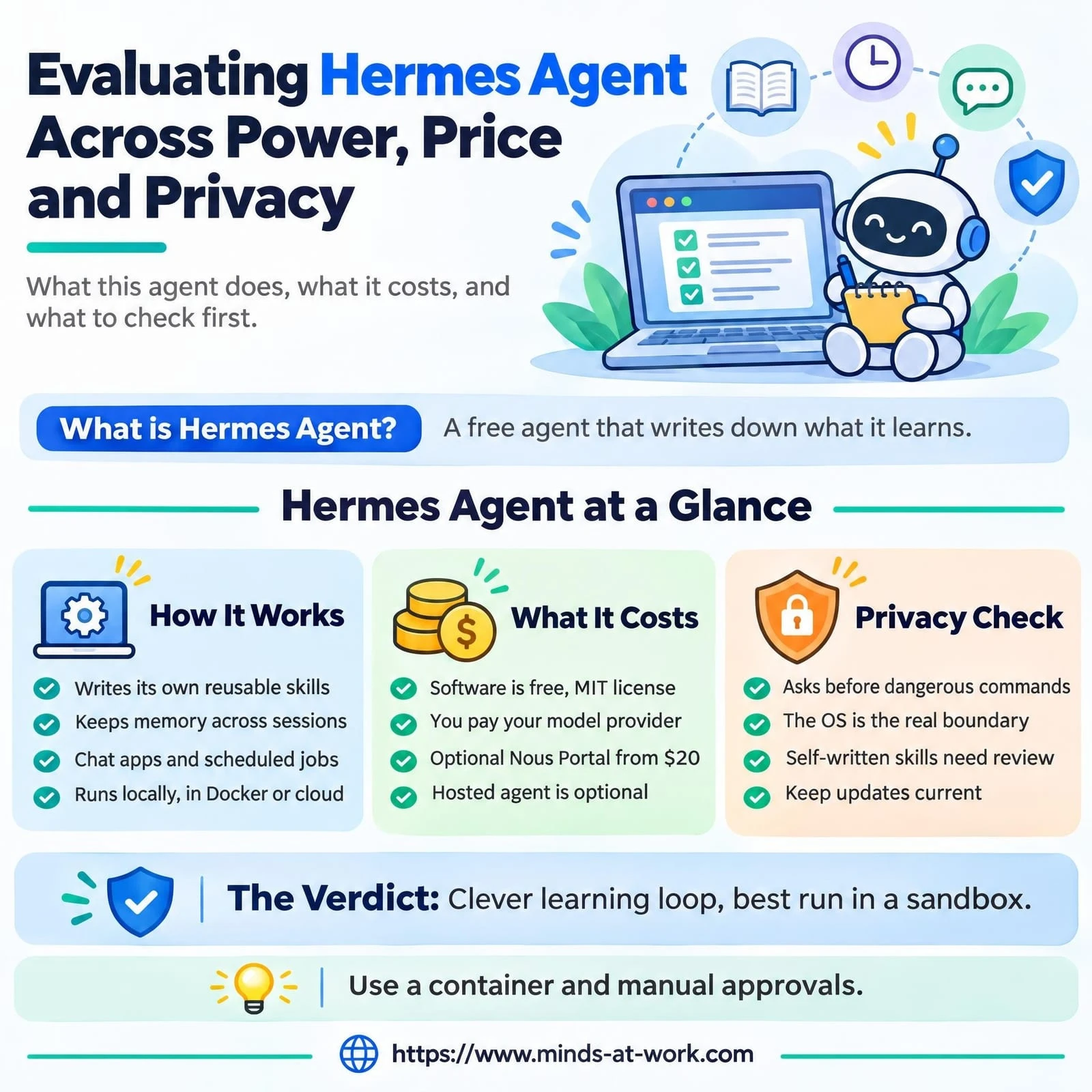
The short answer: Hermes Agent is a free, MIT-licensed agent that you host yourself. You talk to it through a terminal, a desktop app or chat apps. Its distinctive feature is a learning loop. After a hard task it can write a reusable skill, and it keeps notes about your work between sessions. It suits people who are comfortable with a command line. They must also be willing to review what the agent saves. Treat the self-writing feature as something to audit, and run it in a sandbox.
This is Part 15 of 18 in the Personal AI Agents series. Missed the last one? Read Part 14, on OpenClaw.
Hermes Agent is the second self-hosted agent in this series, and it makes a different promise from OpenClaw. OpenClaw’s pitch is that it can connect to everything. Hermes’s pitch is that it should get better at your work by writing down what it learns. That idea is appealing and deserves some caution, so this article looks at both sides. Product facts come from Nous’s own documentation, which I read in November 2026. Security claims come from named outside reviewers.
Hermes Agent at a glance
These are the facts most readers look for first, as of November 2026. Hermes Agent is a self-hosted agent that can write reusable skills from tasks it has finished. The list covers the price, the learning loop, the main security caveats and the evidence. The sections below give the sources and caveats.
- What it is: A free, open-source AI agent from Nous Research, released under the MIT license, that you host yourself
- Learning loop: After a multi-step task, the agent can save a reusable skill, and it keeps notes about your work in
MEMORY.mdandUSER.md - Software price: Free, with no sign-up required to run it; you pay the model provider and any hosting
- Optional Nous Portal: Free (free models only), then $20, $100 and $200 a month, according to Nous’s plans page
- Where it runs: Your computer, a rented server, Docker or a cloud sandbox
- Main risk: Write approval for skills and memory is off by default, according to SysArt’s review
- Safety boundary: The operating system, so run it in a container or on a separate machine, according to NeuralTrust
- Independent evidence: Thin; the proof of the learning loop is the project’s own documentation plus a few brief hands-on impressions
What is Hermes Agent?
Hermes Agent is a free, open-source AI agent made by Nous Research. The AI lab is also known for its family of Hermes language models. An AI agent is software that takes a goal and carries out the steps itself. The agent is software, not a model. Nous’s documentation says it works with Nous Portal, OpenRouter, OpenAI or any compatible endpoint.
How active is the project?
The code is released under the MIT license. Its GitHub page shows more than 265,000 stars, and GitHub’s API lists the repository as created on July 22, 2025. Its v0.23.0 release is dated November 5, 2026, which shows how often it changes.
Where can you run it?
The docs describe Hermes as an agent that “gets more capable the longer it runs” and lives wherever you put it. Nous says you can run it on your own computer. You can also use a $5 virtual private server, which is a rented server in a data center. Nous also names serverless services that cost nearly nothing when idle. Those cost claims are Nous’s, not mine. You talk to it from a terminal, a desktop app or a chat app.
How does Hermes Agent work?
You install it with a one-line command on Linux, macOS or WSL2. On Windows and macOS you can use the Hermes Desktop installer instead. Then you pick a model, and you can switch models later. The table below lists the features that set it apart, according to the docs.
| Feature | What it does | Source |
|---|---|---|
| Learning loop | After a multi-step task, the agent can save a reusable skill, a small how-to file stored in ~/.hermes/skills/, and refine it with use |
Skills docs |
| Memory | Two small notes files, MEMORY.md (the agent’s own notes) and USER.md (your preferences), plus searchable past conversations |
Memory docs |
| Many places to talk to it | “20+ platforms from one gateway,” including Telegram, Discord, Slack, WhatsApp, Signal and Microsoft Teams | Docs home |
| Scheduled jobs | Built-in cron scheduling with delivery to any connected platform | Docs home |
| Choice of where commands run | Six built-in backends: local, Docker, SSH, Daytona, Modal and Vercel Sandbox | Docs home |
How do Hermes skills work?
The skills follow the open agentskills.io standard. A Skills Hub lets you install skills from online registries, with a security scanner on each install. The Turing Post compared Hermes with OpenClaw and put the difference this way. OpenClaw’s skills are written and refined by humans, while Hermes forms them itself.
Nous’s skills documentation says the agent is prompted to save a skill in three cases. One is after a multi-step workflow worth repeating. Another is after it finds a working path through errors, and a third is when you correct its approach. The v0.23.0 release added a lock command. According to its release notes, hermes curator lock stops the agent from rewriting a skill you curated by hand. That is a small sign the project knows self-editing needs a brake.
What can Hermes Agent do?
Hermes does the jobs the other agents in this series do: research, files, messages, scheduled reports and coding help. Its distinctive claim is that it improves with use. The Turing Post described that as a shift from remembering facts to remembering methods. It said the learning loop only helps if the model, tools and guardrails are good enough to make the right things reusable. Its words: “Hermes is truly exciting, but it is not magic.”
I did not find a controlled test of the learning loop. Decrypt ran Hermes in April 2026 and reported one example. After the model succeeded at getting into an account, it wrote its own skill instead of using someone else’s. Decrypt said there is little broader testing of the loop and warned that agents of this kind can go wrong. The claims about how well it works therefore come mostly from the project itself.
Nous’s open-source page says conversations, memories and skills are stored in your Hermes data directory on your own machine. It also tells you to review what the agent keeps.
What does Hermes Agent cost?
The base agent is free. Everything else is optional. I read each figure below on Nous’s plans page and Hermes Cloud page in November 2026.
| Item | Detail |
|---|---|
| Hermes Agent | Free and open source, MIT license; no sign-up required to run it |
| Where it runs | Your computer, a rented server, Docker or a cloud sandbox |
| Model costs | Paid to whichever model provider you choose |
| Nous Portal, Free | $0, pay as you go, free models only, no hosted tools or cloud hosting |
| Nous Portal, Plus | $20 a month, with usage shared across models |
| Nous Portal, Super | $100 a month, five times Plus usage |
| Nous Portal, Ultra | $200 a month, ten times Plus usage |
| Hosted agent | One always-on cloud agent comes with paid Portal plans; extra or larger agents are billed by the day |
The Portal gives paid users a catalog of more than 200 models and hosted tools, such as web search and a cloud browser, under one account. Usage limits reset on daily, weekly and monthly schedules. According to Nous’s FAQ, a local install and a hosted agent do not share their histories automatically. So moving between them takes some manual work.
Is Hermes Agent safe and private?
Partly, and the safe setup is mostly your job. This section covers what Hermes builds in, then what outside reviewers say. It ends with one disputed point: whether the approval check is a real boundary. I name each source so you can check it. The short version is to treat the operating system, not the approval prompt, as your safety boundary.
What protections does Hermes build in?
Hermes’s security documentation lists eight layers. They cover who may talk to the agent, approval of dangerous commands and file write safety. They also cover container isolation and MCP credential filtering. The rest are scanning of project files for hidden instructions, separation between sessions and input sanitization. MCP is a standard way to connect an agent to outside tools, such as search or databases.
The default approval mode is smart. A second AI model judges each risky command. It approves low-risk ones, denies dangerous ones and asks you when it is unsure. You can set the mode to manual, which always asks, or to off, which Nous says disables all safety prompts. A short list of catastrophic commands, such as wiping a disk, is refused even in off mode.
What do outside reviewers say?
- The boundary is the operating system. NeuralTrust’s security review, dated October 26, says the project’s policy describes Hermes as a single-tenant personal agent. It calls the approval gate a heuristic, not containment. The same review notes that with the Docker, Modal, Daytona and Vercel Sandbox backends, commands skip approval because the container is treated as the boundary. Nous’s own security page says the same about containers.
- Self-writing has defaults to check. Consultancy SysArt, in a November 13 review, said the write-approval settings for skills and memory are both off by default. A manipulated web page or email could therefore become a standing instruction in later sessions. It also said commands run directly on the host by default. Nous’s skills documentation confirms that
skills.write_approvaldefaults tofalse. - Vulnerability counts. SysArt said NVD searches on November 13 returned 45 CVE records for Hermes Agent, and that the project had published no security advisories of its own on GitHub. NeuralTrust counted ten advisories in the GitLab Advisory Database on October 26. It highlighted one it scored as critical: the bundled MCP catalog pointed at a third-party repository by a branch name instead of a fixed commit. That was fixed in version 0.19.0. The counts differ because the databases and dates differ. Both reviewers say to keep the software updated.
Is the approval check a real boundary?
Not according to the project’s own policy, and one researcher disputes how that policy got there. Security researcher Nikos Rigas wrote on LinkedIn in June that he found three ways around the approval check. He says the policy then changed from calling approval a core security boundary to calling it an in-process heuristic. He also says two of his three methods still worked.
The project’s side is different. A maintainer closed a related issue on June 26. The maintainer said the smart-approval prompt already wrapped commands in delimiters and stripped shell comments. It also told the reviewing model to ignore embedded directives. Both views are reasonable. I did not test the approval check myself, so I cannot say which account is right. The practical lesson is to use a sandbox.
How does Hermes Agent compare with the other agents in this series?
Hermes differs from earlier agents mainly in who hosts it and how it learns. The table sets it beside OpenClaw, the paid cloud agents and Lindy. A last column shows who sets the safety limits.
| Agent | Where it runs | Software cost | Who sets the safety limits |
|---|---|---|---|
| Hermes Agent | Your machine, server or sandbox | Free, MIT license | You, through approval mode and your sandbox |
| OpenClaw (Part 14) | Your machine | Free, MIT license | You, with a skills marketplace that has a long attack record |
| Manus (Part 10) and Perplexity Computer (Part 13) | The company’s cloud | Paid subscriptions | The vendor, with your accounts connected to its cloud |
| Lindy (Part 9) | The company’s cloud | Paid credits | The vendor, which says outside actions wait for your approval |
Against OpenClaw, Hermes is smaller in scope and focuses on writing its own skills. Against the paid clouds, you pay nothing for the software but supply the hosting and the security yourself.
What should you do before you start?
None of these steps is hard, and each one limits a risk covered above. Do them in this order.
- Run it inside a container or on a separate machine, and choose
manualapproval mode. - Turn on write approval for skills and memory, at least until you see what it saves.
- Allow only your own account to message it, and keep any web dashboard off the public internet.
- Use a separate email account and API keys with spending limits.
- Update often. The project releases frequently, and security fixes ship in those releases.
I apply a simple review-before-reuse rule to any agent that writes its own instructions, a MAW framing. Nothing the agent saved should run again until a human has read it. With Hermes, that means write approval on and a weekly look through the skills folder.
If you are weighing agents like this for a company, our AI strategy for SMB owners guide covers where to start. A Fractional CTO can help decide which accounts an agent should ever touch. More comparisons live in the Personal AI Agents archive.
Who is Hermes Agent for?
Hermes Agent suits some readers well and others poorly. The two lists below show which group you are likely in. It depends on how comfortable you are with a command line. It also depends on whether you will review what an agent writes for itself.
Hermes Agent fits you if:
- You like the idea of an agent that writes down what it learns and are willing to review it.
- You are comfortable with a command line or have help setting it up.
- You want to control hosting and data, with the option of a hosted version later.
It’s a weaker fit if:
- You want a polished consumer app with a support team.
- You would let it run commands on the computer that holds your personal files.
- You need independent proof of how well the learning loop works.
Is Hermes Agent worth it?
Hermes is an open-source agent with a clear idea, a learning loop, and a security policy that is candid about where the real boundary sits. It has a long list of vulnerability reports. Its most unusual feature, writing its own skills and memory, is one you should keep under review. Run it in a sandbox, keep the approvals on, and treat its learning as something to audit.
What is coming in Part 16?
In Part 16, I’ll look at NanoClaw, a lightweight alternative built by someone who liked OpenClaw’s idea but did not trust a codebase that large with his data. Its answer is to put every agent in its own container. It is the third self-hosted agent in this series, so the same questions about setup, cost and safety apply.
Frequently asked questions
These are the questions readers ask most often about Hermes Agent. The answers cover what it is, whether it is really free, whether it is safe on your own computer, what the learning loop does and how it differs from OpenClaw. Each one uses the same sources as the sections above, so the facts and caveats match.
What is Hermes Agent?
Hermes Agent is a free, open-source AI agent from Nous Research, released under the MIT license. You host it yourself, on your computer, a rented server or a cloud sandbox, and talk to it from a terminal, a desktop app or chat apps. Its standout feature is a learning loop that can turn finished tasks into reusable skills.
Is Hermes Agent really free?
The software is free and needs no sign-up to run. You still pay for the AI model, either to a provider such as OpenAI or OpenRouter or through Nous Portal, and for any hosting. Nous Portal’s free tier covers free models only, and paid plans run $20, $100 and $200 a month. Nous’s docs say it can live on a $5 server.
Is Hermes Agent safe to run on my own computer?
It is safer in a container or on a separate machine. By default, commands run directly on the host, and the write-approval settings for skills and memory are off, according to SysArt’s review. Nous’s policy treats the operating system as the real security boundary. Use manual approval mode, turn on write approval, and keep personal files off that machine.
What does Hermes Agent’s learning loop do?
After a multi-step workflow worth repeating, the agent can save a reusable skill in a folder on your computer and improve it with use. It also keeps two small notes files and can search past conversations. Nous says this makes it more capable over time. Independent testing of how well it works is limited, so review what it saves.
How is Hermes Agent different from OpenClaw?
Both are free, MIT-licensed and self-hosted. OpenClaw is the larger ecosystem, with a public skills marketplace and a long record of security problems. Hermes focuses on writing its own skills, which the Turing Post contrasts with OpenClaw’s mostly human-written ones. Hermes also lets you lock a hand-written skill so the agent cannot rewrite it.