Instinct Review: The Agent You Text (Part 8 of 18)
A plain-English look at Instinct, the text-message AI agent: how it works, what it costs, what reviewers found, and the privacy debate around it.
By Dr. Sanju Abraham, Fractional CTO, investor, multiple exits. Published November 13, 2026.
The short answer: Instinct is a personal AI agent you talk to by text. It connects to your email, calendar and other apps and does errands such as bookings, appointments and returns. It is free during an invite-only beta, and reviewers found it as capable as the big-company agents. It has also drawn the sharpest privacy criticism of any agent in this series, so connect it carefully.
This is Part 8 of 18 in the Personal AI Agents series. Missed the last one? Read Part 7, on Microsoft Autopilot.
With this article the series moves from big companies to startups, and Instinct is the startup that started the wave. The Verge wrote that Instinct got its agent to market in August with “an unusual playbook: invite-only, no marketing, and barely so much as a website”. The review adds that it quickly became the buzziest thing in AI. Meta’s Muse and OpenAI’s dots arrived afterward. The Verge described them as the same products, more or less, from far more powerful companies.
That makes Instinct a useful test of whether a focused startup can hold its own. It also drew the sharpest privacy criticism of any agent so far.
Instinct at a glance
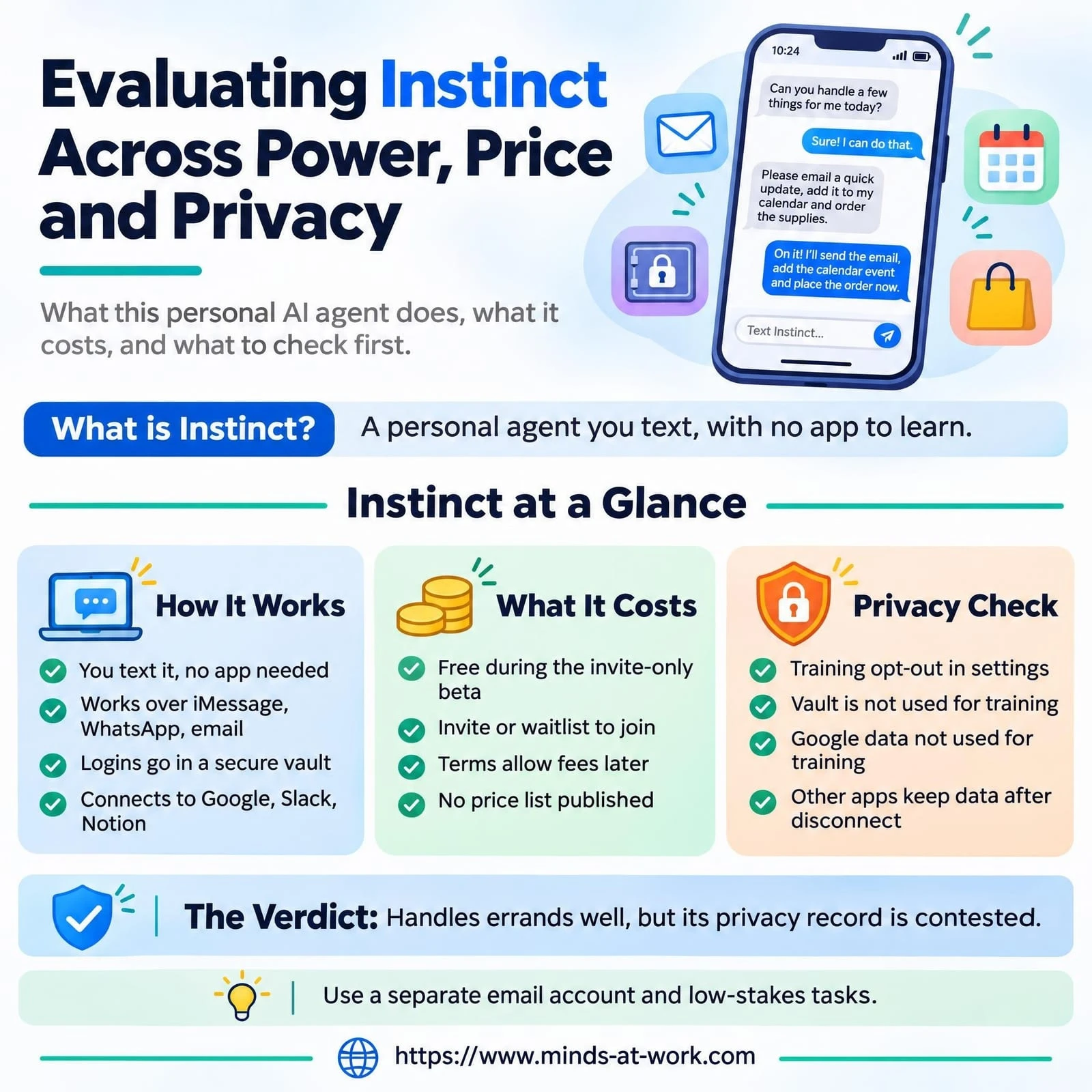
These are the facts most readers look for first, as of the privacy policy revised November 17, 2026. Instinct is a personal AI agent you text, and it does errands through your connected apps. The list covers the maker, the price, the access, the reviewer verdict and the privacy terms. The sections below give the sources and the caveats.
- Maker: Spear Street Technology, Inc., a San Francisco company, according to TechCrunch; the team is led by Noah Shinn
- How you use it: By text through iMessage, WhatsApp or email, with no new app
- Price: Free “for now”, according to The Verge
- Future pricing: Not announced; its terms say it may introduce fees at any time with notice
- Access: By invitation from a current user or approval from a waitlist
- Reviewer verdict: As capable as Muse and dots on everyday errands, and sometimes better, in The Verge’s testing
- Model training: Your information may be used to train models; you can opt out, and the opt-out applies going forward
- Main risk: Data from non-Google services is still retained after you disconnect them
What is Instinct?
Instinct is a personal assistant you talk to by text. An AI agent is software that takes actions for you, such as booking or emailing, instead of only answering questions. Instinct was created by a small team led by Noah Shinn, a former Sierra research scientist. TechCrunch reported that the San Francisco company is operated by Spear Street Technology, Inc. In late September, TechCrunch also reported that a $1 billion funding round valued Instinct at $10 billion.
There is no traditional app. You message it through iMessage, WhatsApp or email. As The Verge’s Allison Johnson put it, there is no cute mascot and no pretense that it sits at a laptop. Its replies are brief. They come with the occasional emoji reaction and “a lot more action than talk”. Because it is just text, it works anywhere you can send a message, such as CarPlay or a watch.
How does Instinct work?
Instinct works by connecting to your apps and a virtual machine, according to The Verge and TechCrunch. A virtual machine is a computer that runs in the cloud instead of on your phone. Instinct can plug into your email and calendar, Google Workspace, Slack and Notion.
If you want it to log into a website, it sends you a link. You enter your details there, in what it calls a secure vault, rather than in the text thread. TechCrunch also reported that Instinct can use device inputs such as audio, location and screen if you connect them.
Instinct’s privacy policy, revised on November 17, describes the service as completing tasks on your behalf through third-party websites, apps and services. That includes ones you have connected and ones you have not.
What can Instinct actually do?
The Verge’s reviewer found that after a slow start, Instinct held its own against Muse and dots. Her account begins with a poor first impression and then covers two weeks of real errands. These are anecdotes, not benchmarks. The list below follows that order, and her overall verdict comes after it.
How did Instinct do in The Verge’s tests?
- It started poorly. After a couple of introductory messages it treated her Cincinnati area code as an invitation to send a local newspaper link and flight results. When she said she no longer lived there, it noted that and moved on.
- It improved with real tasks. After two weeks of meatier work, it impressed her “more often than not.” It found swimming lessons for her son (the times and dates all checked out, though it missed a prerequisite class at the community center), emailed her eye doctor’s office, and did the digital paperwork to start an Ikea return.
- It handled vague instructions well. It figured out which Ikea product she meant from a description, a vertical white thing that “kind of has these like branches off of it,” and it flagged a calendar conflict while doing another chore.
- It won a head-to-head. On a free coworking-space tour, it found the free trial that OpenAI’s dots had missed and set up an appointment within minutes, per The Verge’s earlier dots review.
What limits did the reviewer point out?
The reviewer’s summary was that Instinct is as effective as we can reasonably expect an agent to be right now. But the limits of a robot getting things done in a human world are just as real. The community center prerequisite is a good example. Agents work well with clean data, and a lot of the internet is not clean.
What does Instinct cost, and how do you get access?
At the time of writing, Instinct is free. The Verge reported there is no monthly subscription fee “for now”, and access requires an invitation from a current user or approval from a waitlist. The reviewer said she was approved after a couple of hours. The table shows what is known about price, access and the business model.
| Item | Detail |
|---|---|
| Price | Free during the invite-only beta |
| Access | Invite or waitlist |
| Future pricing | Not announced; Instinct’s terms say it may introduce fees at any time with notice |
| Business model | Not announced. Skift reported that founder Noah Shinn floated keeping it free for users while merchants pay a cut, and framed it as an open question. TechCrunch reported that Instinct did not say whether it earns money from its product recommendations |
So free today does not mean free for good, and how Instinct will earn money is still an open question.
Is Instinct private and secure?
This is where Instinct drew the most attention. The useful move is to separate what happened in August from what the policy says now. The first part below covers the August complaints. The second covers the current policy and terms. Both follow the privacy policy as revised November 17 and the reporting cited in each section.
What went wrong in August?
TechCrunch reported that screenshots of Instinct’s terms of service circulated. They showed a “perpetual and irrevocable” license to user materials, including for training its models. They also showed terms allowing Instinct to make binding agreements on users’ behalf. Early users reported problems too:
- Peter Yang said Instinct would not delete his Gmail records when asked, and the team later added a deletion tool.
- Claire Vo found that Instinct was still summarizing her inbox after she disconnected Google. It told her that the emails were stored in plain text for later searches.
- One tester was alarmed that Instinct could pull a sign-up code from his inbox to book a restaurant table.
- Alex Cohen tested phishing by emailing his real address from a new account with instructions for Instinct, and deleted his account after seeing how easily it could be done.
- Katie Jacobs Stanton said Instinct sent an email on her behalf without checking with her first, and she disconnected her email.
TechCrunch noted that Instinct’s team had not responded publicly to the criticism, and that the product was still in private testing.
What does the privacy policy say now?
The privacy policy, revised November 17, covers six topics, from model training to third-party sites. The table sets out what it says on each.
| Topic | What the policy says |
|---|---|
| Model training | Your information may be used to train models. You can opt out, which means switching training off, in settings at app.instinct.com/settings. The opt-out applies going forward and does not undo training that has already happened. Information flagged for safety review can still be used. |
| The Vault | Information you put in the Vault is used only to provide Instinct and is not used for training. |
| Google Workspace | Data from Google Workspace APIs is not used to train models. If you disconnect Google Workspace, Instinct says it will no longer retain or use data collected from that account. |
| Other connected services | Instinct says it retains data it previously collected, including conversation history, when you disconnect. |
| Account deletion | Deleting an account can take up to 90 days. |
| Third-party sites | Instinct may interact with third-party sites you have not separately connected. |
What do Instinct’s terms say?
I also read Instinct’s current terms, last revised November 17, 2026. They say Instinct may use your materials to develop, provide, maintain and improve the service, including training AI models. You can opt out going forward. The only “perpetual” and “irrevocable” wording I found applies to feedback you give Instinct, not to your materials.
In short, the policy answers some of August’s complaints, mainly for Google data. It leaves the rest as a choice you make when you connect an app.
How does Instinct compare with Muse, dots and Duet?
Instinct compares with the three earlier agents on price, feel and published safeguards.
- Against Muse (Part 2): both are free today. Muse comes from Meta, which has an advertising business and a large privacy debate to answer for. Instinct is a startup with an unproven business model and no published plan to charge, which raises its own question about how it will earn money.
- Against dots (Part 3): dots needs a paid ChatGPT plan and feels like workplace software. Instinct feels like texting a helpful person, and The Verge’s reviewer thought it handled errands as well or better.
- Against Duet (Part 4): Duet publishes a detailed safety document with approvals, a separate sensitive-information classifier and credentials kept away from the model. Instinct’s controls are described mostly in its privacy policy and terms.
What should you do before connecting anything?
If you get an invite, a few habits would have helped the August testers. I call them the four-habit connect check, a MAW framing. Each one limits what a young product can see or keep.
- Give it an inbox of its own. Use a separate email account if you can, and forward only what you want it to see. A HypeSkeptics writer made the same suggestion for Duet.
- Put website logins in the Vault. Instinct says Vault contents are not used for training.
- Turn off model training in settings if you do not want your information used, remembering that it applies from then on.
- Apply the stop-versus-delete rule. Treat disconnecting as a stop, not as deletion. For non-Google services, disconnecting ends new access and does not erase what was collected. Ask for deletion separately by emailing the address in the privacy policy.
If you are weighing agents like this for a company, our AI strategy for SMB owners piece covers where to start. A Fractional CTO can help you decide which accounts an agent should be allowed to read.
Who is Instinct for?
Instinct suits people who run personal errands by text and can live with a young company’s changing rules. The two lists below show which group you are likely to be in. The deciding factors are the tasks you have in mind and how much you mind data sticking around.
Instinct fits you if:
- You like the idea of an agent you text, with no new app to learn.
- Your tasks are personal errands such as bookings, appointments, forms and returns.
- You can get an invite and are comfortable with a young company’s changing terms.
It’s a weaker fit if:
- You need to connect work accounts. Reviews and TechCrunch’s reporting suggest keeping it away from them.
- You want predictable pricing. It is free now, and the terms allow fees later.
- You are uncomfortable with data from non-Google services staying after you disconnect.
What is the verdict on Instinct?
As of the privacy policy revised November 17, Instinct is, in The Verge’s testing, as capable as the big-company agents on everyday errands, with a simple interface. Its privacy record is still the most contested of the agents so far, even though the current policy has improved. If you try it, use a separate email account if you can and start with low-stakes tasks. Read what disconnecting an app actually does before you rely on it.
The full series lives in the Personal AI Agents archive.
What is coming in Part 9?
In Part 9, I’ll look at Lindy, an agent that presents itself as a teammate you ask over Slack, text, call or email. It is one of the few in this series with a published credit-based price list. That makes it a good contrast with Instinct, because I can look at cost in detail instead of waiting for pricing.
Frequently asked questions
These are the questions readers ask most often about Instinct. The answers cover what it is, whether it is free and whether it trains on your data. They also cover what happens when you disconnect an app, whether it is safe to connect to your email and how you get access. Each answer follows the same sources as the sections above.
What is Instinct?
Instinct is a personal AI agent you talk to by text, through iMessage, WhatsApp or email. There is no traditional app. It connects to services such as your email, calendar, Google Workspace, Slack and Notion, and completes tasks on your behalf, such as booking appointments, emailing offices and starting returns. It was created by a small San Francisco team led by Noah Shinn.
Is Instinct free?
Yes, for now. The Verge reported that Instinct has no monthly subscription fee during its invite-only period, and the reviewer was approved after a couple of hours. Instinct has not announced future pricing, and its terms say it may introduce fees at any time with notice, so free today does not mean free permanently.
Does Instinct train on my data?
It may. The privacy policy, revised November 17, says your information may be used to train models, and you can opt out in settings. The opt-out applies going forward and does not undo earlier training. Vault contents and data from Google Workspace APIs are not used for training, and information flagged for safety review can still be used.
What happens to my data when I disconnect an app?
It depends on the service. For Google Workspace, Instinct says it will no longer retain or use data collected from that account. For other connected services, it says it retains data it previously collected, including conversation history. Disconnecting stops new access but is not deletion, and deleting an account can take up to 90 days.
Is Instinct safe to connect to my email?
Reviewers and TechCrunch suggest caution. In August, testers reported that Instinct sent an email without checking first, stored inbox content in plain text, and was open to a phishing test. The policy has since been revised, but a young company’s terms can change. Use a separate email account and low-stakes tasks first.
How do you get access to Instinct?
Access is by invitation from a current user or approval from a waitlist. The Verge’s reviewer was approved after a couple of hours. Instinct launched in August with an invite-only approach, no marketing and barely a website. Once you are in, you reach it by text through iMessage, WhatsApp or email.